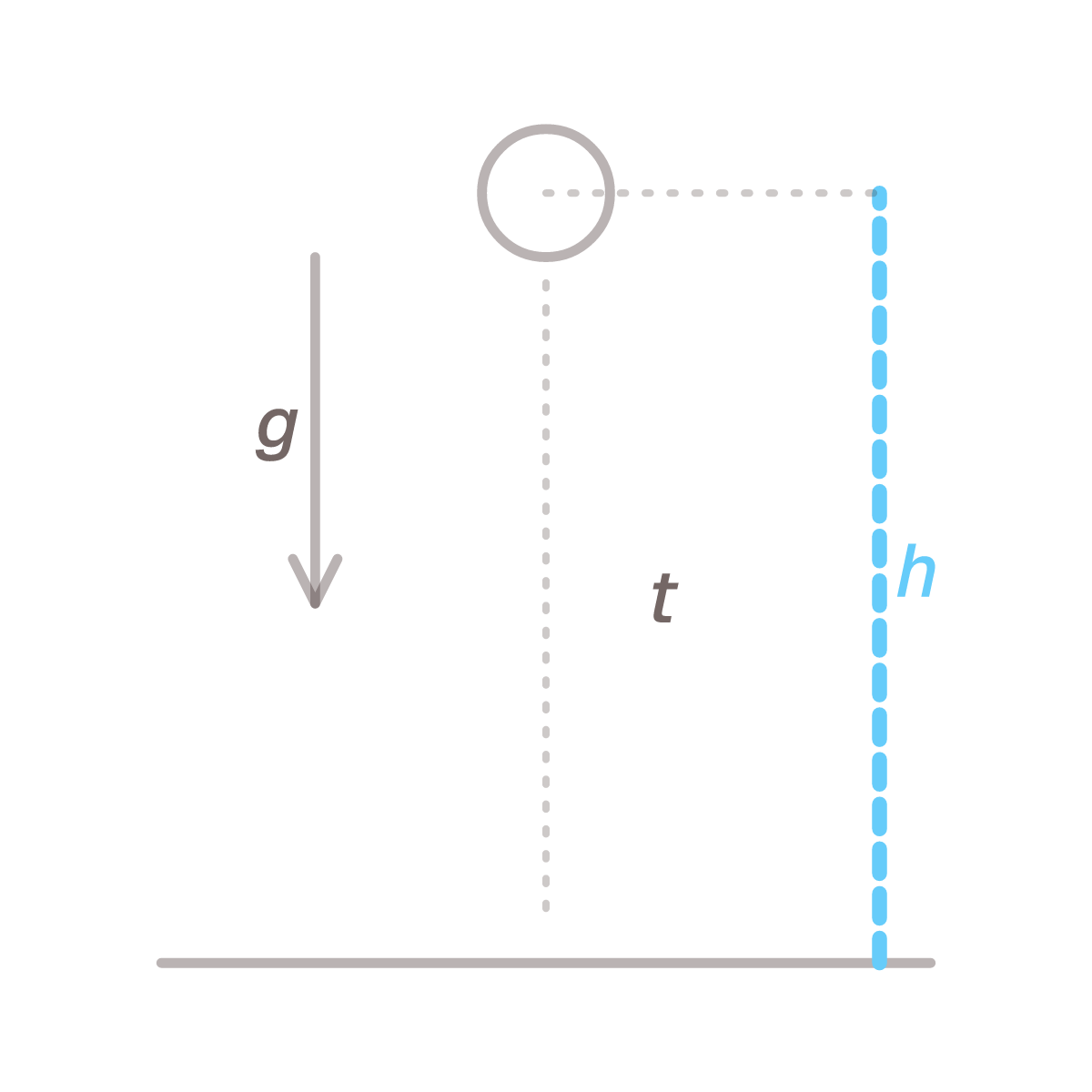
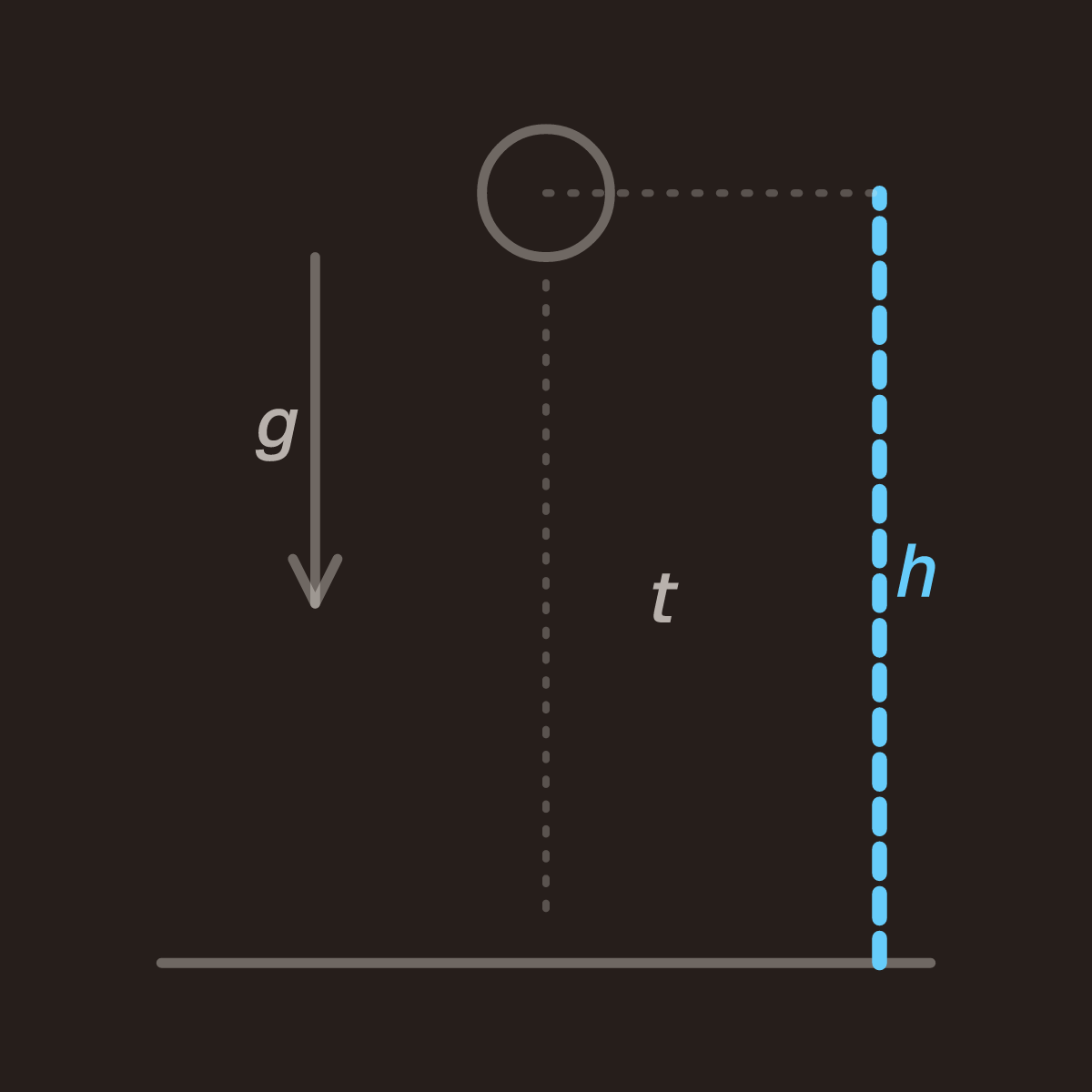
g is the acceleration due to gravity in m/s², t the falling time in seconds and h the height in
metres. Something falling for 3 seconds has fallen 9.81 · 9 / 2 = 44.15 m.
Holds when the object is dropped from rest, air resistance can be neglected and the drop is short enough for
g to stay constant.
This is distance under constant acceleration
with a starting speed of zero and an acceleration of g. No new physics, only a special
case.
A hammer and a feather fall at the same rate in a vacuum. Heavier objects are pulled harder by the earth but are also harder to set moving, and the two
effects cancel exactly. What separates a feather from a hammer in real life is the air, not the mass.
Which g?
Gravity varies with latitude and altitude. The standard value is 9.81 m/s², and many books round to
9.8; Swedish textbooks use 9.82, the value at Swedish latitudes. The difference is at most a fifth of a
percent, negligible for an estimate but visible in the third digit. So g is a field you can change on the card above rather than a number baked into the formula.
Worked examples
A stone down a well. You hear the splash after 2 seconds: h = 9.81 · 4 / 2 = 19.6 m. The sound
coming back takes about six hundredths of those two seconds, so the stone fell for about 1.95 s and the
well is nearer 18.7 m deep.
From a ten-storey building. 30 m takes t = √(2 · 30 / 9.81) ≈ 2.5 s.
The speed at the ground. After 3 seconds of falling the speed is g·t = 9.81 · 3 ≈ 29.4 m/s, a
little over 100 km/h.
Common mistakes
- Forgetting the half. Without it the height comes out twice what it should be.
- Confusing speed with distance. After 3 seconds the speed is 29.4 m/s and the distance is 44 m — two
different formulas and two different units.
- Using the formula for long falls. After a few seconds the air slows things noticeably. A human body
reaches a terminal speed of about 55 m/s near the ground. From a very great height, where the air is
thin, the speed can be much higher before the air thickens.
- Squaring g. It is the time that is squared.
Frequently asked questions
How fast is something going after a given time?
v = g·t, which is acceleration with a starting speed of
zero. After 2 seconds: 9.81 · 2 ≈ 19.6 m/s.
Why does a feather fall more slowly in real life?
Air resistance. It depends on speed, shape and area, not on mass — and for a feather it is large
compared with its weight. On the moon, with no atmosphere, the feather falls exactly like the hammer,
as the Apollo 15 crew demonstrated in 1971.
Does the formula work for something thrown downwards?
Not as it stands, because the starting speed is then not zero. Use
distance under constant acceleration
with v₀ set to the throwing speed and a = g.