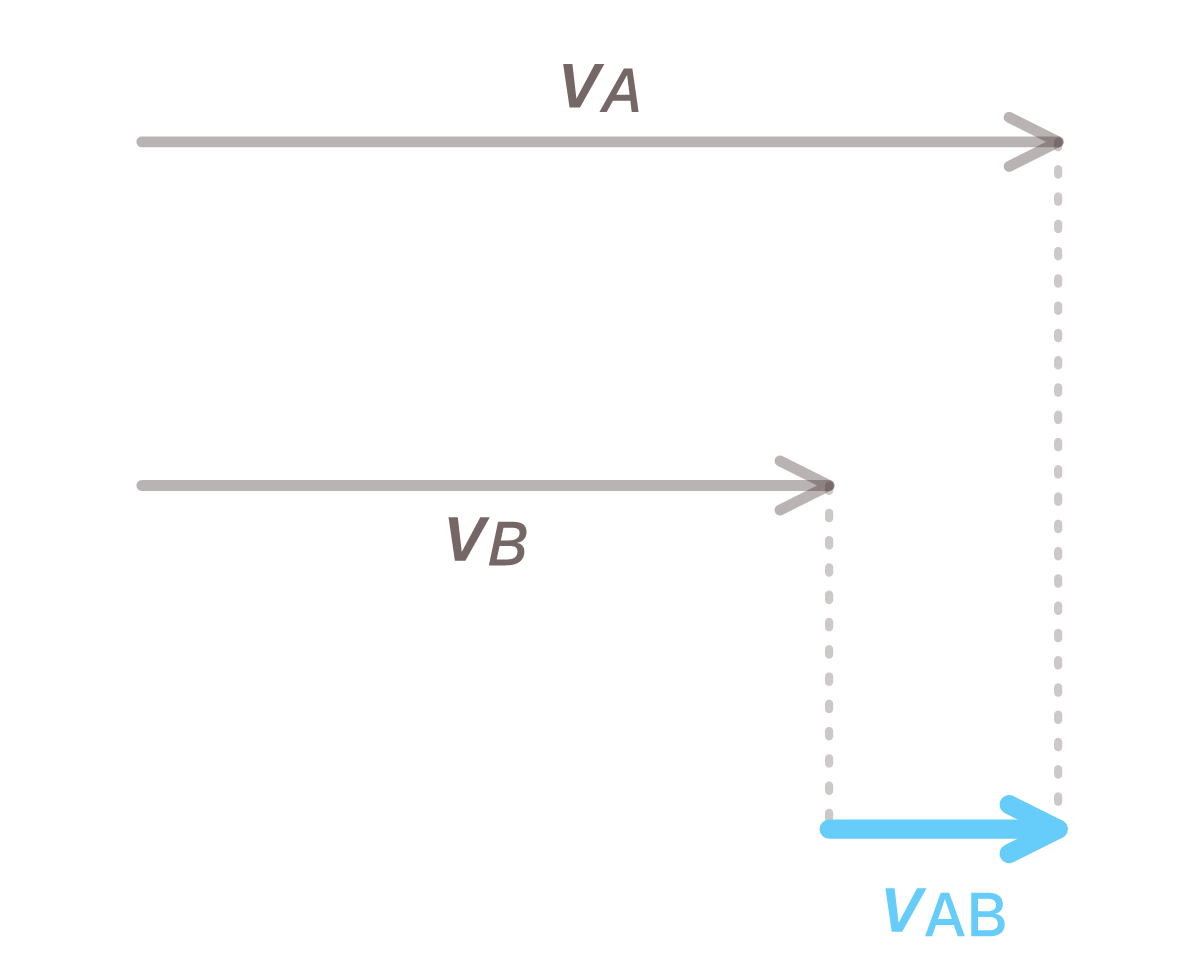
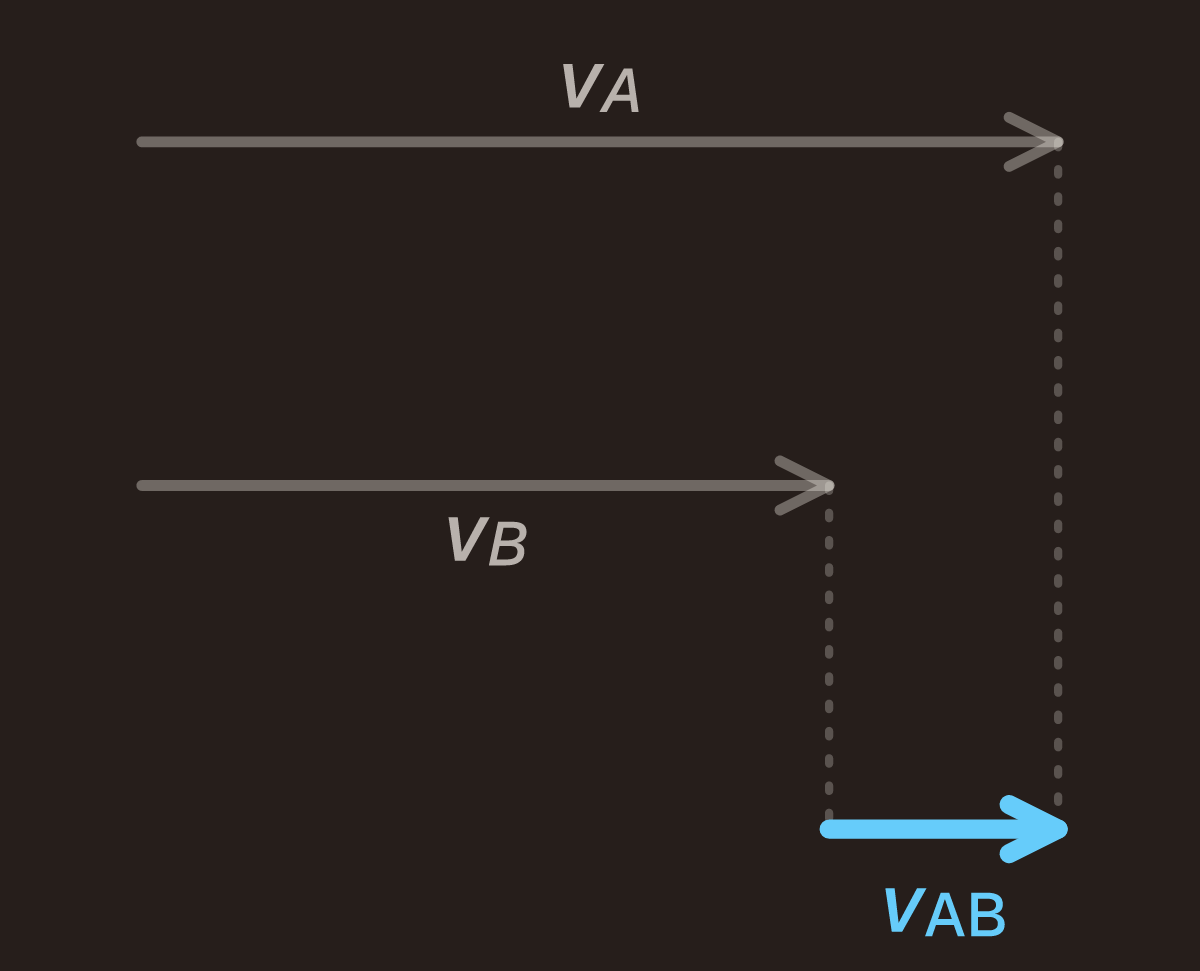
vAB = vA − vB
v_A and v_B are the velocities of A and B, measured from the ground, and v_AB is A’s velocity as seen
from B. The formula is for motion along one line, like two cars on the same road.
Holds when the speeds are far below the speed of light. Near it, velocities combine differently.
What matters is the sign. Choose which direction is positive. A velocity that way is positive, and a
velocity the other way gets a minus sign. Then it is an ordinary subtraction.
Worked examples
A car catching up. A drives at 20 m/s and B ahead at 15 m/s, the same way. A closes on B at
20 − 15 = 5 m/s.
Meeting. A drives at 25 m/s and B at 20 m/s towards A. With A’s direction positive, vB = −20,
and vAB = 25 − (−20) = 45 m/s. The same two cars meet nine times as fast as one catches up with
the other.
Overtaking. A car at 30 m/s overtakes a lorry at 25 m/s and needs to gain 25 m on it: the lorry’s 20 m
and a margin. At 5 m/s relative to the lorry that takes 25 / 5 = 5 s. An oncoming car at 25 m/s closes
at 30 + 25 = 55 m/s, which is 275 m in those five seconds.
Common mistakes
- Dropping the minus sign. A car going the other way has a negative velocity. Forget it and meeting
at 25 and 20 m/s becomes a difference of 5 m/s instead of 45.
- Swapping A and B. vBA = vB − vA is the same size with the opposite sign: seen
from A, B moves backwards.
- Using speed instead of velocity. Speed has no direction. The formula needs velocities with signs.
Frequently asked questions
What does a negative relative velocity mean?
That A moves in the negative direction as seen from B. If A drives at 15 m/s and B at 20 m/s the same
way, vAB = −5 m/s: seen from B, A drifts backwards.
Does it work for planes in wind and boats in a current?
Yes, as long as everything moves along one line. A plane flying 250 m/s relative to the air into a
20 m/s headwind moves 230 m/s relative to the ground. In a crosswind the velocities add as vectors,
with Pythagoras when they are at right angles.