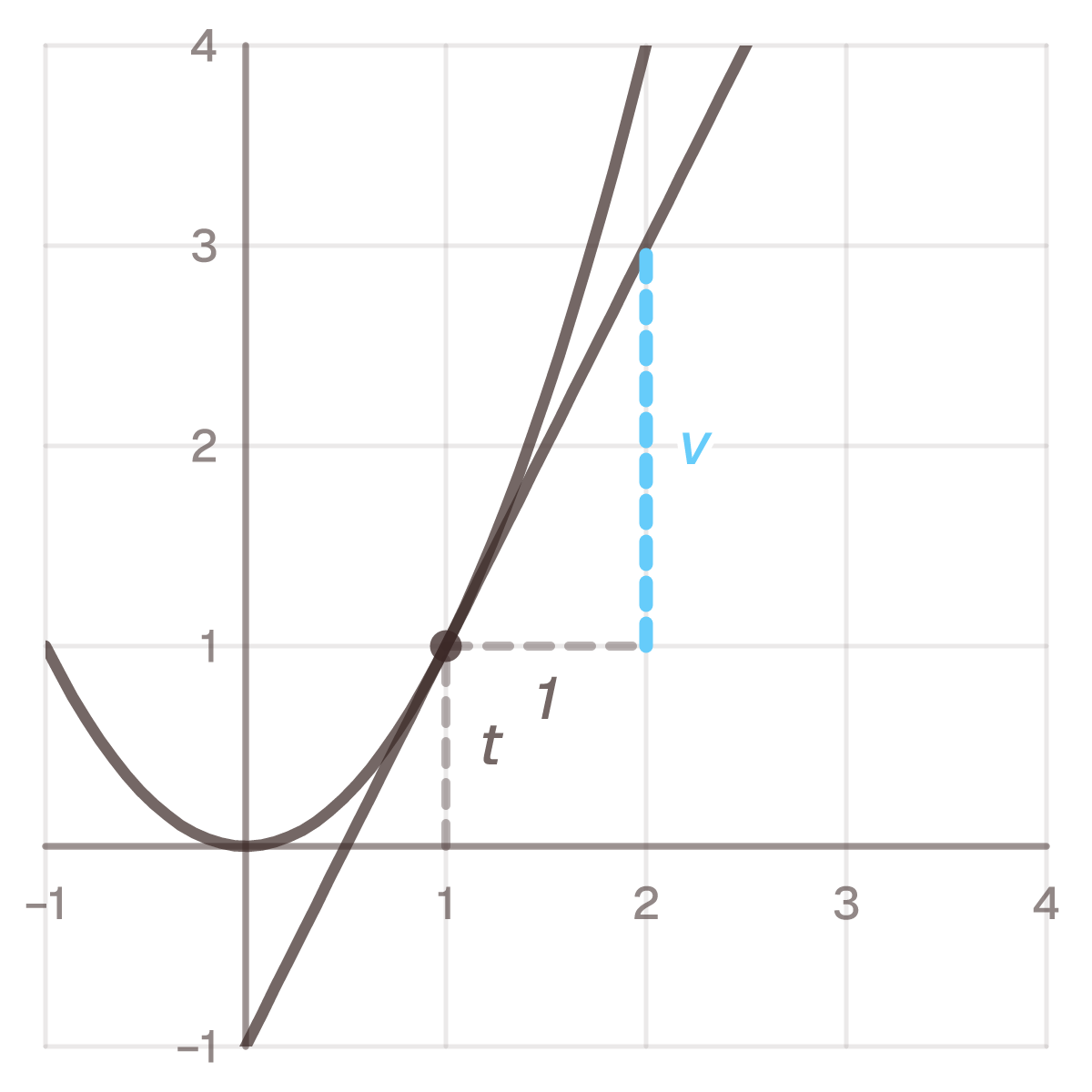
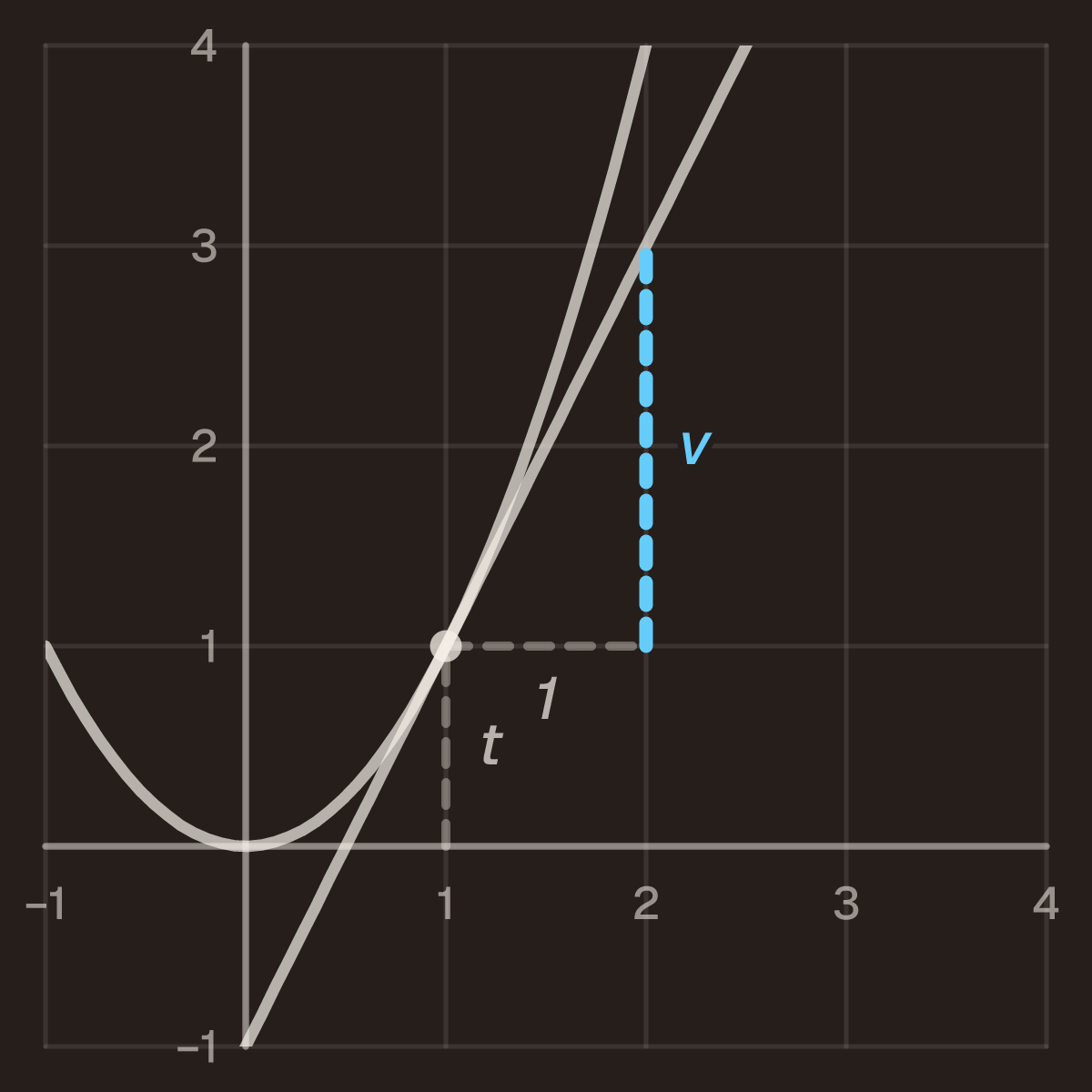
The formula
- v = ds/dt = s′(t)
s(t) is the position along a line in metres, t the time in seconds and v the velocity in m/s. Geometrically it is the slope of the tangent to the position curve at the moment t. The average speed over an interval turns into this when the interval shrinks towards zero.
Holds for motion along a line where s(t) can be differentiated at the moment in question.
Worked example
A cart has the position s(t) = 2t² + 3t metres. Differentiating gives v(t) = 4t + 3. At t = 5 s the velocity is 4 · 5 + 3 = 23 m/s, and at t = 0 it is 3 m/s.
Compare the average over the first five seconds: s(5) = 50 + 15 = 65 m, so 65/5 = 13 m/s. The two differ because the cart speeds up, and only the derivative describes the moment itself.
Common mistakes
- Dividing the position by the time. s/t is the average velocity from the start, not the velocity at the moment.
- Differentiating the wrong number of times. One derivative of the position gives v, and a second gives the acceleration.
- Reading a negative sign as slowing down. A negative v means motion in the negative direction.
Where next
- The next derivative: acceleration as a derivative.
- The rule used above: the power rule, and the line it measures: the tangent.
Common questions
Why is the derivative the velocity at a moment?
The average velocity over a short interval is Δs/Δt. Letting the interval shrink to zero turns that quotient into ds/dt, which is the definition of the derivative.