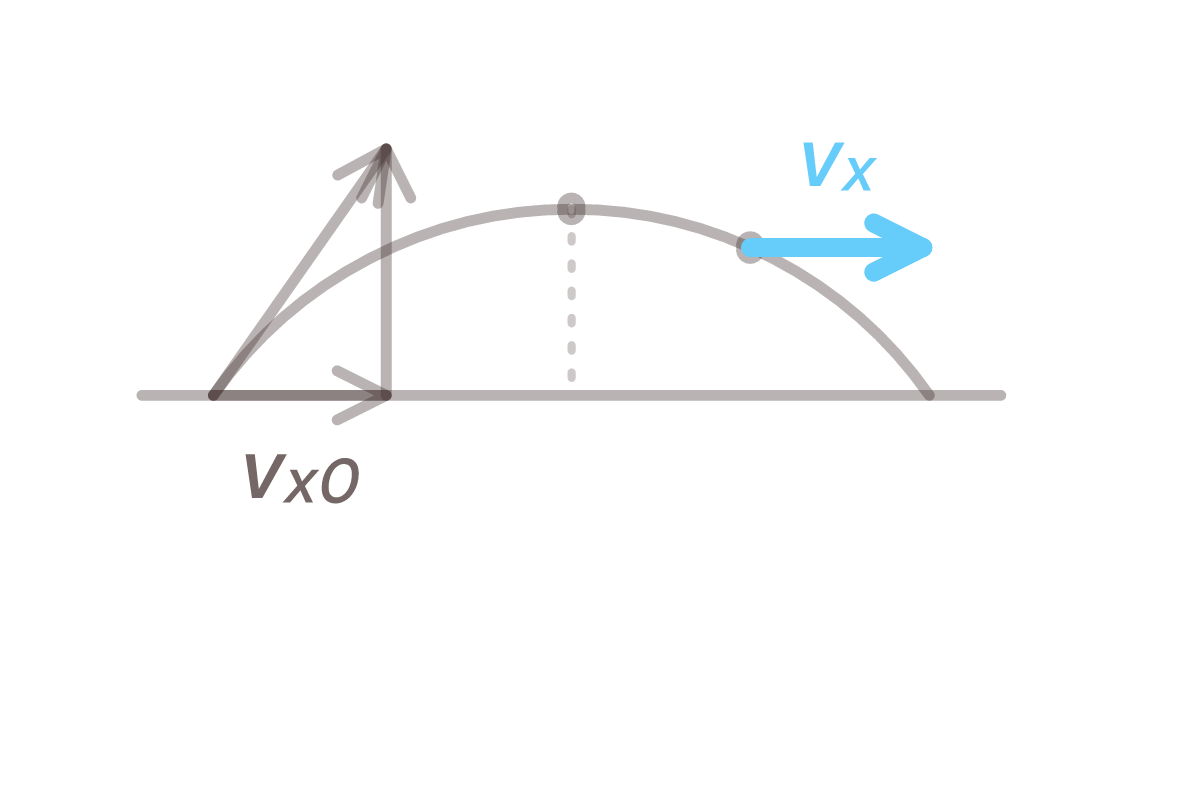
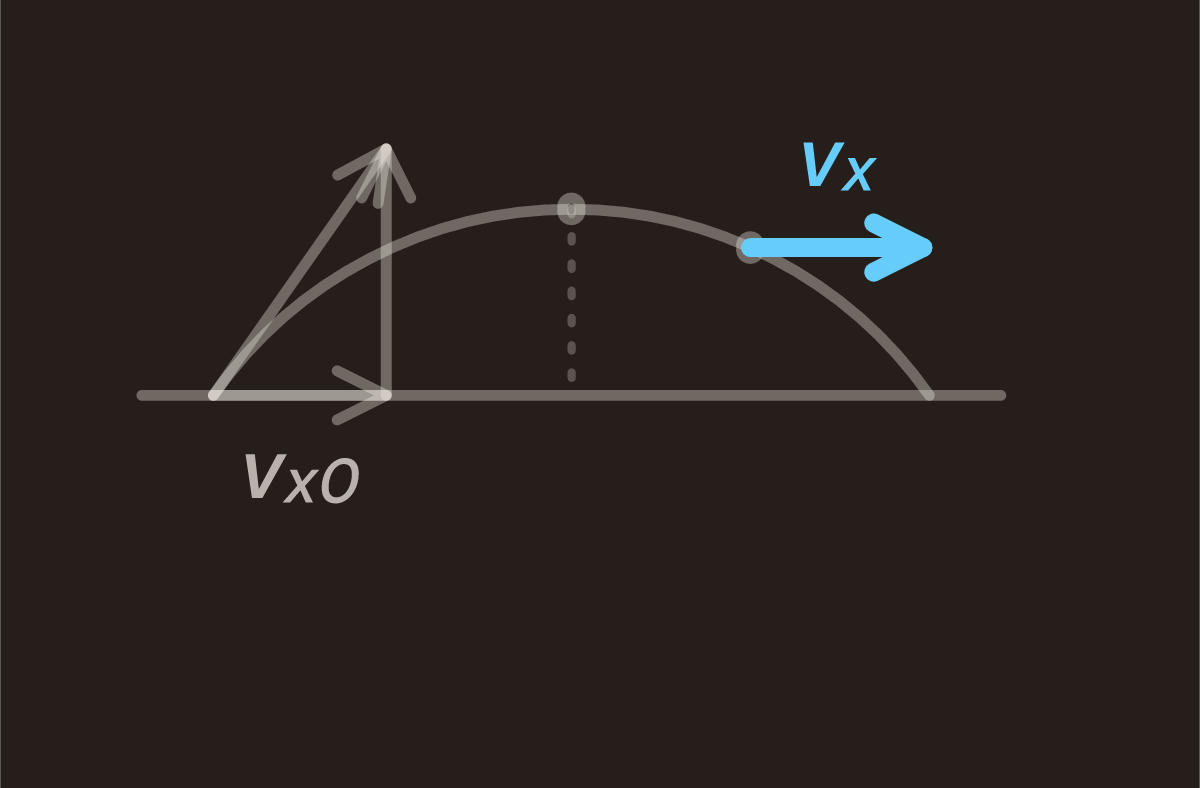
With air resistance left out, nothing acts along the ground, so the horizontal part of the velocity is the same at every moment of the flight as at the launch.
Solve for
vₓ=12m/s
vₓ equals 12 m/s
Working1 steps
vₓ
=
12
The formula
vₓ = vₓ₀
vₓ₀ is the horizontal speed at the launch, in m/s, and vₓ the horizontal speed at any later moment. Gravity acts straight down, so it changes the vertical velocity (vᵧ = vᵧ₀ − g·t) and leaves the horizontal one alone.
Holds when air resistance is left out and the only force is gravity.
Worked example
The defaults. A ball leaves the hand with a horizontal speed of 12 m/s, so vₓ = 12 m/s after 0.5 s, after 1 s and just before it lands.
Launched at an angle. At 20 m/s and 30° the horizontal part is 20 · cos 30° ≈ 17.3 m/s (the launch components). That is also its horizontal speed at the top of the path, where the vertical speed is zero.
Common mistakes
Letting the horizontal speed fall with the vertical one. Only the vertical part is slowed by gravity.
Thinking the object stops at the top. It still moves sideways at vₓ₀.
Forgetting air. In real flight drag slows vₓ, and a football or a shuttlecock loses much of it.
Frequently asked questions
Why is this used?
It is the half of the problem that makes it easy. With a constant speed, the horizontal position is just x = vₓ₀ · t.
Looking for another letter? The formula solved for each one
Copy the code into your page where the formula card should appear. It loads from lovetocalc.com, so it stays current on its own — all we ask is that the credit line comes with it.