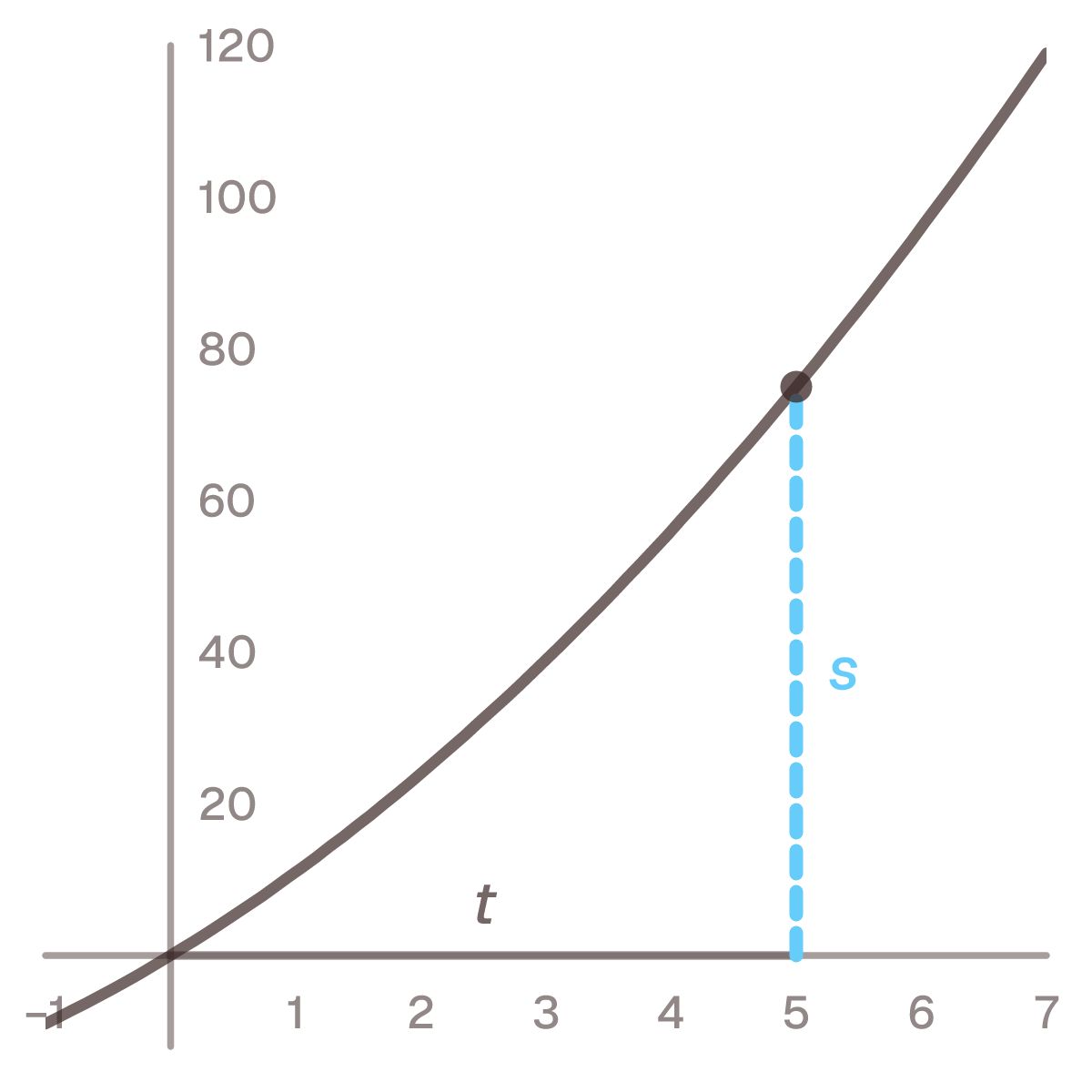
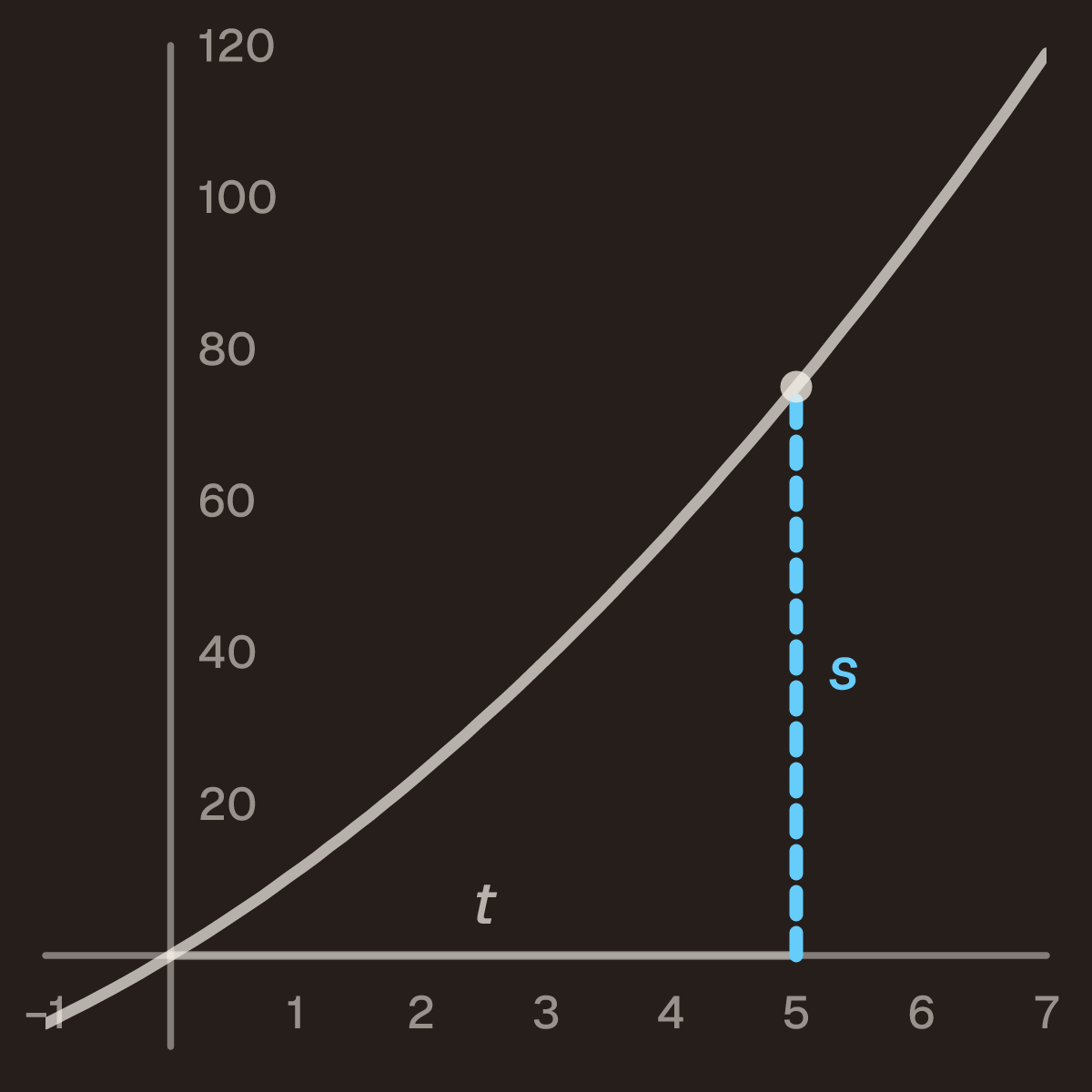
v₀ is the starting speed in m/s, a the acceleration in m/s², t the time in seconds and s the
distance in metres.
Holds when the acceleration is constant throughout the time t.
With v₀ = 10 m/s, a = 2 m/s² and t = 5 s the distance is 10 · 5 + 2 · 25 / 2 = 50 + 25 = 75 m.
The two terms
The formula looks awkward until you see that it is two simple things added together:
- v₀ · t is the distance you would have covered if the speed had never changed —
distance, speed and time, straight off.
- a · t² / 2 is what the acceleration added. The half is there because the extra speed builds up
throughout: on average you only have half of it.
If something starts from rest the first term disappears and what is left is s = a·t²/2. And t² is this
page’s most important detail: double the time and the distance quadruples, it does not double.
The time is the awkward rearrangement, because t appears both to the first and the second power. The
textbook solves the quadratic and gets t = (−v₀ + √(v₀² + 2as))/a, but that form divides by a and
breaks when the acceleration is zero. Multiply it through by its conjugate and you get
t = 2s/(v₀ + √(v₀² + 2as)), the form the card uses: the same number, and it holds then too — with a = 0 it becomes
s/v₀, the distance divided by the speed.
Worked examples
From rest. A car at 3 m/s² for 6 seconds: 0 · 6 + 3 · 36 / 2 = 54 m.
A braking distance. 25 m/s and −5 m/s² for 5 seconds: 25 · 5 + (−5) · 25 / 2 = 125 − 62.5 = 62.5 m.
After 5 seconds the car is stationary — do not carry the formula past that point, or it starts reversing.
The time while braking. How long do the first 40 metres take for the same car? Under the root is
25² + 2 · (−5) · 40 = 225, and t = 80 / (25 + 15) = 2 s. Ask for 70 metres and the number under the
root turns negative: the car stops after 62.5 m and never gets there, and the card says so.
What was the acceleration? Something covered 75 m in 5 s starting at 10 m/s:
a = 2(75 − 50)/25 = 2 m/s².
Double the time. The same car as above for 12 seconds rather than 6: 3 · 144 / 2 = 216 m, four
times as far. That is t² at work, and it is why a small increase in speed makes such a difference to a
braking distance.
Common mistakes
- Forgetting the half. Without it the distance comes out too long, and the error grows with time.
- Carrying on after the object has stopped. A negative acceleration stops applying once the speed
reaches zero. Check when that happens: t = v₀/|a|.
- Squaring the wrong thing. It is the time that is squared, not the acceleration.
- Mixing units. m/s, m/s² and seconds. An answer in metres never comes out of a speed in km/h.
Frequently asked questions
What if I do not know the time?
Then use the relation without it: velocity without time,
v² = v₀² + 2as. It is written for braking distances.
Does the formula apply to a falling object?
Yes, with a = g. If you drop something from rest it is free fall,
h = g·t²/2 — the same formula with the first term gone.
Why is it a quadratic when I solve for the time?
Because t appears both to the first and the second power. Two moments can give the same distance when
the acceleration is negative — the object passes the point, turns and passes it again — and it is the
first of them that answers a real question. The form in the table gives exactly that one.