Distance, speed and time
The relation
d
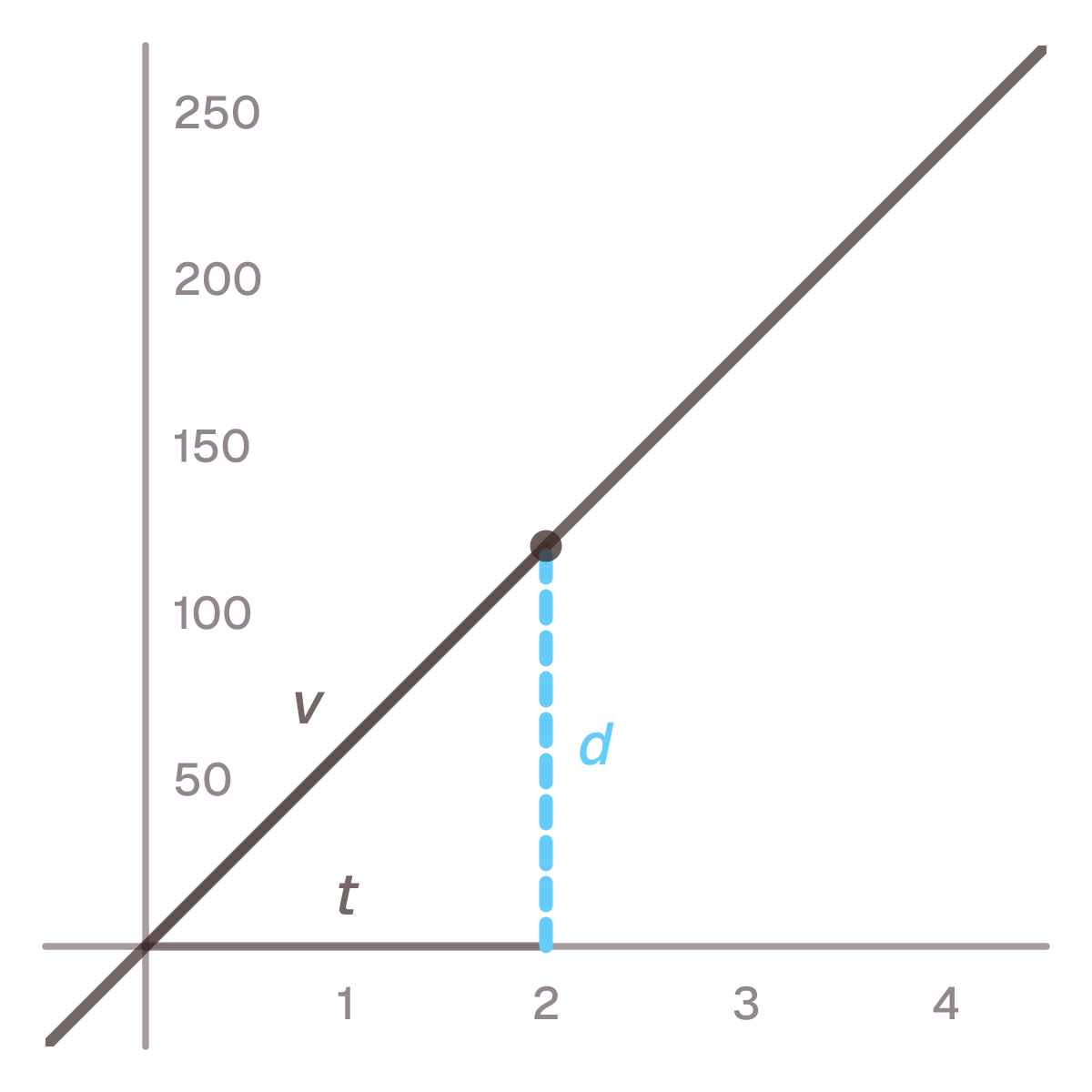
Distance is speed times time, as long as the speed is constant.
Solve for
d=120km
d equals 60 times 2, equals 120 km
Den här sidan finns på svenska. Byt till svenska
Definition — what does that mean?
Distance is speed times time — as long as the speed is constant, or as long as you mean the average.
In Swedish: Sträcka, hastighet och tid
d
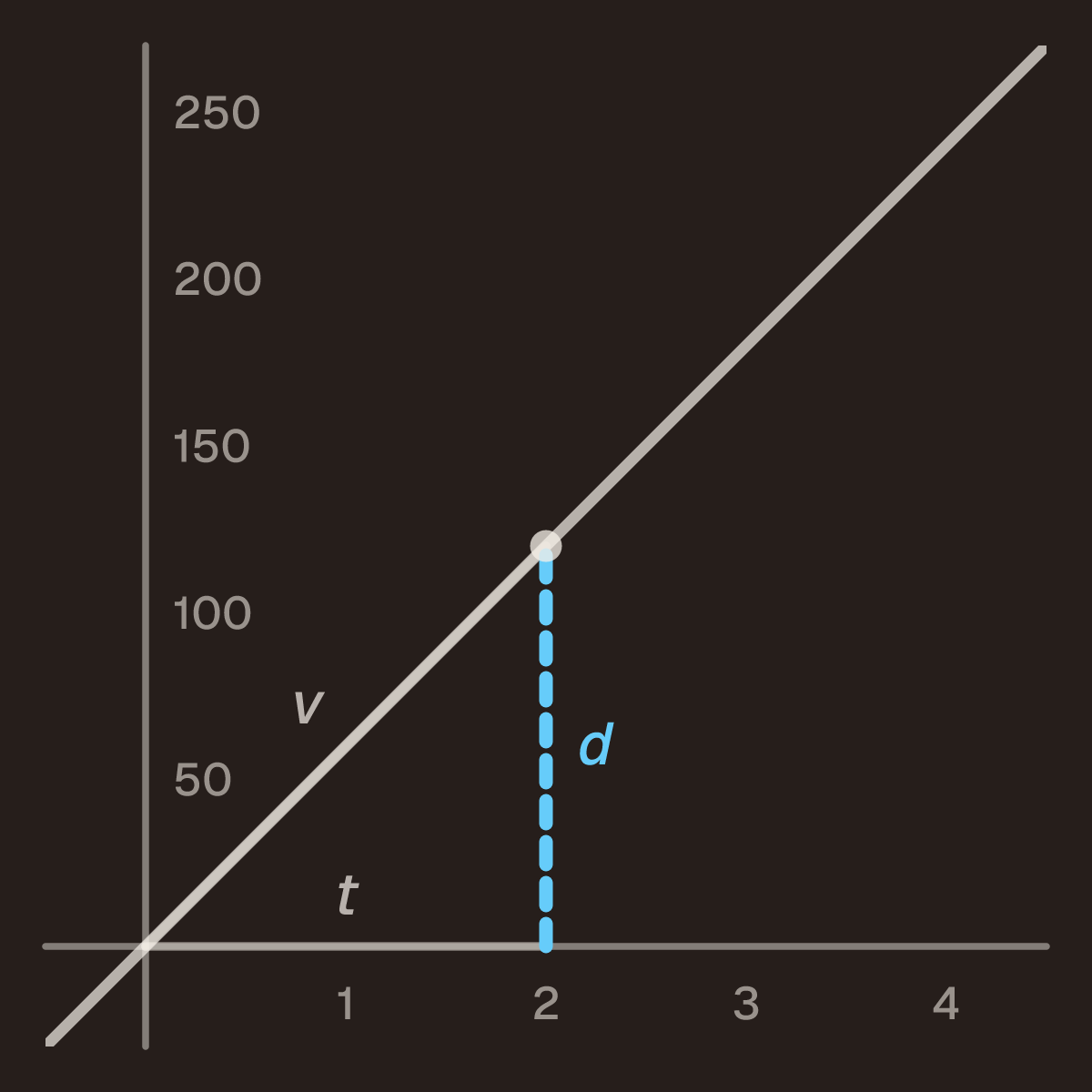
Distance is speed times time, as long as the speed is constant.
d=120km
d equals 60 times 2, equals 120 km
You are given
Pick the unit your lengths are in. Areas are then labelled in square units and volumes in cubic units; nothing is converted.
All three are the same relation solved in different directions, and the card above does the rearranging for you. The middle one is what explains what speed is: distance per unit of time. That is why the formula is a definition — it says what the word means, and there is nothing underneath it to prove.
Speed, time and distance have to come from the same family:
| Speed | Time | Distance |
|---|---|---|
| km/h | hours | km |
| m/s | seconds | metres |
| mph | hours | miles |
Multiply 90 km/h by 30 minutes and you do not get 2,700 of anything. Convert the time to 0.5 hours first and the answer is 45 km. The card above lets you pick a unit set instead, and then keeps all three in step.
From km/h to m/s: divide by 3.6. A kilometre is 1,000 metres and an hour is 3,600 seconds, so 1 km/h = 1,000/3,600 m/s. That makes 90 km/h into 25 m/s, and 72 km/h into 20 m/s.
The distance. 120 km/h for 2.5 hours: 120 · 2.5 = 300 km.
The time. 300 km at 80 km/h: 300 / 80 = 3.75 h, which is 3 hours and 45 minutes. Note that 0.75 hours is 45 minutes, not 75.
The speed. 3.5 km in 25 minutes is 3.5 / (25/60) = 8.4 km/h.
The formula gives the average over the whole journey. A car covering 300 km in three hours averages 100 km/h even if it stood still for half an hour and did 120 for the rest.
And an average speed is not the average of the speeds: drive 100 km at 100 km/h and 100 km at 50 km/h and the trip takes 1 + 2 = 3 hours for 200 km, so 66.7 km/h — not 75. The slow stretch takes longer, so it weighs more.
Does the formula hold if the speed varies?
Yes, but then v is the average over the whole distance. Finding the speed at one instant needs calculus;
see the definition of the derivative.
How do I convert m/s back to km/h?
Multiply by 3.6 — the same conversion the other way.
| Solve for | Rearranged | With the numbers | Comes to |
|---|---|---|---|
| v | dt | 1202 | 60 km/h |
| t | dv | 12060 | 2 h |
| d | vt | 60·2 | 120 km |
Table
| Unit | In seconds |
|---|---|
| ms | 0.001 |
| s | 1 |
| min | 60 |
| h | 3,600 |
| d | 86,400 |
| v | 604,800 |
Table
| Unit | In metres per second |
|---|---|
| km/h | 0.277777777778 |
| ft/s | 0.3048 |
| mph | 0.44704 |
| kn | 0.514444444444 |
| m/s | 1 |
Last reviewed October 6, 2026 ·How pages are reviewed
Sheets that ask this formula, with their answer keys. Open one to see the questions or print it.
Twelve questions on one relation, but what is asked for changes: sometimes the speed, sometimes the distance, sometimes the time. The key works the first one.
Copy the code into your page where the formula card should appear. It loads from lovetocalc.com, so it stays current on its own — all we ask is that the credit line comes with it.