Skip to content
LoveToCalc

Definition — what does that mean?

Time of flight of a projectile

How long a launch stays in the air, from its speed and angle.

In Swedish: Kaströrelse — flygtid

Projectile motion — time of flight

The relation

T=2v₀ sin(θ)g

How long a launch from level ground stays in the air, from its speed and angle: the time the upward speed takes to run out, twice.
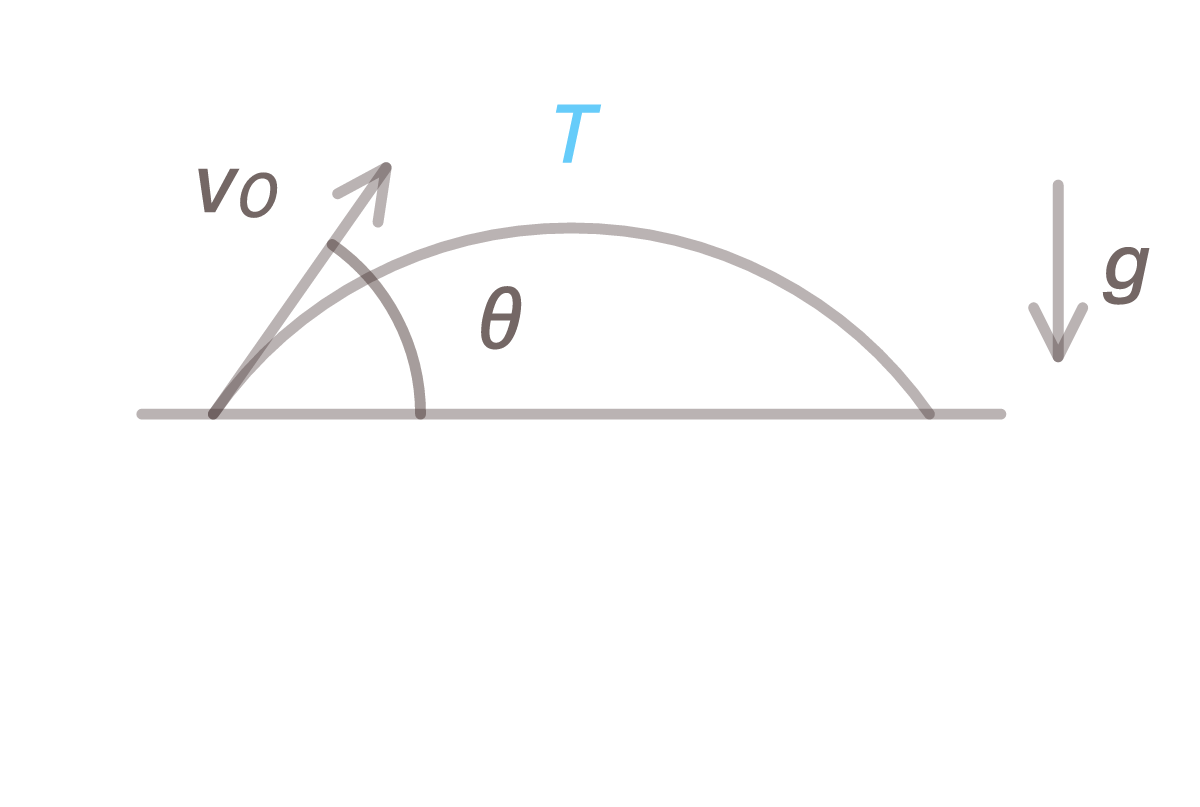
A ball thrown from the ground with the initial speed v₀ at the angle θ above the horizontal, and the curved path it follows until it lands. T marks the time it spends in the air; the arrow beside the path shows gravity g.
Solve for

T≈2.0387s

T equals (2 times (20 times the sine of (30 degrees))) divided by 9.81, equals (2 times (20 times 0.5)) divided by 9.81, equals (2 times 10) divided by 9.81, equals 20 divided by 9.81, is approximately 2.0387 s

Working5 steps

Practice questions

You are given

  • v₀=20m/s
  • θ=30°
  • g=9.82m/s²

Round to 2 decimals.

The formula

T = 2v₀ · sinθ / g

v₀ is the launch speed in m/s, θ the launch angle above the ground, g gravity and T the time in seconds from launch until it lands at the same height. Air resistance is left out.

Where it comes from

The upward part of the speed is v₀·sinθ. Gravity takes away g metres per second every second, so the upward speed runs out after v₀·sinθ / g. That is the highest point. Without air, the way down mirrors the way up and takes as long, hence the 2.

Worked examples

The defaults. 20 m/s at 30°: T = 2 · 20 · 0.5 / 9.81 ≈ 2.04 s.

The same speed at 45°. T = 2 · 20 · 0.707 / 9.81 ≈ 2.88 s. A steeper launch stays up longer.

A football kick. 25 m/s at 30° gives T = 2 · 25 · 0.5 / 9.81 ≈ 2.55 s. Times the forward speed, 25 · cos(30°) ≈ 21.65 m/s, that is 55.2 m, the same answer the range gives.

Common mistakes

Frequently asked questions

How high does it go in that time? See maximum height. At 20 m/s and 30° it is about 5.1 m, reached after 1.02 s, half the time of flight.

Why does the forward speed not change the time? The forward motion and the upward motion are independent. Gravity only pulls down, so it does not slow the forward speed, and the forward speed does not change how fast the launch falls.

Looking for another letter? The formula solved for each one
Solved for each letter
Solve forRearrangedWith the numbersComes to
v₀Tg2 sin(θ)2.0387·9.812 sin(30°)20 m/s
θarcsin(Tg2v₀)arcsin(2.0387·9.812·20)30°
g2v₀ sin(θ)T2·20 sin(30°)2.03879.81 m/s²
T2v₀ sin(θ)g2·20 sin(30°)9.812.0387 s

Last reviewed October 6, 2026 ·How pages are reviewed

MotionAll formulas

Put this formula on your site

Copy the code into your page where the formula card should appear. It loads from lovetocalc.com, so it stays current on its own — all we ask is that the credit line comes with it.