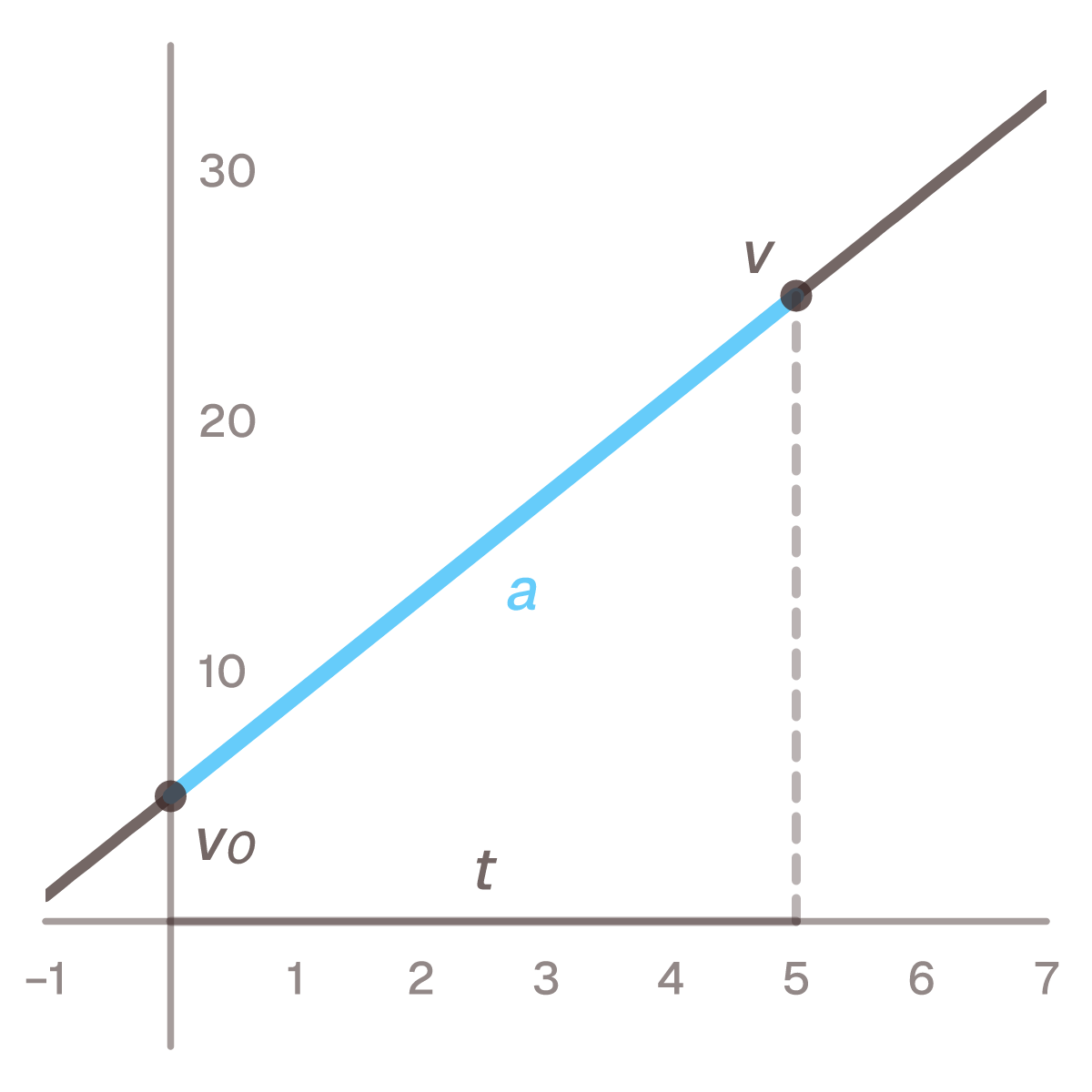
v₀ is the speed you started at, v the speed afterwards, t the time between them and a the
acceleration. The unit is metres per second per second, m/s², because the number says how many m/s
the speed changes by each second.
A car going from 5 m/s to 25 m/s in 5 seconds accelerates at (25 − 5)/5 = 4 m/s².
The same formula rearranged as v = v₀ + a·t is the form many problems ask for: how fast
is it going after eight seconds? The card above solves for whichever of the four you want.
Negative acceleration
When something brakes, v is smaller than v₀, the numerator is negative and so is the acceleration.
That is not a mistake — it is the direction. A car going from 25 m/s to 0 in 5 seconds has an
acceleration of (0 − 25)/5 = −5 m/s², and that number is exactly what a braking calculation needs.
The word deceleration means the same thing with the sign taken off. Keep the sign and the direction comes
along with it.
Worked examples
A plane on the runway. 0 to 70 m/s in 35 seconds: (70 − 0)/35 = 2 m/s².
The speed after a time. A cyclist at 4 m/s accelerates at 0.5 m/s² for 6 seconds:
v = 4 + 0.5 · 6 = 7 m/s.
The time to a speed. From a standing start to 100 km/h — that is 27.8 m/s — at 4 m/s² takes
(27.8 − 0)/4 ≈ 7 s.
Braking. 30 m/s down to 10 m/s in 4 seconds: (10 − 30)/4 = −5 m/s².
Common mistakes
- Mixing km/h with m/s. The formula works in m/s and m/s². Divide km/h by 3.6 first: 90 km/h is
25 m/s.
- Assuming fast means accelerating. A plane at cruising speed is going quickly and accelerating not at
all — the speed is large, the change is zero.
- Throwing away the minus sign. Carrying on with a positive acceleration while braking gives you a car
that speeds up instead of stopping.
- Using the formula when the acceleration is not constant. The answer is then the average
acceleration over the time, which is often enough but is not the acceleration at any one moment.
Frequently asked questions
What does 0–60 in 7 seconds mean?
From a standing start to 60 mph, about 27 m/s, in 7 seconds — an average acceleration of roughly
4 m/s². A real car accelerates harder at the start and less at the top, so the figure is an average.
How far does something travel while accelerating?
That is a formula of its own, because the speed is changing throughout:
distance under constant acceleration.
Is gravity an acceleration like any other?
Yes. A falling object gains about 9.81 m/s of speed every second, and the arithmetic is the same — see
free fall.