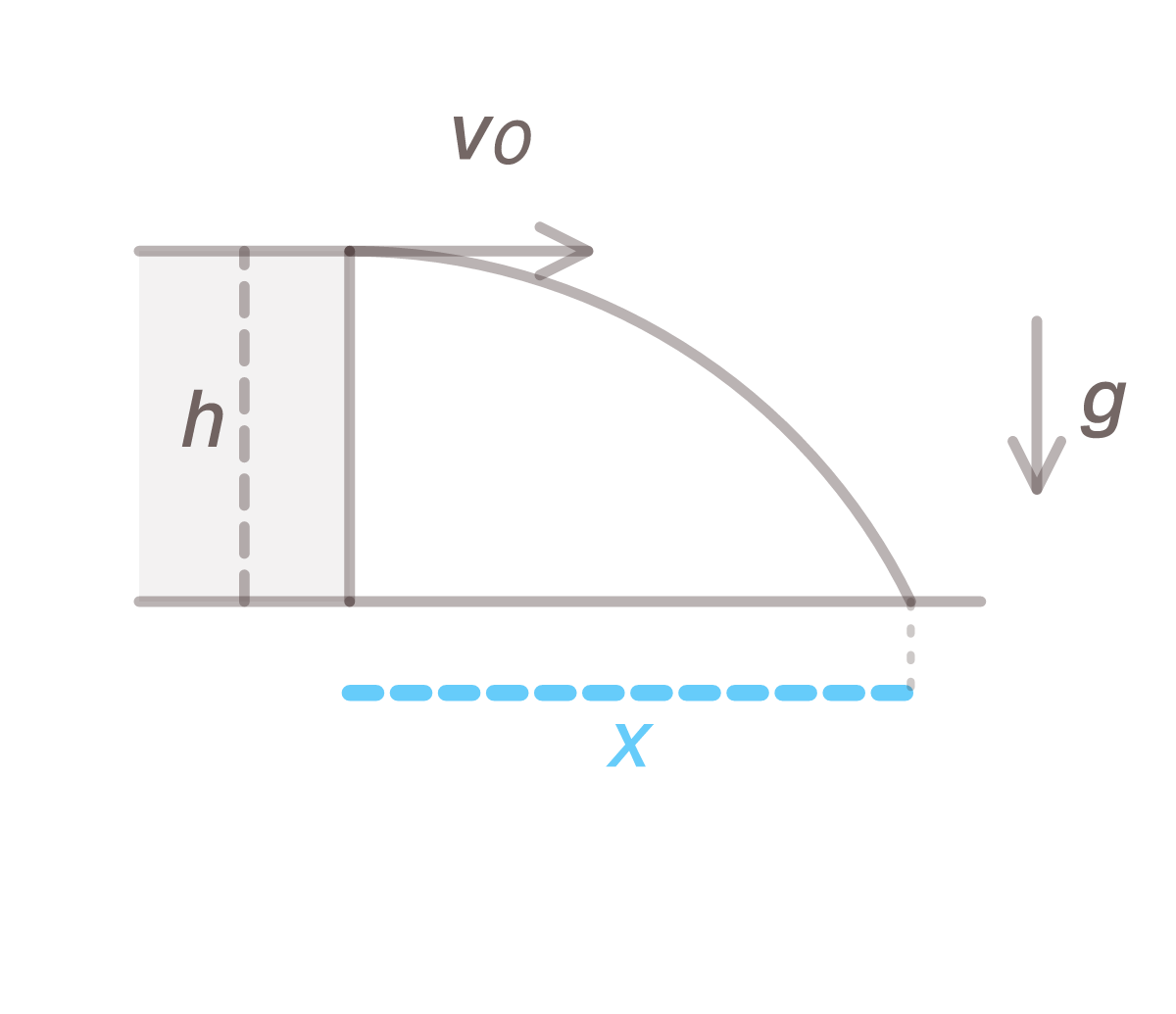
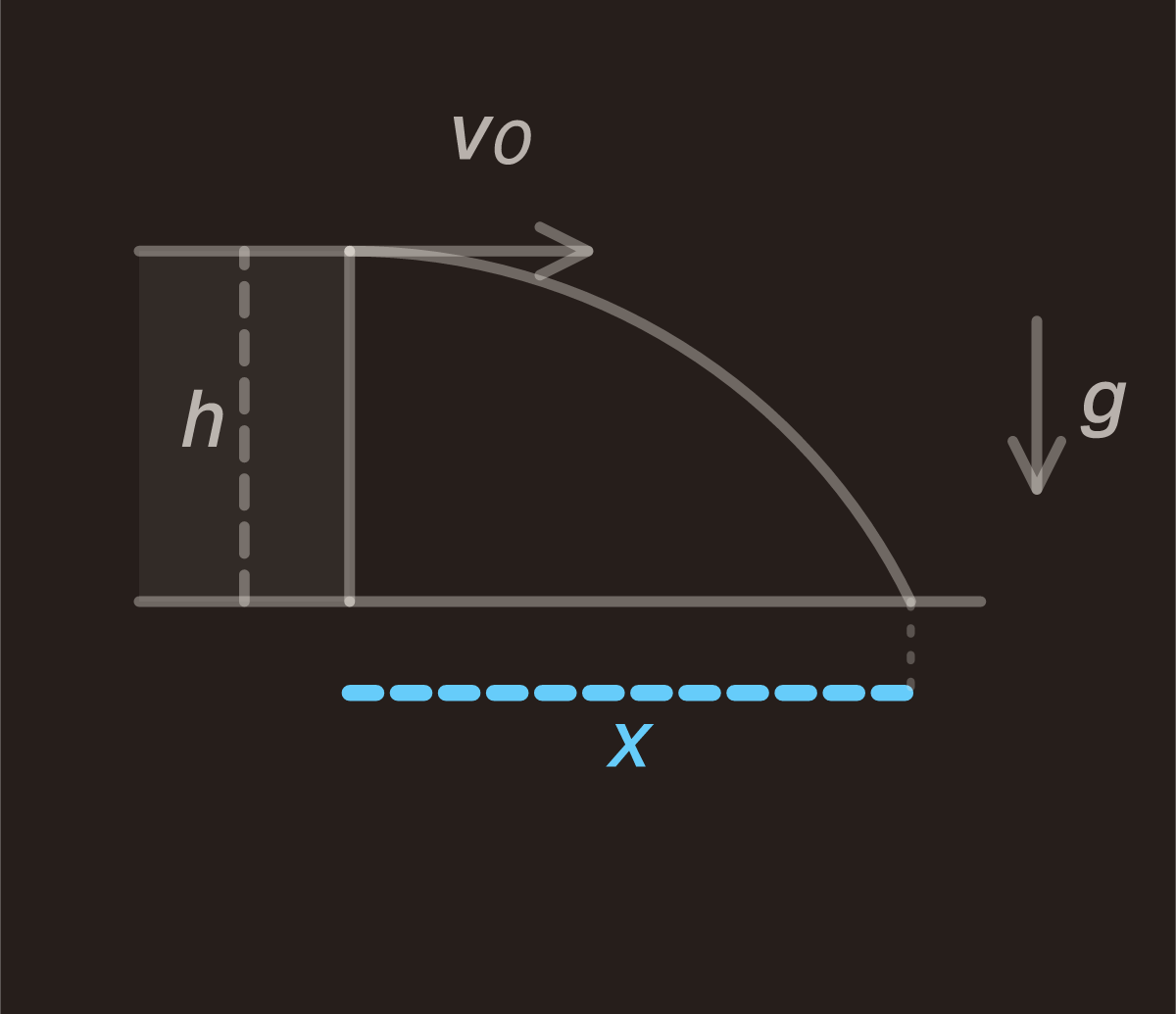
x = v₀ · √(2h / g)
v₀ is the forward speed in m/s, h the height it falls, g gravity and x how far forward it lands, in
metres. The launch is straight forward, with no angle up or down, and air resistance is left out.
Two motions that leave each other alone
Downward, the object falls exactly as if it had been dropped. Free fall
gives h = g·t²/2, so the time to the ground is t = √(2h/g). Forward, it keeps the same speed v₀ for all
of that time, because nothing slows it in that direction. The forward distance is speed times time.
That means something that sounds wrong and is true: a bullet fired straight forward and a bullet
dropped from the same height at the same moment hit the ground together.
Worked examples
The defaults. 15 m/s from 19.64 m: t = √(2 · 19.64 / 9.81) ≈ 2.00 s, and x ≈ 15 · 2.00 = 30.0 m.
A ball rolling off a table. 2 m/s from 1.25 m: t = √(2.5 / 9.81) ≈ 0.50 s, and x ≈ 2 · 0.50 ≈
1.01 m from the edge.
A stone off a cliff. 10 m/s straight out from 20 m: t = √(40 / 9.81) ≈ 2.02 s, and x ≈ 20.2 m.
Common mistakes
- Forgetting the square root. The time is √(2h/g), not 2h/g. Four times the height gives only twice
the time.
- Thinking the forward speed changes the fall time. It does not. A faster bullet lands further away,
but just as soon.
- Using it for a launch angled upward. Then the launch has some upward speed to begin with and stays
up longer, and the time takes a quadratic equation.
Frequently asked questions
How fast is it going when it lands?
The forward speed is still v₀. The downward speed is g·t. The total speed is √(v₀² + (g·t)²), by
Pythagoras. From the defaults: √(15² + 19.64²) ≈ 24.7 m/s.
How is this different from the range from level ground?
A launch from the ground has an angle and lands at the height it started from, so its upward speed sets
the time. See projectile range. Here there is no upward
speed, and the height sets the time.