The formula
- a = dv/dt = v′(t)
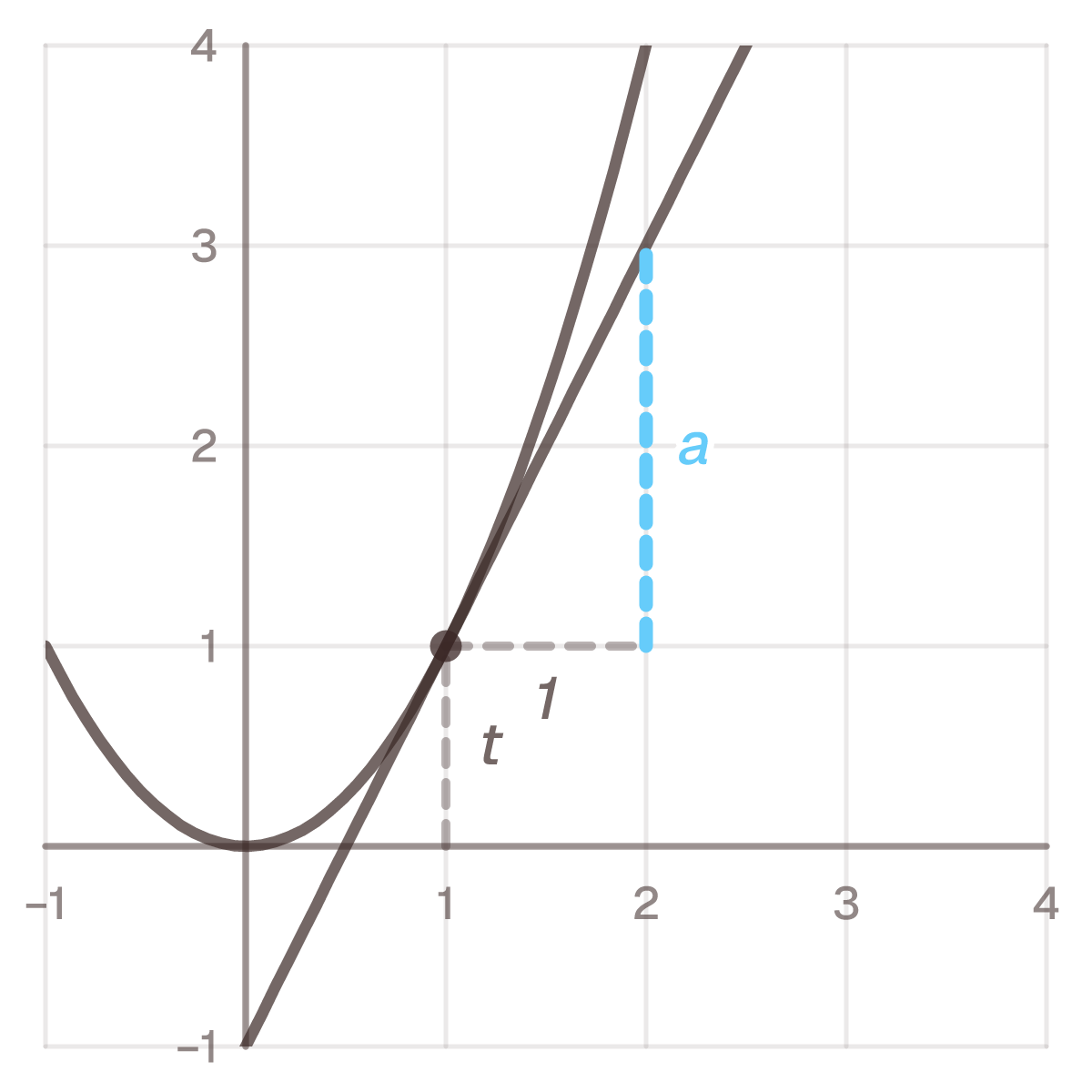
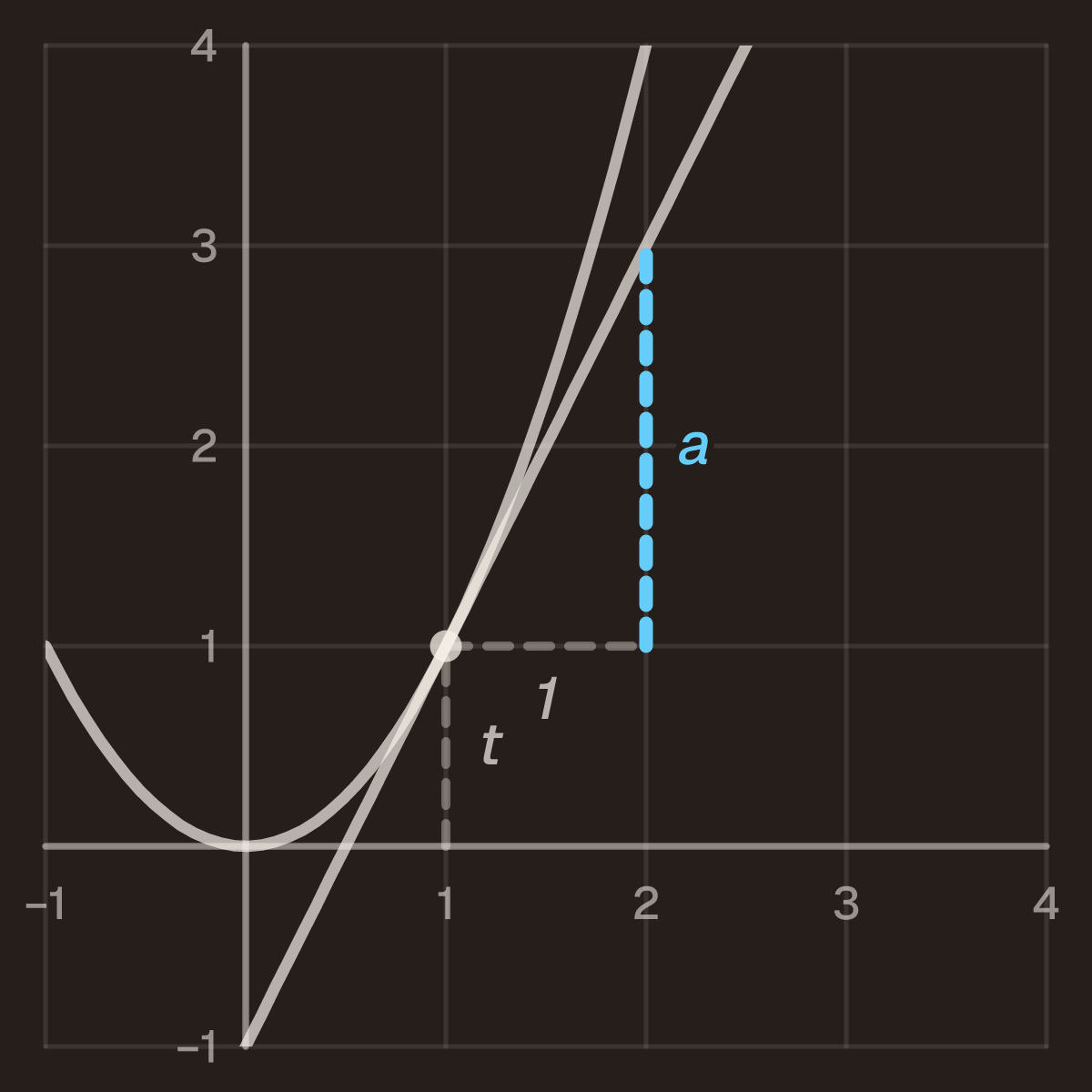
v(t) is the velocity in m/s, t the time in seconds and a the acceleration in m/s². It is the slope of the velocity curve at the moment t. Since v = ds/dt, the acceleration is also the second derivative of the position, a = s″(t). With a constant slope this is the ordinary acceleration.
Holds for motion along a line where v(t) can be differentiated at the moment in question.
Worked example
A body has the velocity v(t) = t² + 2t m/s. Then a(t) = 2t + 2. At t = 3 s the acceleration is 8 m/s².
The average acceleration over the first three seconds is smaller. v(3) = 9 + 6 = 15 m/s and v(0) = 0, so 15/3 = 5 m/s². The acceleration itself grows with time, which is why the two numbers differ.
Common mistakes
- Using Δv/Δt for a moment. That quotient is the average over an interval. Only the derivative gives the value at the moment.
- Mixing up the graphs. The acceleration is the slope of the velocity graph, not the height of it.
- Wrong unit. A velocity in m/s differentiated with respect to seconds gives m/s².
Where next
- The step before: velocity as a derivative.
- With a constant acceleration the position follows s = v₀t + at²/2.
Common questions
Is the acceleration zero when the velocity is zero?
Not necessarily. A ball at the top of its path has v = 0 for an instant, but its acceleration there is still about 9.81 m/s² downwards.