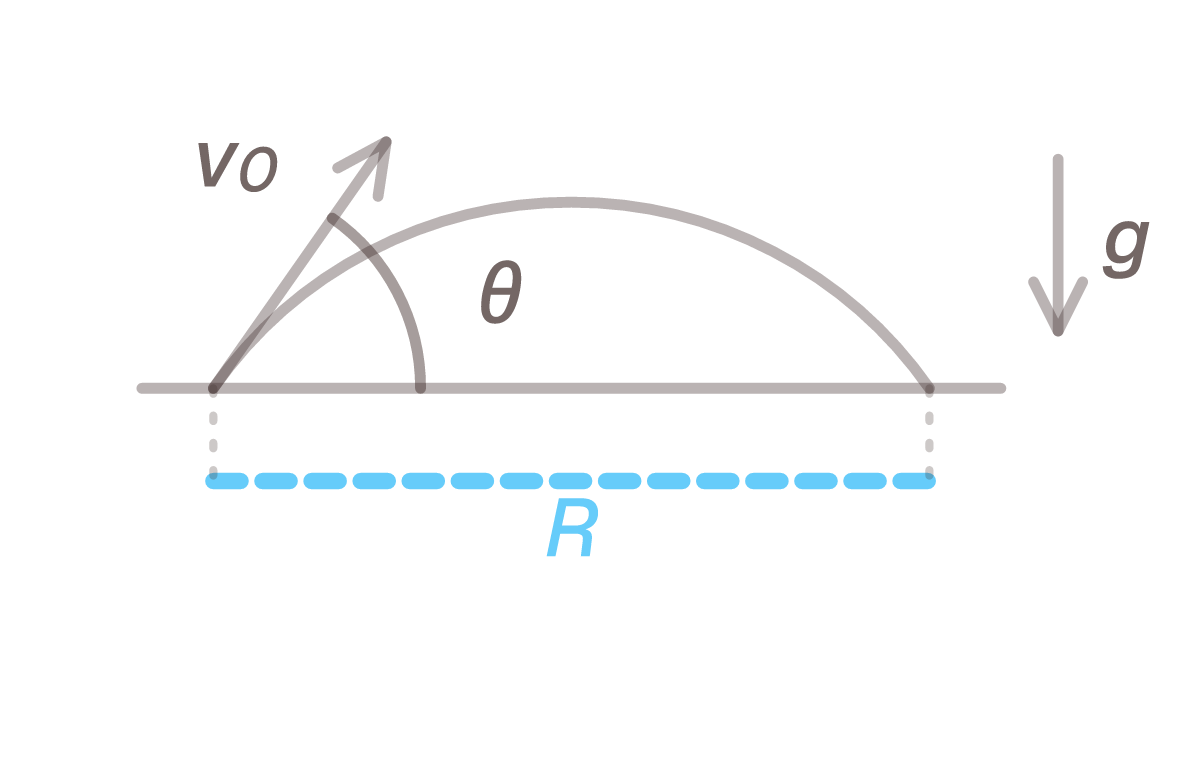
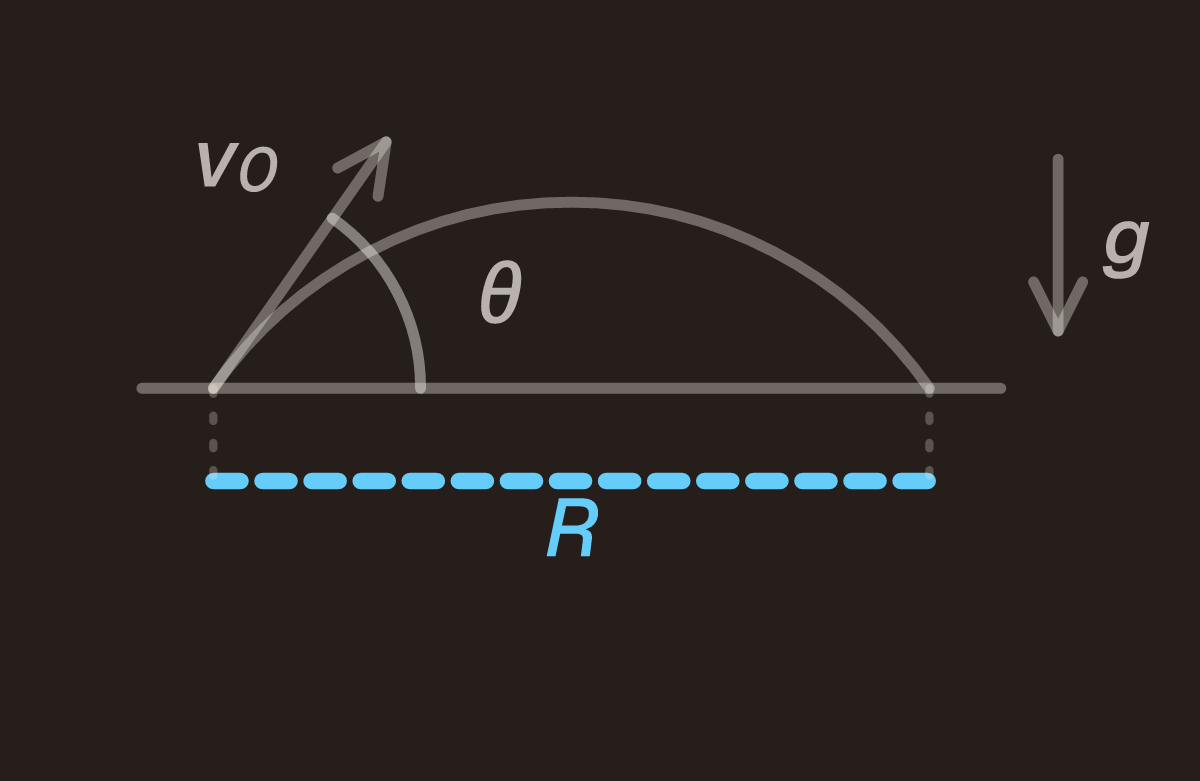
R = v₀² · sin(2θ) / g
v₀ is the launch speed in m/s, θ the launch angle above the ground, g gravity and R the range in
metres. The formula holds for a launch that lands at the height it started from, with air resistance
left out.
It comes from two simple motions happening at once. Forward, the launch moves at a steady v₀·cosθ.
Upward, gravity slows it and it is back after 2v₀·sinθ / g, the
time of flight. The range is the forward speed
times that time, and 2·sinθ·cosθ is the same thing as sin(2θ).
Why 45° goes furthest
sin(2θ) is at most 1, which it reaches when 2θ = 90°, so at θ = 45°. The range is then v₀²/g. A flatter
launch has more forward speed but lands too soon; a steeper one stays up longer but moves forward more
slowly. 45° is where the two trade off best.
For the same reason, two angles that add up to 90° give the same range. 30° and 60° land in the same
place, one flat and quick, the other high and slow. Solve for the angle on the card above and you get
both answers.
Worked examples
The defaults. 20 m/s at 45°: R = 400 · sin(90°) / 9.81 = 400 / 9.81 ≈ 40.77 m.
The same speed at 30° and 60°. sin(60°) and sin(120°) are both about 0.866, so both launches land
400 · 0.866 / 9.81 ≈ 35.31 m away.
A football kick. 25 m/s at 30° gives 625 · 0.866 / 9.81 ≈ 55.2 m. A real ball lands shorter,
because the air slows it.
Common mistakes
- Taking sin(θ) instead of sin(2θ). Double the angle before taking the sine. At 45° the difference is
0.707 against 1.
- A calculator in radians. sin(90) in radians is 0.894, not 1. Check the calculator is set to degrees.
- Using the formula when the launch lands higher or lower. A throw off a cliff or up at a raised
basket has a different time of flight, and the formula no longer holds. A launch flat off a height has
its own formula: range of a horizontal launch.
Frequently asked questions
Is 45° best in real life too?
Almost never. Air resistance takes the most from a launch that is fast and long in the air, which
favours a slightly flatter angle. A shot putter reaches furthest at around 37–40°, partly also because
the shot leaves the hand above the ground.
How high does it go?
That is a formula of its own: maximum height,
h = v₀²·sin²θ / 2g. At 45° and 20 m/s it is about 10.2 m.
Does the mass matter?
Not without air resistance. As in free fall, heavy and light
things fall at the same rate, so a tennis ball and a cannonball launched at the same speed and angle
land in the same place.