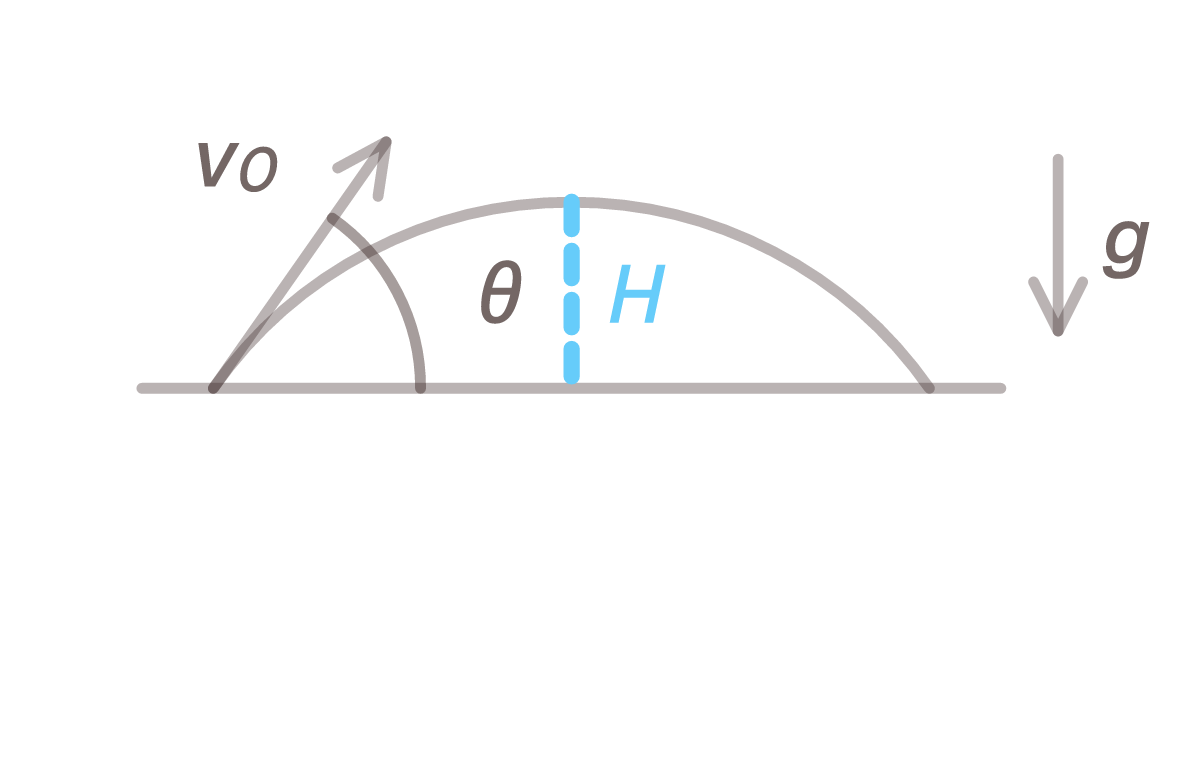
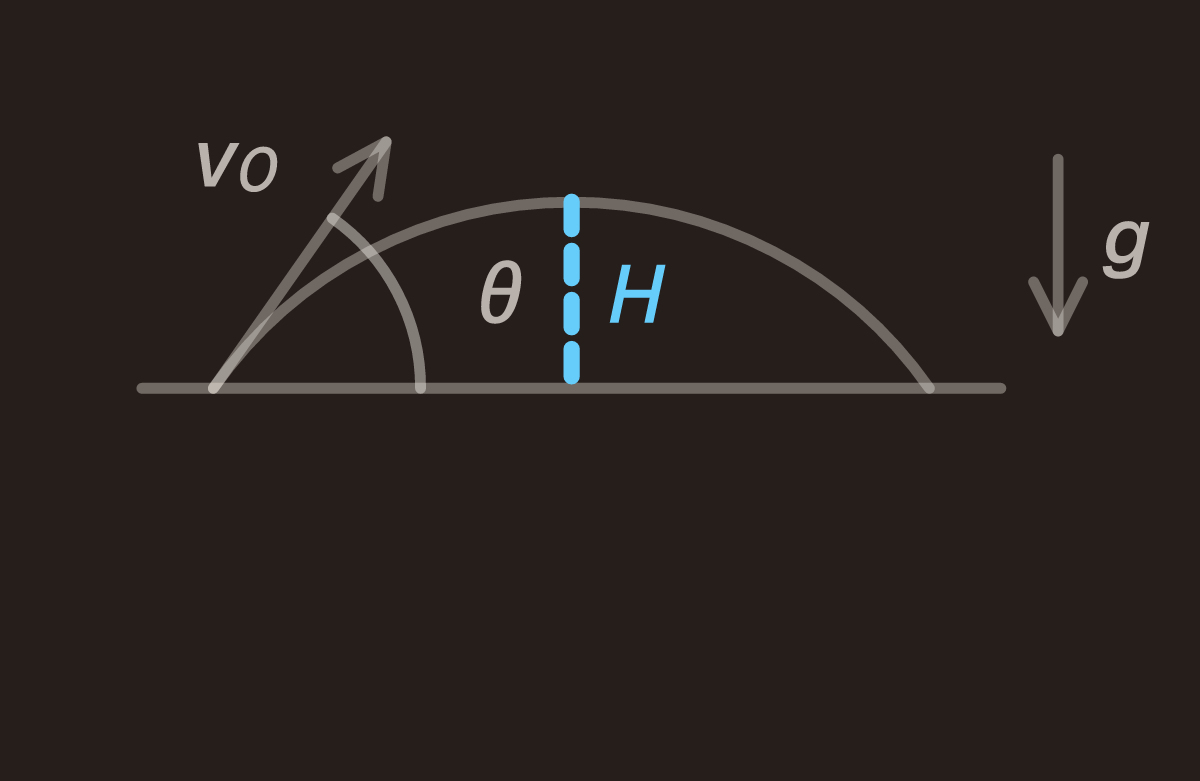
H = v₀² · sin²θ / 2g
v₀ is the launch speed in m/s, θ the launch angle above the ground, g gravity and H the greatest
height in metres, measured from where the launch started. Air resistance is left out.
sin²θ means (sinθ)², the sine of the angle squared. It is not the sine of θ².
Where it comes from
Only the upward part of the speed, v₀·sinθ, lifts the launch. Gravity slows it until it is zero, and
that is the highest point. It is the same as throwing something straight up at v₀·sinθ, and
velocity without time then gives v² = 2gh, so
H = (v₀·sinθ)² / 2g. The forward speed has no effect on the height at all.
Worked examples
The defaults. 20 m/s at 45°: sin²(45°) = 0.5, so H = 400 · 0.5 / 19.62 ≈ 10.19 m.
Straight up. At 90°, sin²θ = 1 and H = 400 / 19.62 ≈ 20.39 m, twice as high as at 45°.
A football kick. 25 m/s at 30° gives sin²(30°) = 0.25 and H = 625 · 0.25 / 19.62 ≈ 7.96 m.
Common mistakes
- Forgetting to square the sine. Both the speed and the sine are squared. At 30° that is 0.5 against
0.25, twice as high as it should be.
- Forgetting the 2 in the denominator. The denominator is 2g, not g.
- A calculator in radians. Check the calculator is set to degrees before taking the sine of 30 or 45.
Frequently asked questions
When does the launch reach its highest point?
Halfway through the flight, after v₀·sinθ / g. The whole
time of flight is twice as long, because the
way down takes as long as the way up.
Which angle goes highest?
90°, straight up. But then it lands where it started. The angle that goes furthest forward is 45°; see
projectile range.