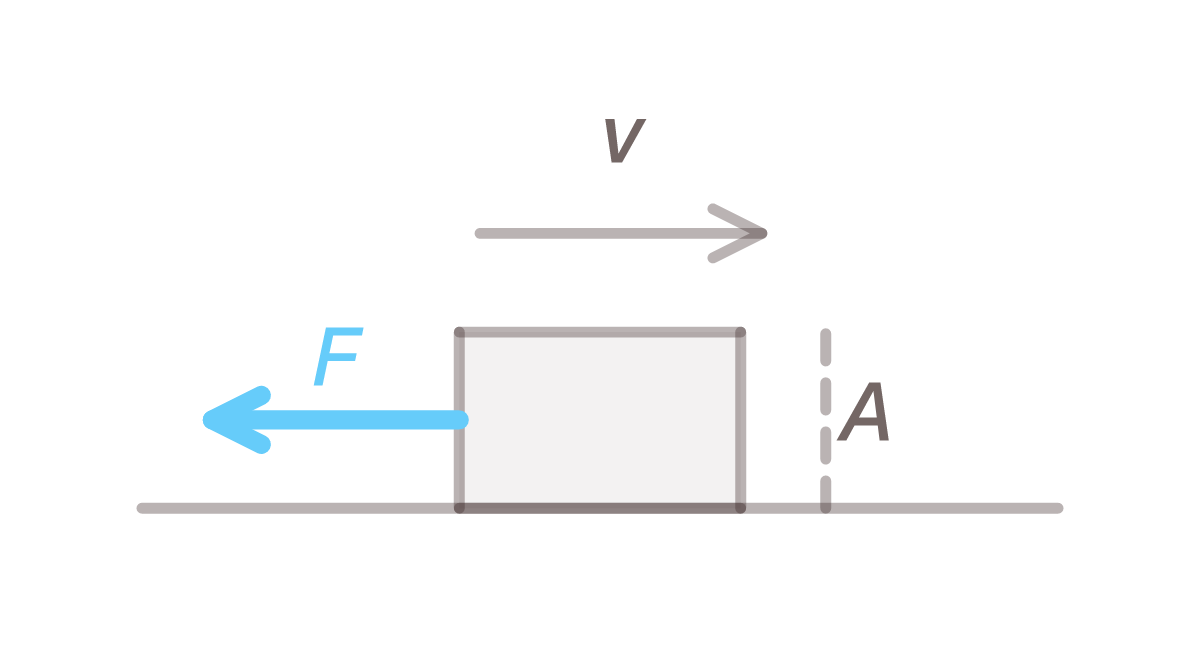
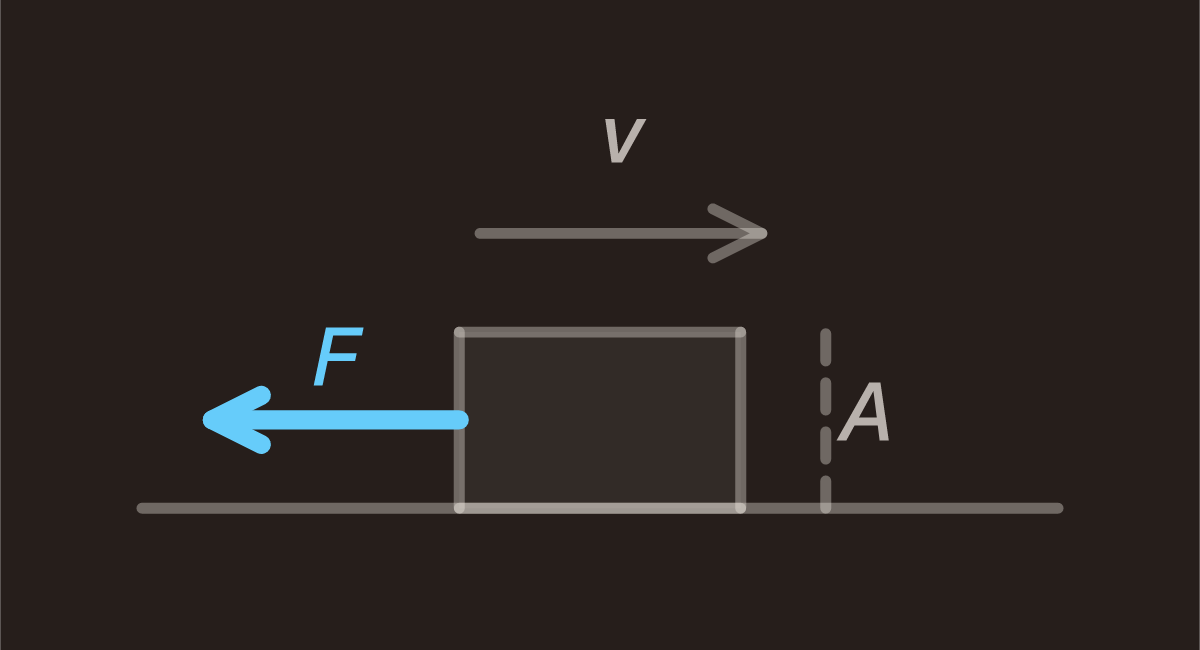
ρ is the air density (about 1.2 kg/m³ at room temperature), C_d the drag coefficient, a number with
no unit that depends on the shape, A the frontal area in m², v the speed in m/s and F the force in
newtons.
In Swedish C_d is luftmotståndskoefficienten, and car brochures call it the cw-värde.
Holds when the speed is well below the speed of sound and the object is large and fast enough for drag to
grow with the speed squared, as for cars, cyclists and skydivers.
A typical family car has C_d = 0.29 in the table of drag coefficients.
Assume a frontal area of 2.2 m². At 90 km/h, which is 25 m/s:
F = ½ · 1.2 · 0.29 · 2.2 · 25² ≈ 239 N.
Speed squared — and in m/s
The same car at 120 km/h (33.3 m/s) meets F ≈ 425 N. A third more speed is almost 80% more drag:
| Speed |
F |
| 90 km/h = 25 m/s |
239 N |
| 120 km/h = 33.3 m/s |
425 N |
| 90 m/s, km/h typed in as m/s |
3,101 N |
The last row is an easy mistake to miss: putting in 90 without dividing by 3.6. The answer is thirteen times
too large.
A second example: when drag carries the weight
An 80 kg skydiver falls belly down. Assume C_d = 0.7 and A = 0.6 m², numbers that vary with posture and
clothing and that no table fixes. The speed stops growing when the drag
equals the weight, 80 · 9.81 = 784.8 N. Solve for the speed:
v = √(2F / (ρ · C_d · A)) = √(2 · 784.8 / (1.2 · 0.7 · 0.6)) ≈ 56 m/s, about 200 km/h.
Where next
Common mistakes
- Speed in km/h. Divide by 3.6 first.
- Forgetting the square. Twice the speed is four times the force, not twice.
- Forgetting the half. The ½ comes first and follows into every rearrangement.
- The wrong area. It is the frontal area, seen straight from the front, not the whole surface.
Common questions
Does it work in water?
Yes, with water’s density, about 1,000 kg/m³. That is why running in water is so much harder.
Does it hold at low speeds?
Not for very small objects in slow, viscous flow, like dust or mist droplets. There the drag grows with
the speed, not with its square.