Skip to content
LoveToCalc

Definition — what does that mean?

Centripetal force

Anything moving in a circle needs a force towards the centre. Something has to supply it.

In Swedish: Centripetalkraft

Centripetal force

The relation

F=mv²r

Mass times speed squared, divided by the radius: the force pointing at the centre that a curved path needs. Friction, a string or gravity has to supply it.
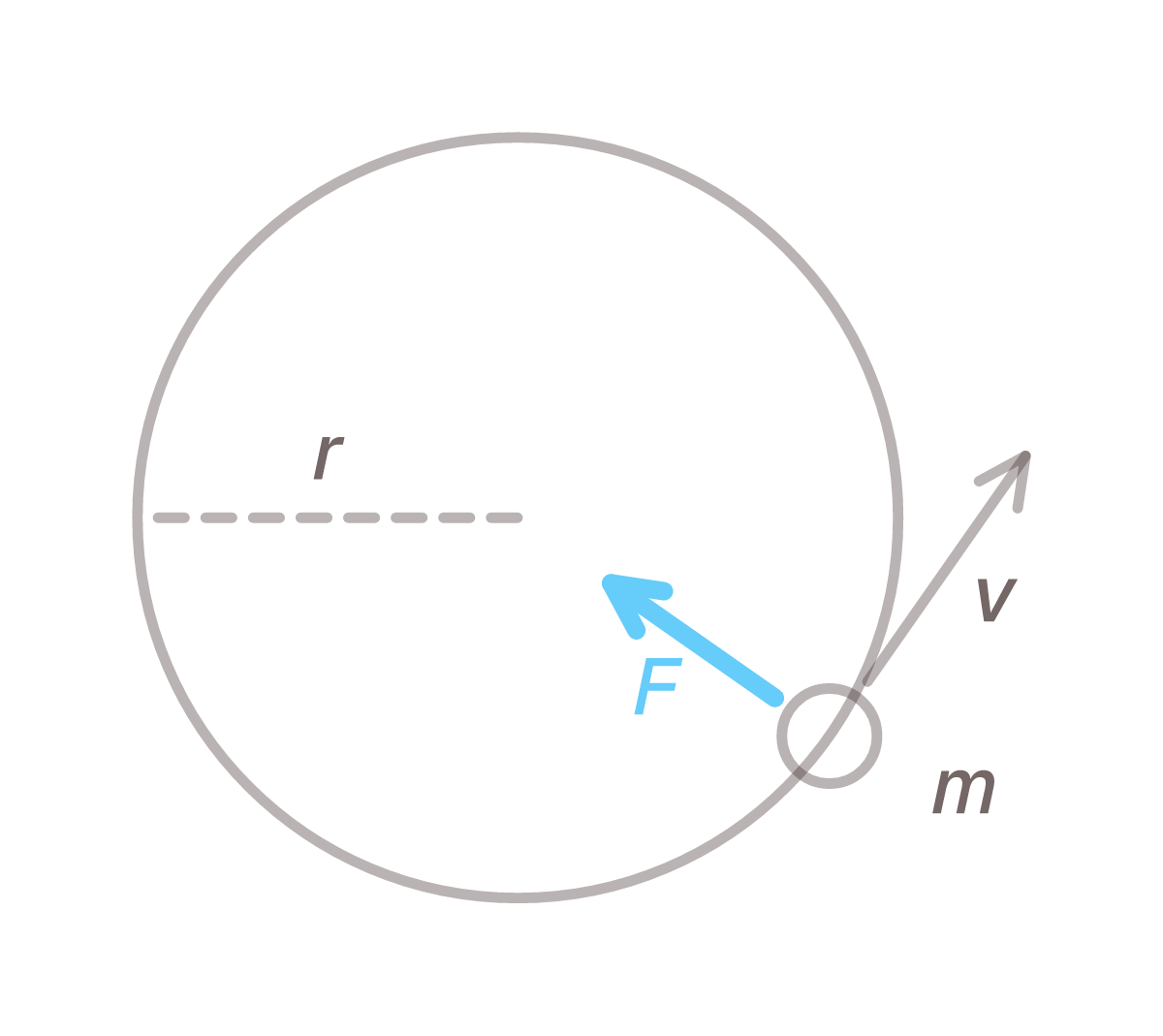
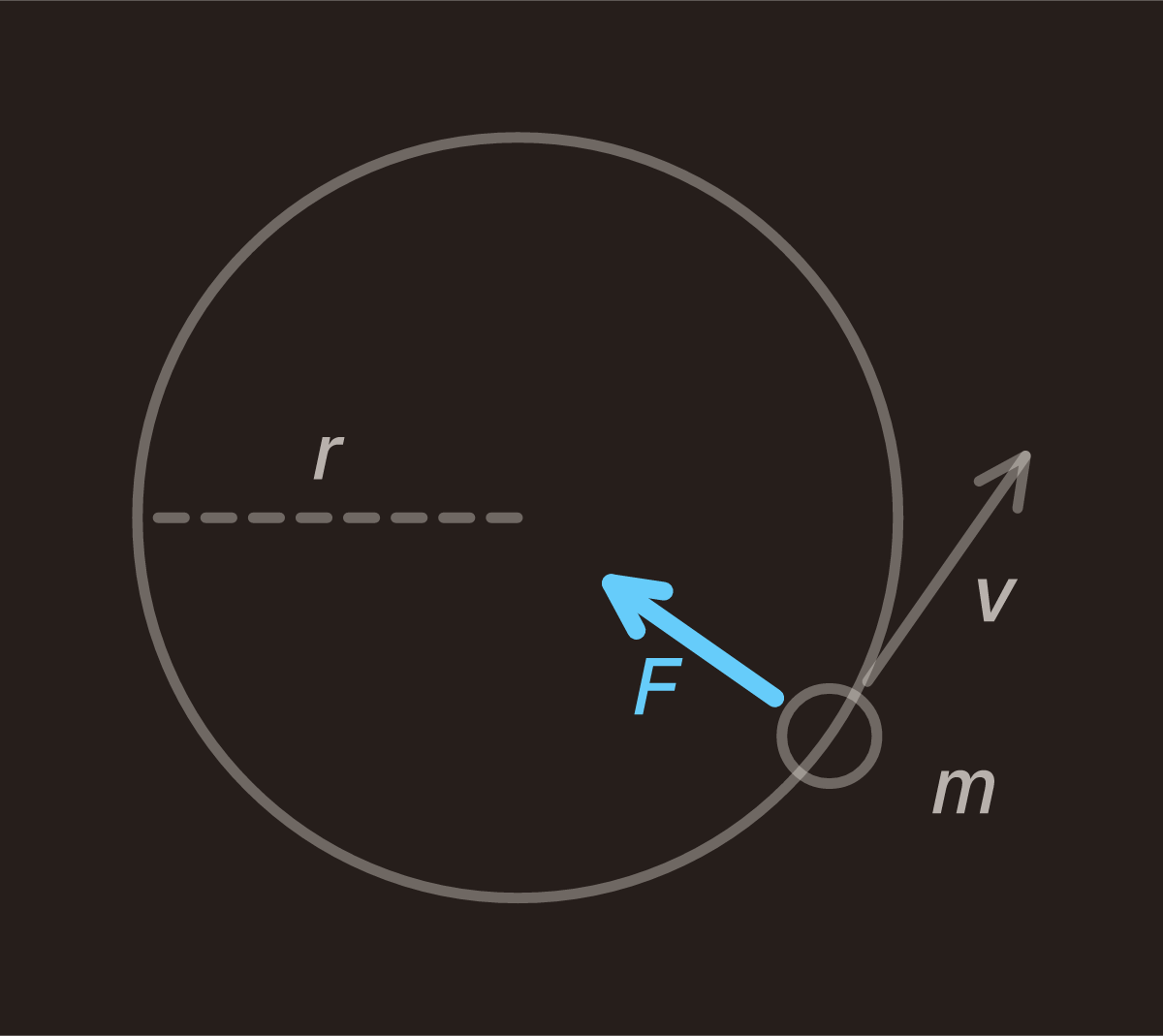
A body of mass m going round a circle of radius r at speed v. The speed arrow is tangent to the circle, and the force F that holds the body on the circle points inwards, towards the centre.
Solve for

F=9,600N

F equals (1,200 times 20 squared) divided by 50, equals (1,200 times 400) divided by 50, equals 480,000 divided by 50, equals 9,600 N

Working4 steps

Practice questions

You are given

  • m=1500kg
  • v=5m/s
  • r=70m

Round to 2 decimals.

The formula

F = m · v² / r

F is the force in newtons, m the mass in kilograms, v the speed in m/s and r the radius in metres. It is Newton’s second law, F = m · a, with the centripetal acceleration a = v²/r put in.

Holds for motion along a circular arc at constant speed, far below the speed of light.

What supplies the force?

Centripetal force is not a kind of force of its own. It is the name for the net force pointing at the centre, and one of the ordinary forces supplies it:

If the force is not enough, the body carries on in a wider arc. The car slides out; the string snaps.

Worked examples

The defaults. A 1,200 kg car at 20 m/s through a curve of radius 50 m: F = 1,200 · 20² / 50 = 9,600 N. The tyres have to manage that force.

A stone on a string. 0.2 kg swung at 3 m/s on a 0.5 m string: F = 0.2 · 9 / 0.5 = 3.6 N.

Common mistakes

Frequently asked questions

Why are motorway curves banked? A tilted road lets the normal force from the road point partly inwards. It can then supply some of the centripetal force, and friction does not have to do it all.

Looking for another letter? The formula solved for each one
Solved for each letter
Solve forRearrangedWith the numbersComes to
mFrv²9,600·5020²1,200 kg
vFrm9,600·501,20020 m/s
rmv²F1,200·20²9,60050 m
Fmv²r1,200·20²509,600 N

Last reviewed October 6, 2026 ·How pages are reviewed

MechanicsAll formulas

Put this formula on your site

Copy the code into your page where the formula card should appear. It loads from lovetocalc.com, so it stays current on its own — all we ask is that the credit line comes with it.