Weight
The relation
F
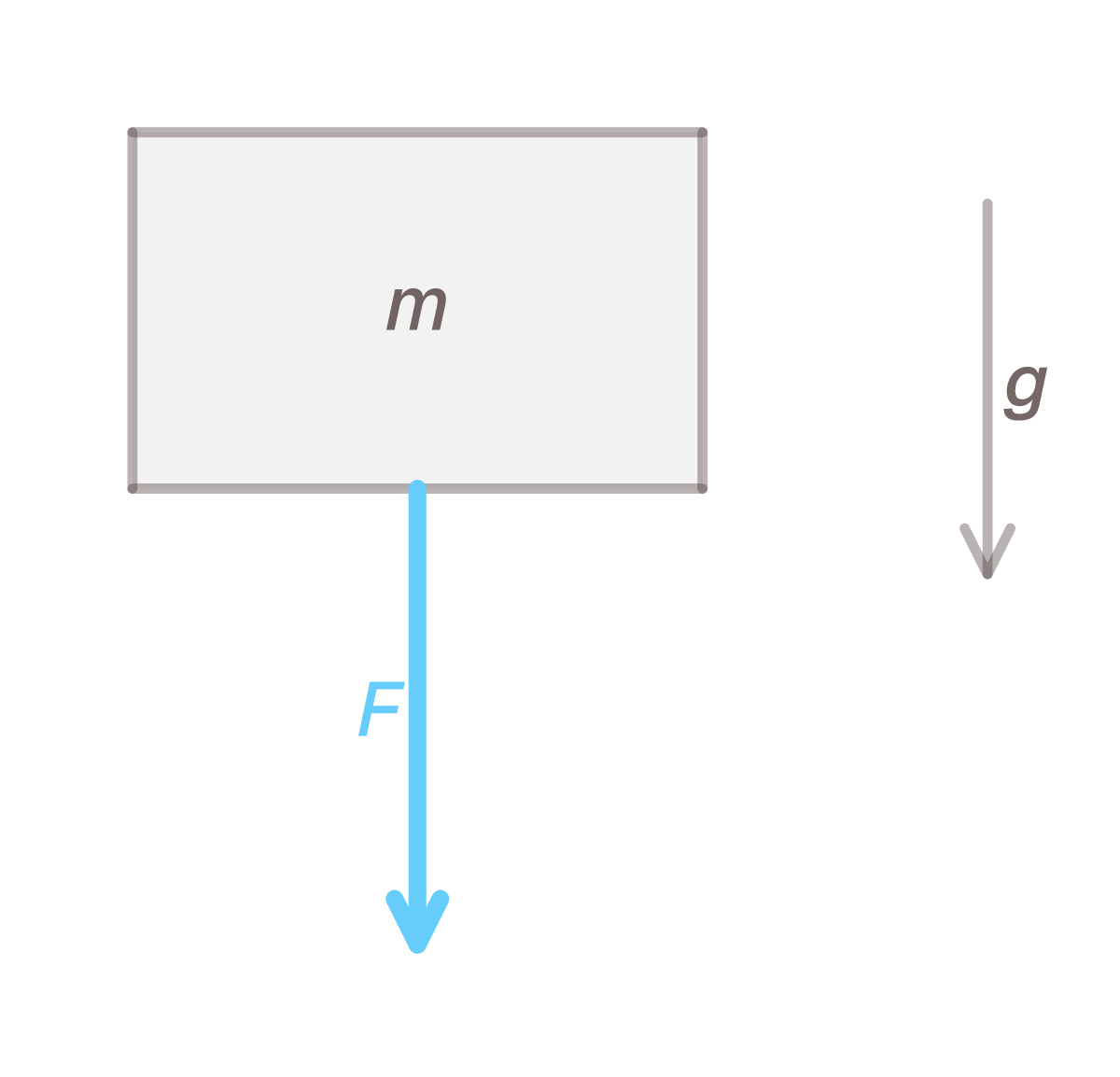
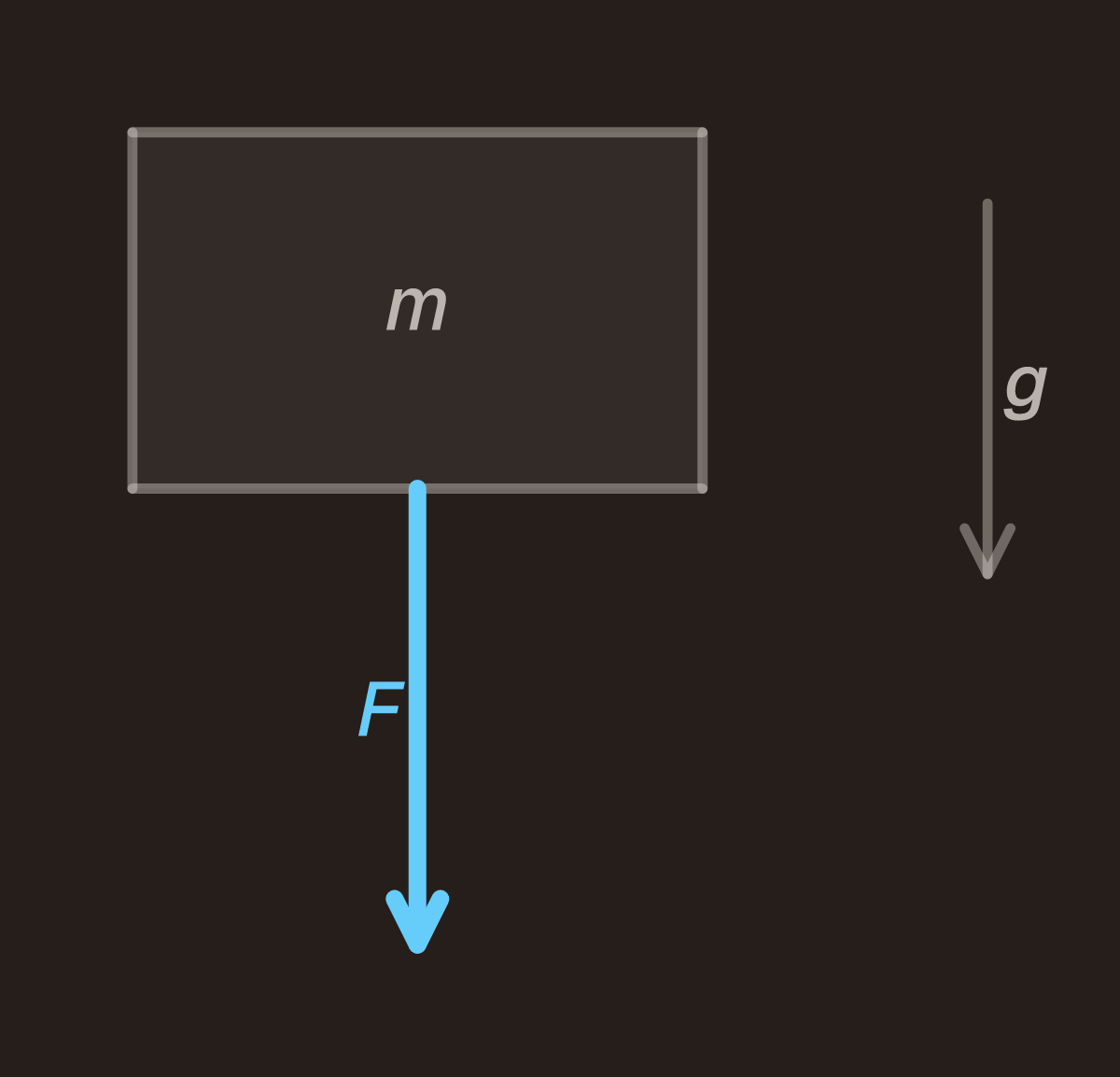
Weight is a force: mass times gravity. The kilograms on a scale are a mass, and the newtons pulling them down are this.
Solve for
F=686.7N
F equals 70 times 9.81, equals 686.7 N
Den här sidan finns på svenska. Byt till svenska
Definition — what does that mean?
The kilograms on a scale are a mass. Weight is a force, and g stands between them.
In Swedish: Tyngdkraft
F
Weight is a force: mass times gravity. The kilograms on a scale are a mass, and the newtons pulling them down are this.
F=686.7N
F equals 70 times 9.81, equals 686.7 N
You are given
Round to 2 decimals.
Questions that start in another formula and end in this one.
A block of metal has a known volume. Look up the metal’s density in the table and work out the block’s mass and weight.
You are given
Carry a rounded answer into the next step if you like. That is marked right too.
Round to 3 decimals.
Opens when step 1 is answered.
m is the mass in kilograms, g the acceleration due to gravity in m/s² and F the weight in newtons.
A 70 kg person has a weight of 70 · 9.81 = 686.7 N.
A 70 kg person has a mass of 70 kg on earth, on the moon and in a space station. Their weight is 687 N on earth and 113 N on the moon. At the height of the space station, about 400 km, g is still about 8.7 m/s² and the weight about 610 N. The astronauts float because they and the station are falling freely together; see orbital velocity.
In everyday speech we say “I weigh 70 kilos”, and it is the mass we mean. A bathroom scale actually measures a force and divides by g before showing the number.
Gravity varies with latitude and altitude. The standard value is 9.81 m/s² (9.80665 exactly, by
convention), and many books round to 9.8. So g is a field you can change on the card above, not a
number baked into the formula.
| Place | g (m/s²) | Weight of 70 kg |
|---|---|---|
| Standard value | 9.81 | 687 N |
| The equator | 9.78 | 685 N |
| The moon | 1.62 | 113 N |
| Mars | 3.72 | 260 N |
A bag of shopping. 12 kg of groceries: 12 · 9.81 ≈ 118 N.
Mass from a force. A force meter reads 245.25 N: m = 245.25 / 9.81 = 25 kg.
On the moon. The same 70 kg with g = 1.62: 70 · 1.62 = 113 N, a sixth of the weight on earth.
The normal force. Something resting on a level floor presses on it with exactly its weight, and that normal force is what friction is worked out from.
Why does a scale show kilograms if it measures a force?
Because it is calibrated for the earth’s gravity and does the division for you. The same scale on the
moon would read about 12 kg for a 70 kg person, because it still divides by the earth’s g.
Is gravity the same thing as an acceleration?
Yes, the same quantity and the same unit. g is the acceleration a freely falling object gets, which
is exactly what free fall works with.
Why does a lift feel heavier as it sets off upwards?
Because the floor then has to give you more than your weight: both hold you up and accelerate you. The
extra force is m·a, and it sits on top of m·g.
| Solve for | Rearranged | With the numbers | Comes to |
|---|---|---|---|
| m | Fg | 686.79.81 | 70 kg |
| g | Fm | 686.770 | 9.81 m/s² |
| F | mg | 70·9.81 | 686.7 N |
Table
| Unit | In kilograms |
|---|---|
| mg | 0.000001 |
| g | 0.001 |
| oz | 0.028349523125 |
| hg | 0.1 |
| lb | 0.45359237 |
| kg | 1 |
| st | 6.35029318 |
| t | 1,000 |
Table
| Quantity | Symbol | Value | Unit | Uncertainty | Exact or measured |
|---|---|---|---|---|---|
| Caesium hyperfine transition frequency | ΔνCs | 9,192,631,770 | Hz | 0 | Exact — defines the SI |
| Speed of light in vacuum | c | 299,792,458 | m/s | 0 | Exact — defines the SI |
| Planck constant | h | 6.62607015 × 10⁻³⁴ | J·s | 0 | Exact — defines the SI |
| Elementary charge | e | 1.602176634 × 10⁻¹⁹ | C | 0 | Exact — defines the SI |
| Boltzmann constant | k | 1.380649 × 10⁻²³ | J/K | 0 | Exact — defines the SI |
| Avogadro constant | Nₐ | 6.02214076 × 10²³ | mol⁻¹ | 0 | Exact — defines the SI |
| Luminous efficacy of 540 THz radiation | Kcd | 683 | lm/W | 0 | Exact — defines the SI |
| Molar gas constant | R | 8.314462618 | J/(mol·K) | 0 | Exact — follows from the definitions |
| Faraday constant | F | 96,485.33212 | C/mol | 0 | Exact — follows from the definitions |
| Stefan–Boltzmann constant | σ | 5.670374419 × 10⁻⁸ | W/(m²·K⁴) | 0 | Exact — follows from the definitions |
| Standard atmosphere | atm | 101,325 | Pa | 0 | Exact — follows from the definitions |
| Standard acceleration of gravity | gₙ | 9.80665 | m/s² | 0 | Exact — agreed value |
| Newtonian constant of gravitation | G | 6.6743 × 10⁻¹¹ | m³/(kg·s²) | 1.5 × 10⁻¹⁵ | Measured |
| Electron mass | mₑ | 9.1093837139 × 10⁻³¹ | kg | 2.8 × 10⁻⁴⁰ | Measured |
| Proton mass | mₚ | 1.67262192595 × 10⁻²⁷ | kg | 5.2 × 10⁻³⁷ | Measured |
| Neutron mass | mₙ | 1.67492750056 × 10⁻²⁷ | kg | 8.5 × 10⁻³⁷ | Measured |
| Unified atomic mass unit | u | 1.66053906892 × 10⁻²⁷ | kg | 5.2 × 10⁻³⁷ | Measured |
| Fine-structure constant | α | 0.0072973525643 | 1 | 1.1 × 10⁻¹² | Measured |
| Rydberg constant | R∞ | 10,973,731.568157 | m⁻¹ | 0.000012 | Measured |
| Bohr radius | a₀ | 5.29177210544 × 10⁻¹¹ | m | 8.2 × 10⁻²¹ | Measured |
| Bohr magneton | μ_B | 9.2740100657 × 10⁻²⁴ | J/T | 2.9 × 10⁻³³ | Measured |
| Vacuum electric permittivity | ε₀ | 8.8541878188 × 10⁻¹² | F/m | 1.4 × 10⁻²¹ | Measured |
| Vacuum magnetic permeability | μ₀ | 0.00000125663706127 | N/A² | 2 × 10⁻¹⁶ | Measured |
Last reviewed October 6, 2026 ·How pages are reviewed
Sheets that ask this formula, with their answer keys. Open one to see the questions or print it.
Seventeen questions on force: F = ma, weight, friction and Hooke's law.
Copy the code into your page where the formula card should appear. It loads from lovetocalc.com, so it stays current on its own — all we ask is that the credit line comes with it.