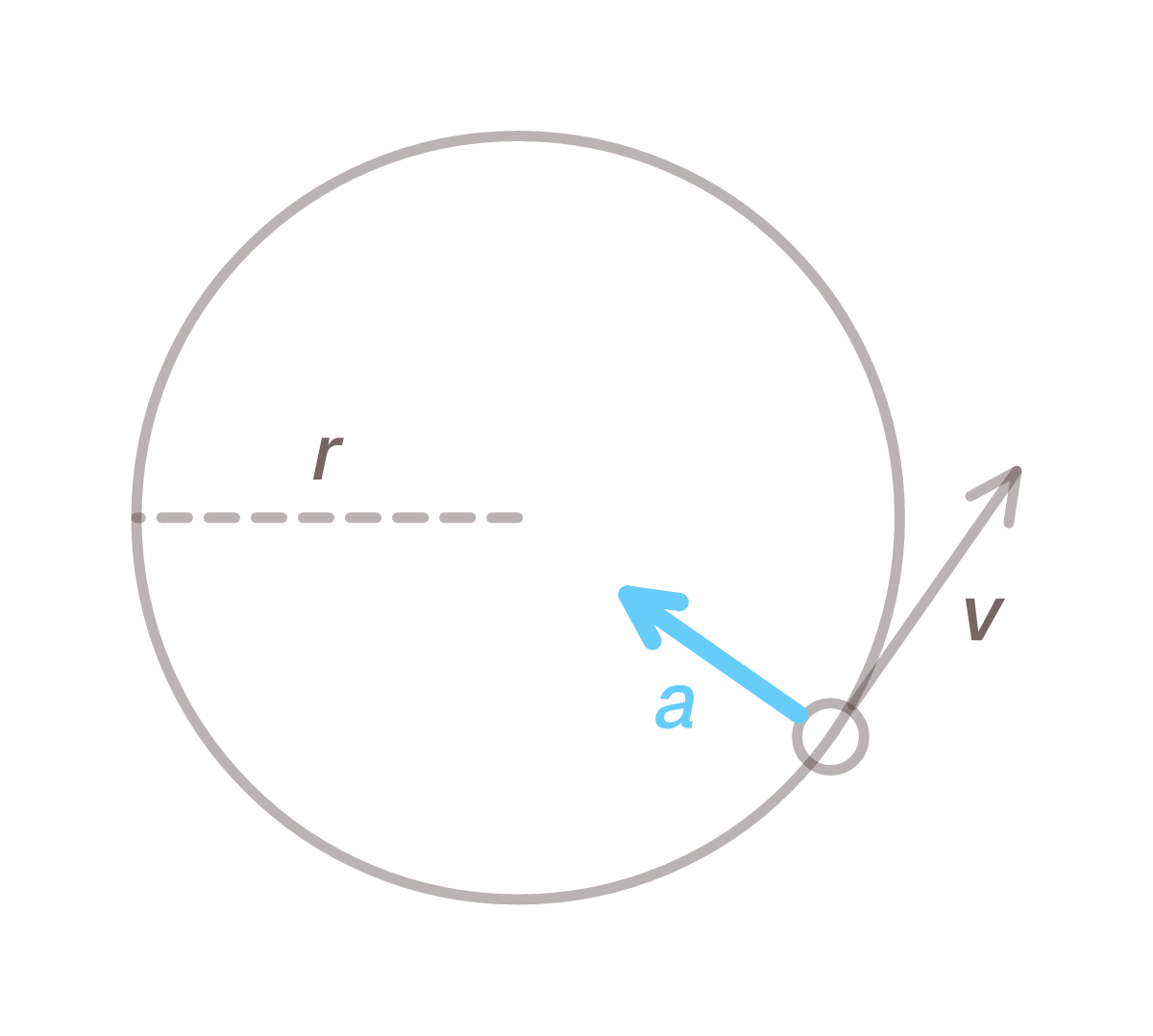
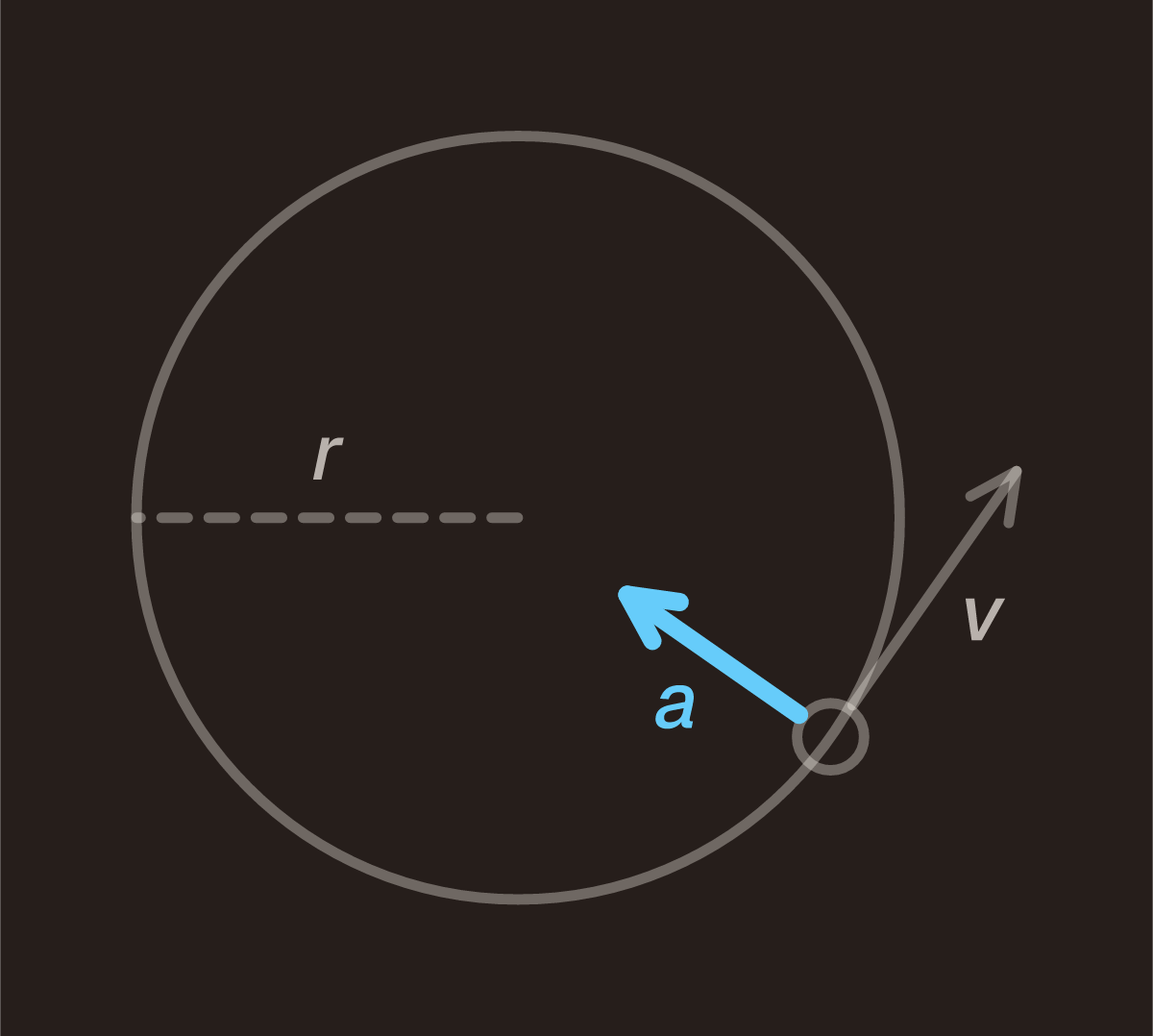
a = v² / r
a is the acceleration in m/s², v the speed in m/s and r the radius of the path in metres. The
acceleration points at the centre of the circle.
Holds for motion along a circular arc at constant speed. If the speed changes, there is an acceleration
along the path as well.
Why it is an acceleration
Acceleration is a change in velocity, and velocity has both a size and a direction. A car taking a curve at
constant speed changes direction all the time, and that change points into the centre of the curve. The
speed is squared, so twice the speed means four times the acceleration.
Worked examples
The defaults. 20 m/s on a curve of radius 50 m: a = 20² / 50 = 400 / 50 = 8 m/s². That is almost as
much as the acceleration of gravity.
A roundabout. 15 m/s, which is 54 km/h, round a roundabout of radius 30 m: a = 225 / 30 = 7.5 m/s².
The top speed on a curve. If the tyres can manage 5 m/s² on a curve of radius 80 m, the top speed is
v = √(5 · 80) = 20 m/s, 72 km/h.
Common mistakes
- Working in km/h. Convert to m/s first by dividing by 3.6.
- Thinking the acceleration points outwards. It points inwards. The feeling of being pushed out is your
body carrying on straight ahead by inertia.
- Forgetting the square. Taking a curve 30 km/h too fast is much more than a small increase.
Frequently asked questions
How does it differ from centripetal force?
The acceleration is what the circular motion demands. The centripetal force is
the force that provides it: the mass times a, by Newton’s second law.
Is there a centrifugal force?
Only as seen by someone riding round the curve. From outside there is only a force inwards, and what
feels like a force outwards is inertia.