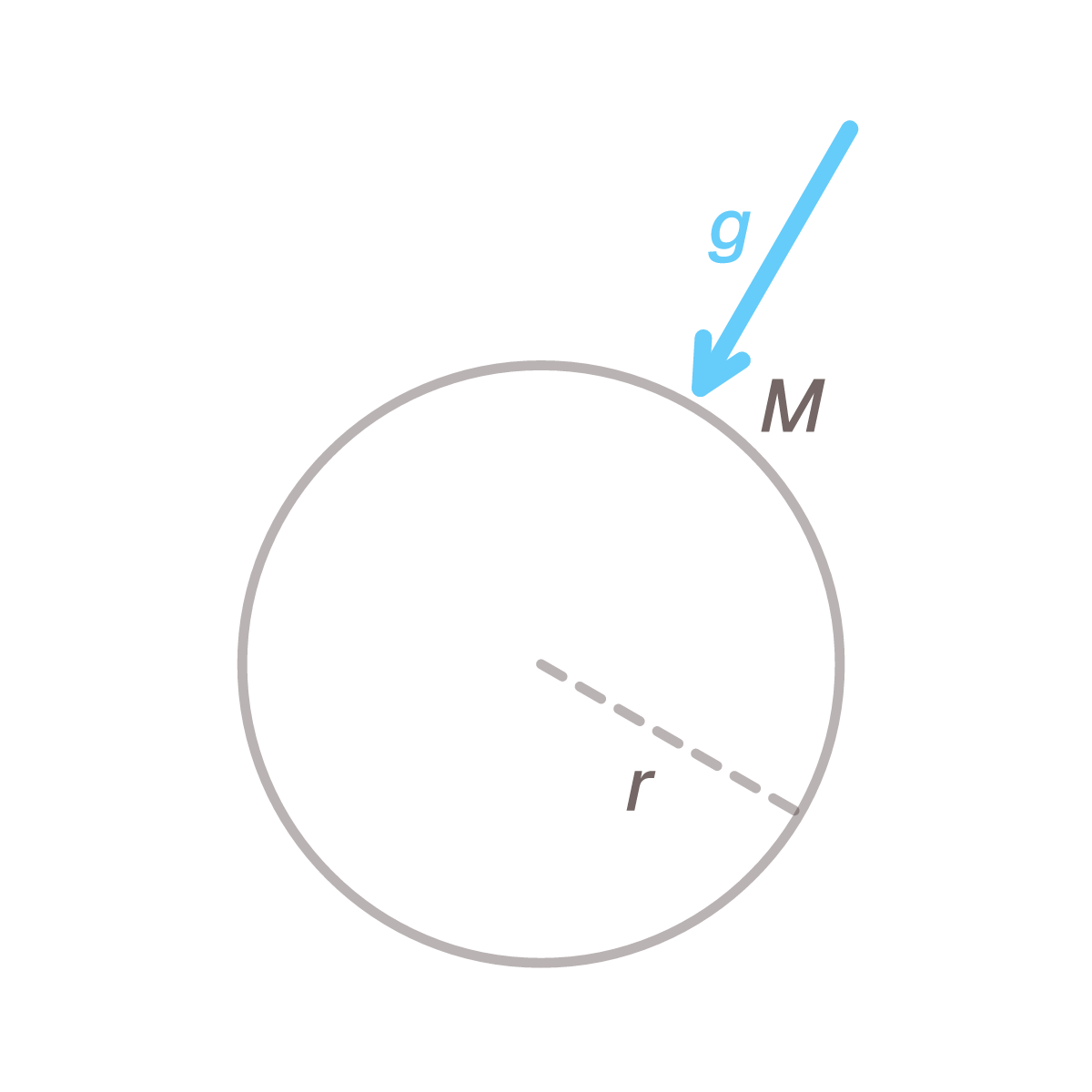
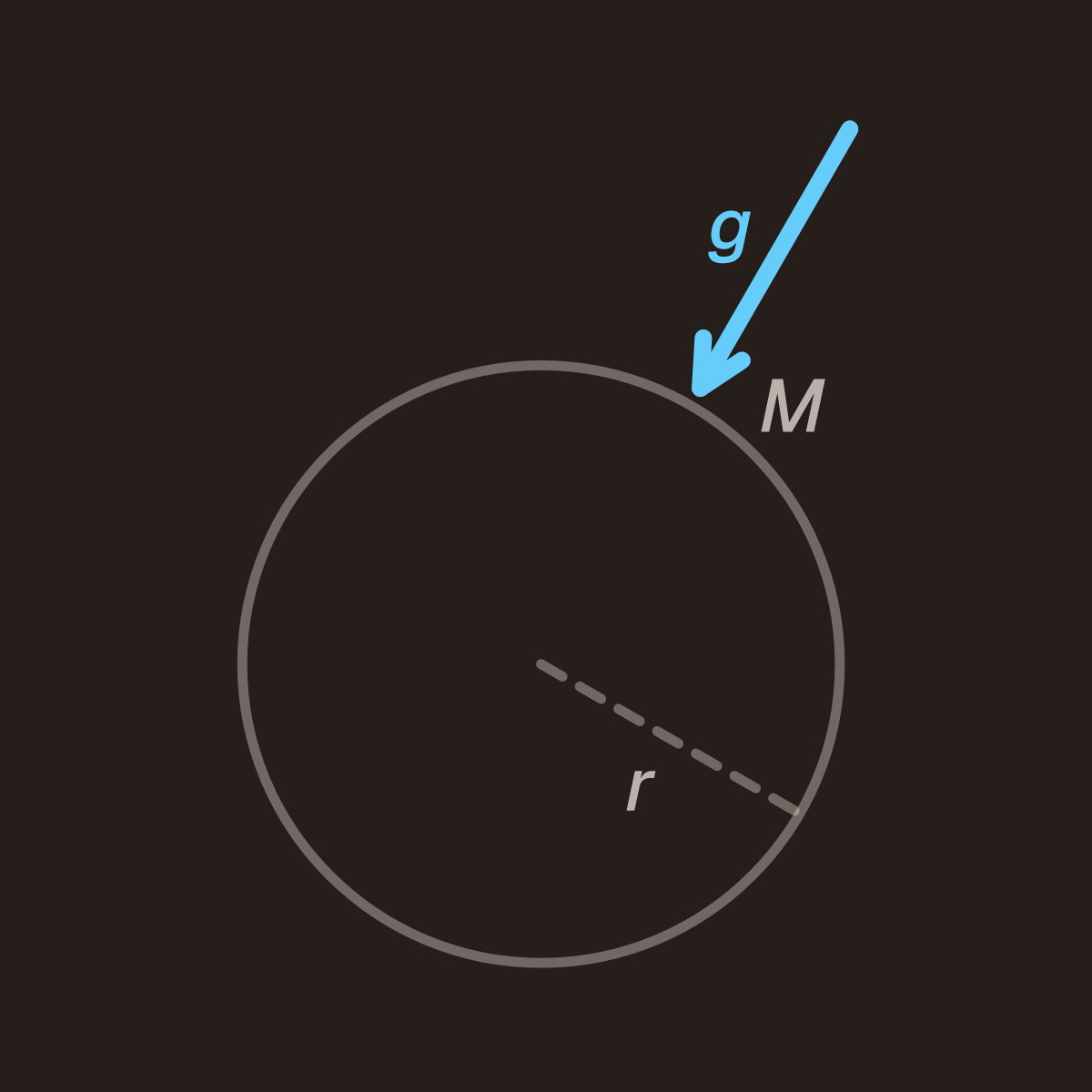
g = G · M / r²
g is the field strength in m/s² (the same as N/kg), G the gravitational constant 6.674 · 10⁻¹¹ N·m²/kg²,
M the mass of the body in kilograms and r the distance to its centre in metres.
Holds outside a spherically symmetric body, with r measured from its centre; the Earth’s rotation and
flattening shift g by a few parts per thousand.
Where it comes from
Newton’s law of gravitation gives the force G · M · m / r² on a mass m. Divide by
m and you get the force per kilogram, which is the field strength. That is why the weight
is m · g.
Worked examples
The Earth. M = 5.972 · 10²⁴ kg and r = 6,371,000 m:
g = 6.674 · 10⁻¹¹ · 5.972 · 10²⁴ / 6,371,000² ≈ 9.82 m/s².
The Moon. M = 7.34 · 10²² kg and r = 1,737,000 m give g ≈ 1.62 m/s², about a sixth.
At space-station height. 400 km up, r = 6,771,000 m and g ≈ 8.7 m/s². Astronauts float not because
gravity is gone but because they are falling around the Earth all the time.
Common mistakes
- Measuring from the surface. r is measured from the centre. At height h above the surface, r is the
Earth’s radius plus h.
- Forgetting the square. Twice the distance gives a quarter of the field strength.
- Keying in the powers of ten wrong. 6.674 · 10⁻¹¹ is 6.674E-11 on most calculators. An answer far from
10 on Earth usually means a dropped exponent.
Frequently asked questions
Why is g about 9.83 at the poles but 9.78 at the equator?
The Earth is slightly flattened, so the equator is further from the centre. And the Earth’s rotation uses
part of gravity to keep you on your circular path. Both effects are largest at the equator.