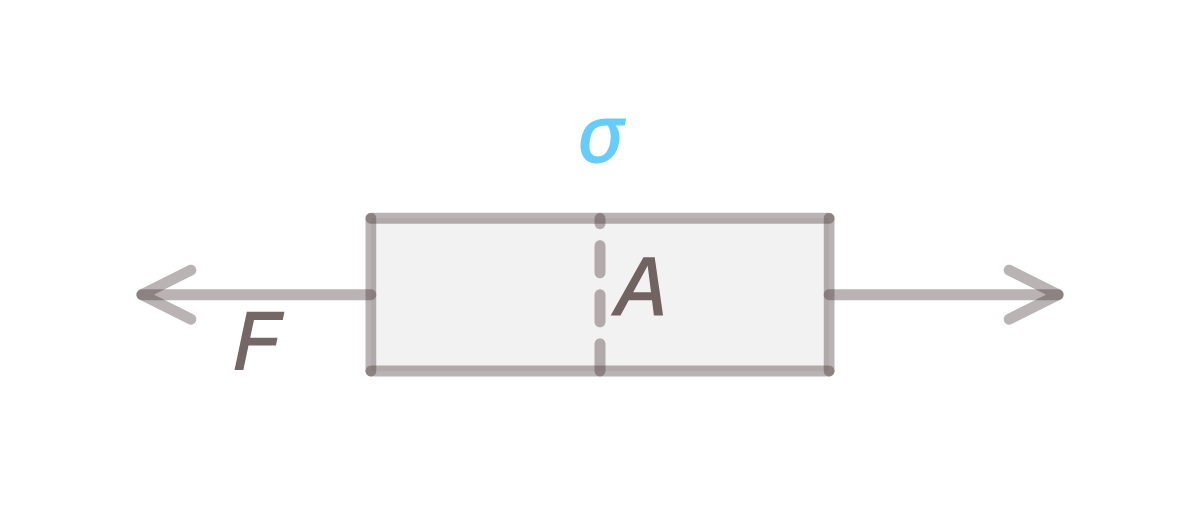
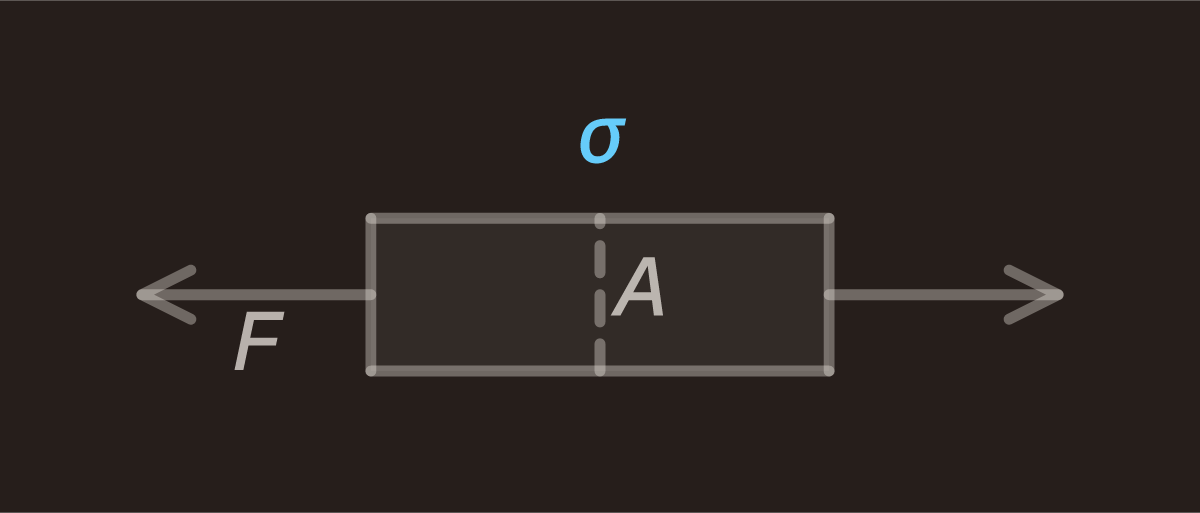
σ = F / A
σ (sigma) is the stress in pascals, F the force in newtons and A the cross-sectional area in square
metres.
A 5,000 N load on a bar 2 cm × 2 cm (A = 0.0004 m²): σ = 5,000 / 0.0004 = 12,500,000 Pa = 12.5 MPa.
Megapascals and N/mm²
Stresses in solids are large numbers of pascals, so engineers use megapascals — and 1 MPa is exactly
1 N/mm². Working in millimetres skips the conversion: 5,000 N / 400 mm² = 12.5 N/mm², the same answer.
A steel rod 10 mm in diameter carrying 10 kN: A = π · 5² ≈ 78.5 mm², so σ = 10,000 / 78.5 ≈ 127 MPa.
Ordinary structural steel starts to yield at a few hundred megapascals, so that rod is working hard but
holding.
Stress and pressure
The formula is the same as for pressure, and so is the unit. The difference is where it acts:
pressure is a fluid pushing on a surface, equally in every direction; stress is inside a solid, and it can
pull (tension) as well as push (compression). The amount a material stretches under it is the
strain, and the ratio of the two is Young’s modulus.
Common mistakes
- Area in cm² or mm² with the force in N, answer read as Pa. Either use m² for Pa, or mm² for MPa.
- The wrong area. It is the cross-section at right angles to the force — the end face of a rod, not its
side.
- Diameter instead of radius in π r².
Questions people ask
Is stress the same everywhere in a part?
Only for a straight bar pulled evenly. At holes, notches and sharp corners it concentrates and can be
several times higher — which is where parts crack.