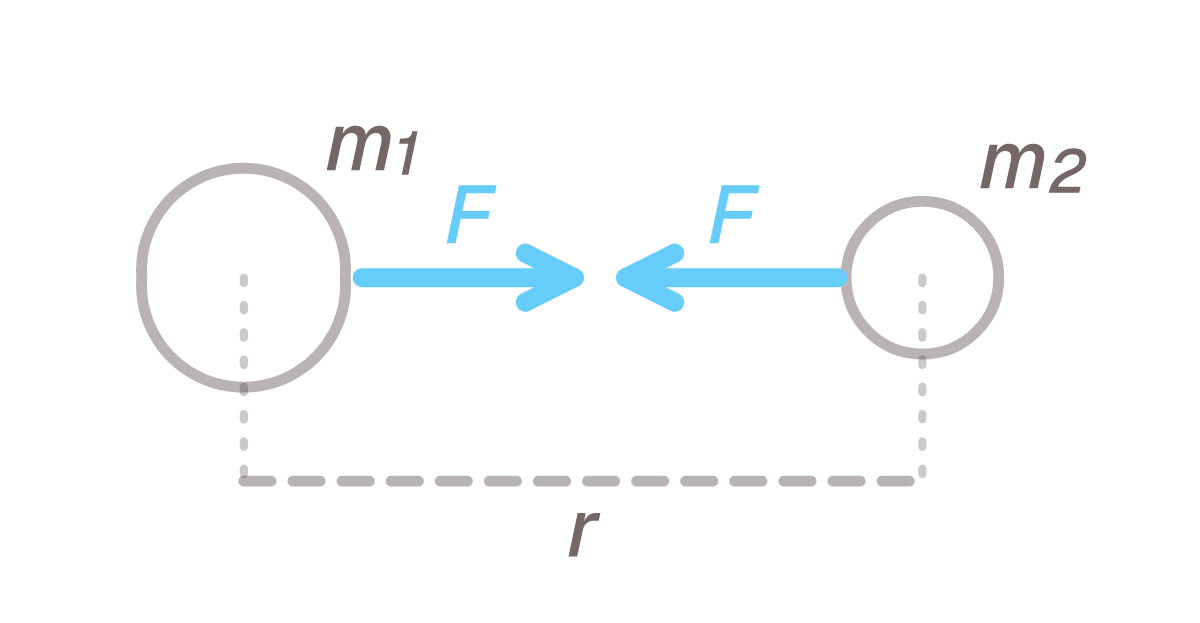
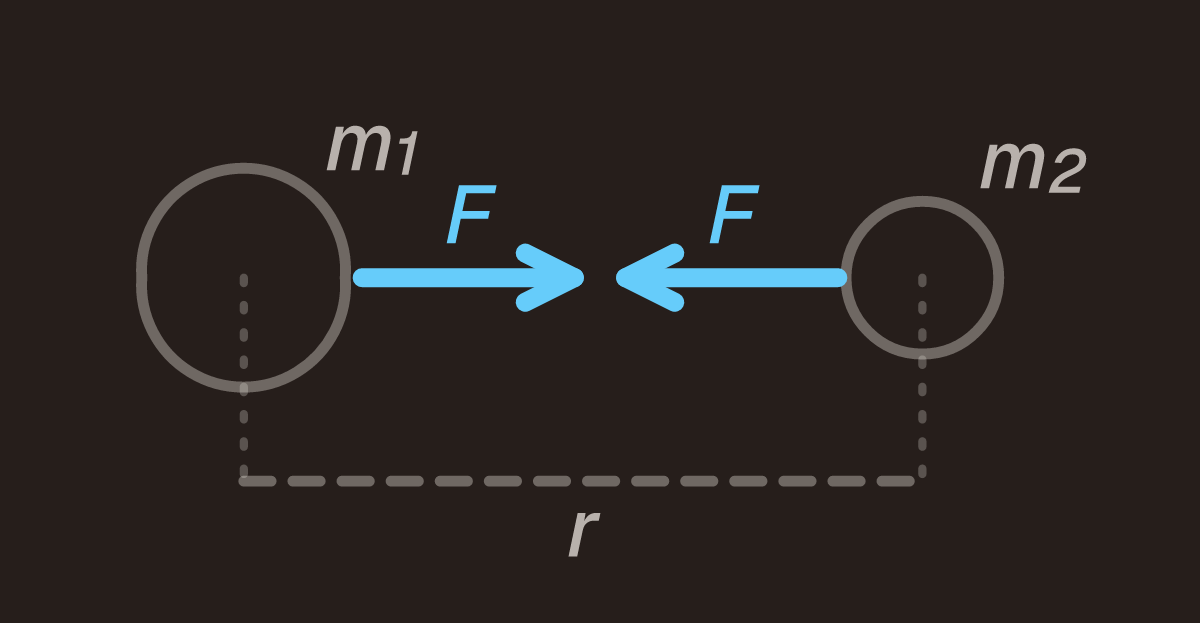
m₁ and m₂ are the two masses in kilograms, r the distance between their centres in metres and G
the gravitational constant. F is the force in newtons, and it is equally large on both bodies.
It is also called Newton’s law of universal gravitation.
Holds for point masses or spherically symmetric bodies, when the field is weak enough that general
relativity is not needed.
| Quantity |
Value |
| G |
6.674 · 10⁻¹¹ N·m²/kg² |
| Mass of the Earth |
5.972 · 10²⁴ kg |
| Radius of the Earth |
6,371,000 m |
G is very small in SI units, so you do not feel the pull between yourself and the
person next to you on the bus. Two people of 70 kg a metre apart attract each other with 3 · 10⁻⁷ N —
about the weight of a speck of dust.
The same answer as mg
Put a 70 kg person at the Earth’s surface:
- F = 6.674 · 10⁻¹¹ · 5.972 · 10²⁴ · 70 / 6,371,000² ≈ 687.4 N
That is what weight gives with g = 9.82, the value G·M/r² takes
at this radius; the standard 9.81 is a rounded average over latitudes. The two
formulas are not two laws but one: g is G·M/r² for the Earth, worked out once and written down as
a number. The simpler formula only holds near the surface, where r barely changes.
The square of the distance
Twice the distance is a quarter of the force. Measured from the Earth’s centre:
| Height above the surface |
Share of surface weight |
| 0 km |
100% |
| 400 km (the space station) |
89% |
| 6,371 km (one Earth radius up) |
25% |
| 35,786 km (geostationary orbit) |
2.3% |
Astronauts on the space station therefore weigh almost as much as on the ground. They float anyway
because they are falling all the time — falling around the Earth
instead of into it.
Worked examples
The Moon and the Earth. 7.34 · 10²² kg at a distance of 384,400,000 m:
F = 6.674 · 10⁻¹¹ · 5.972 · 10²⁴ · 7.34 · 10²² / (3.844 · 10⁸)² ≈ 1.98 · 10²⁰ N.
Gravity on the Moon. With the Moon’s mass of 7.34 · 10²² kg and radius of 1,737,000 m,
g = G·M/r² ≈ 1.62 m/s², a sixth of the Earth’s — hence the bounding in the Apollo footage.
Two people. 70 kg and 70 kg a metre apart: 6.674 · 10⁻¹¹ · 4,900 / 1 ≈ 3.3 · 10⁻⁷ N.
Common mistakes
- Measuring
r from the surface. The distance runs between the centres, so for something on the
ground it is the Earth’s radius, not zero.
- Forgetting to square the distance. The result is wrong by an enormous factor.
- Confusing G with g.
G is a universal constant of 6.674 · 10⁻¹¹; g is about 9.81 m/s² and applies
only to the Earth, only near the surface.
- Thinking weightlessness means no gravity. It means free fall.
Frequently asked questions
Do I pull on the Earth as hard as it pulls on me?
Yes, exactly as hard. The difference is what the force achieves:
Newton’s second law divides force by mass, and
the Earth is 10²³ times heavier.
How is the Earth’s mass known?
From this formula. Measure g and the Earth’s radius, measure G in a laboratory — Cavendish did it
in 1798 with two lead spheres — and the mass follows.
Does the law still hold?
For everything ordinarily calculated, yes. General relativity describes gravity more precisely and is
needed for Mercury’s orbit and for the clocks on GPS satellites, but Newton is enough otherwise.