Skip to content
LoveToCalc

Definition — what does that mean?

Acceleration on a slope with friction

The pull along the slope, less the friction per kilogram.

In Swedish: Acceleration på plan med friktion

Acceleration on a slope with friction

The relation

a=g sin(α)−μg cos(α)

The pull along the slope, g sin α, minus the friction per kilogram, μ g cos α. The mass cancels, so the result depends on the angle and the friction coefficient alone.
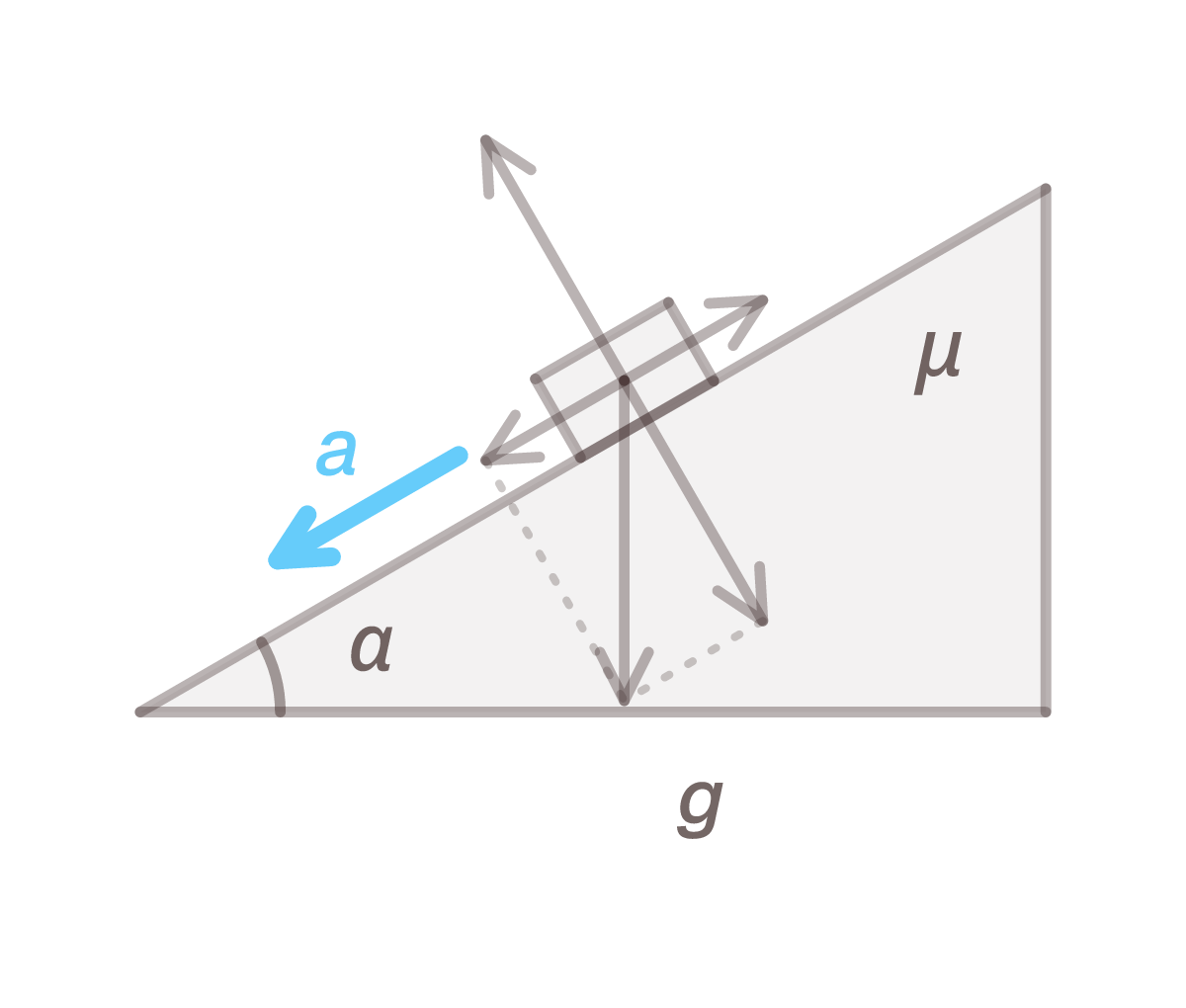
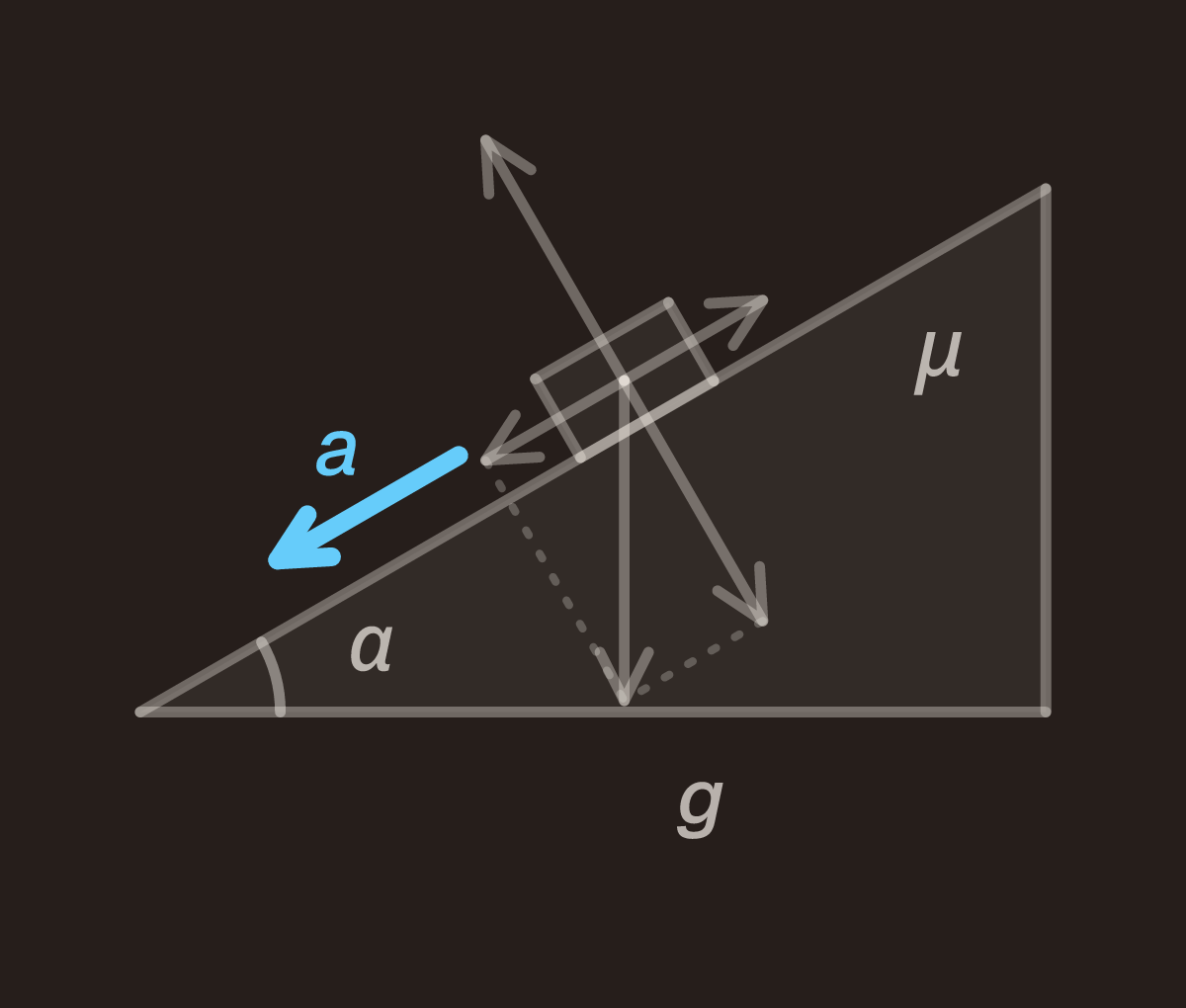
A block on a slope that rises at the angle α to the horizontal. Gravity pulls straight down from the block; its two components are drawn as arrows along the slope and into it, closed by a dashed rectangle, and the normal force pushes out of the slope at a right angle. Friction, with the coefficient μ of the surface, pulls up the slope against the sliding; the arrow beside the slope, pointing down it, is the acceleration a that is left.
Solve for

a≈3.2059m/s²

a equals (9.81 times the sine of (30 degrees)) minus ((0.2 times 9.81) times the cosine of (30 degrees)), is approximately (9.81 times 0.5) minus (1.962 times 0.866), is approximately 4.905 minus 1.6991, is approximately 3.2059 m/s²

Working4 steps

Practice questions

You are given

  • g=9.82m/s²
  • α=55°
  • μ=0.2

Round to 2 decimals.

The formula

a = g · sin α − μ · g · cos α

g is the acceleration due to gravity, α the slope angle, μ the coefficient of friction and a the acceleration down the slope in m/s². The first term is the pull along the slope per kilogram; the second is the friction μFₙ per kilogram, using the normal force m·g·cos α.

Holds for a block that is sliding down. The mass cancels.

Worked examples

The defaults. α = 30° and μ = 0.2: a = 9.81 · (0.5 − 0.2 · 0.866) ≈ 3.21 m/s².

A steeper slope. α = 40° and μ = 0.25: a = 9.81 · (0.643 − 0.25 · 0.766) ≈ 4.43 m/s².

When it stays put. α = 10° and μ = 0.3: the bracket is negative, 0.174 − 0.295. The block does not slide at all, and the real acceleration is 0. It slides only if tan α is above μ.

Common mistakes

Frequently asked questions

How do I find μ from an experiment? Tilt the plane until the block just slides: then μ = tan α.

Looking for another letter? The formula solved for each one
Solved for each letter
Solve forRearrangedWith the numbersComes to
gasin(α)−μ cos(α)3.2059sin(30°)−0.2 cos(30°)9.81 m/s²
μg sin(α)−ag cos(α)9.81 sin(30°)−3.20599.81 cos(30°)0.2
ag sin(α)−μg cos(α)9.81 sin(30°)−0.2·9.81 cos(30°)3.2059 m/s²

Last reviewed October 13, 2026 ·How pages are reviewed

MechanicsAll formulas

Put this formula on your site

Copy the code into your page where the formula card should appear. It loads from lovetocalc.com, so it stays current on its own — all we ask is that the credit line comes with it.