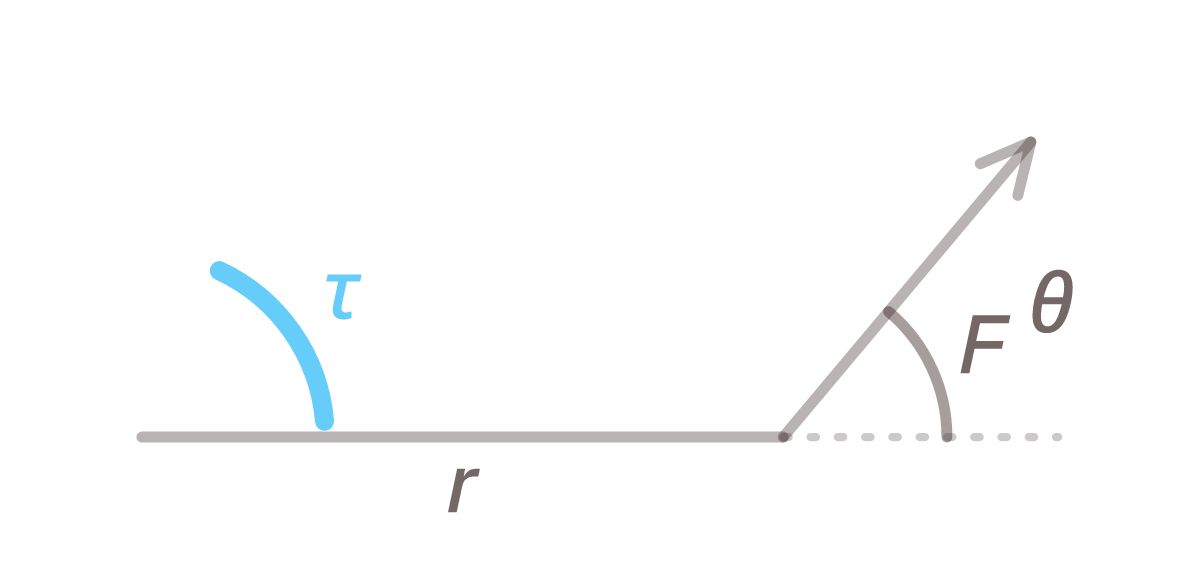
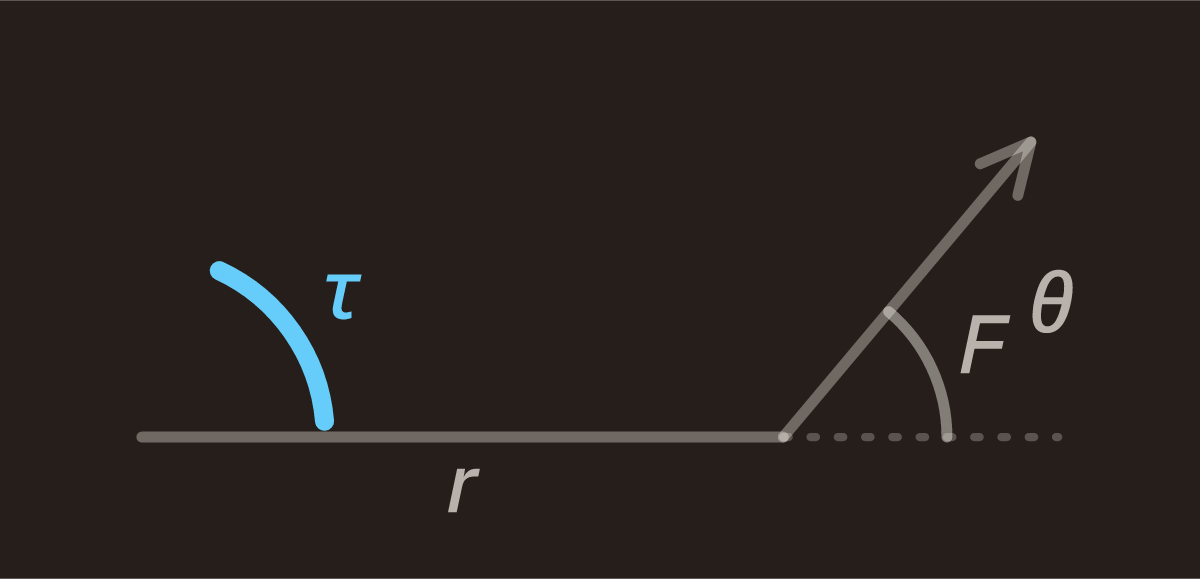
τ = r · F · sin θ
τ (tau) is the torque in newton-metres, r the distance from the axis to where the force acts, F the
force in newtons and θ the angle between the lever and the force.
Torque is also called the moment of force.
A 200 N push, 0.5 m from the axis, at 30° to the lever: τ = 0.5 · 200 · sin 30° = 0.5 · 200 · 0.5 =
50 N·m.
The angle decides how much of the force counts
Only the part of the force at right angles to the lever turns anything. Pushing straight along the lever,
at 0°, pulls on the axle and turns nothing.
| Angle |
sin θ |
Torque with r = 0.5 m, F = 200 N |
| 0° |
0 |
0 N·m |
| 30° |
0.5 |
50 N·m |
| 90° |
1 |
100 N·m |
| 150° |
0.5 |
50 N·m |
At 90° the formula becomes the plain moment of a force, M = F · l, that school
physics starts with.
Why a longer wrench helps
A wheel nut to be tightened to 40 N·m with a 0.25 m wrench needs F = 40 / 0.25 = 160 N at right angles.
A wrench twice as long halves the force. The same reason puts a door handle as far from the hinges as it
will go: push near the hinge and the door barely moves.
Common mistakes
- Measuring r to the wrong point. It runs from the axis to where the force is applied, not to the end
of the object.
- Calculator in radians. sin 30 in radians is −0.99; set it to degrees.
- Confusing N·m of torque with joules. Same units, different things: torque does not need anything to
move.
Questions people ask
What does torque do to a rotating body?
It gives it an angular acceleration, by Newton’s second law for rotation:
τ = I · α.
Why is the engine’s torque quoted on car spec sheets?
Because it is what turns the wheels. Power is torque times angular speed, so an engine’s torque curve
shows where it pulls hardest.