Pressure
The relation
p
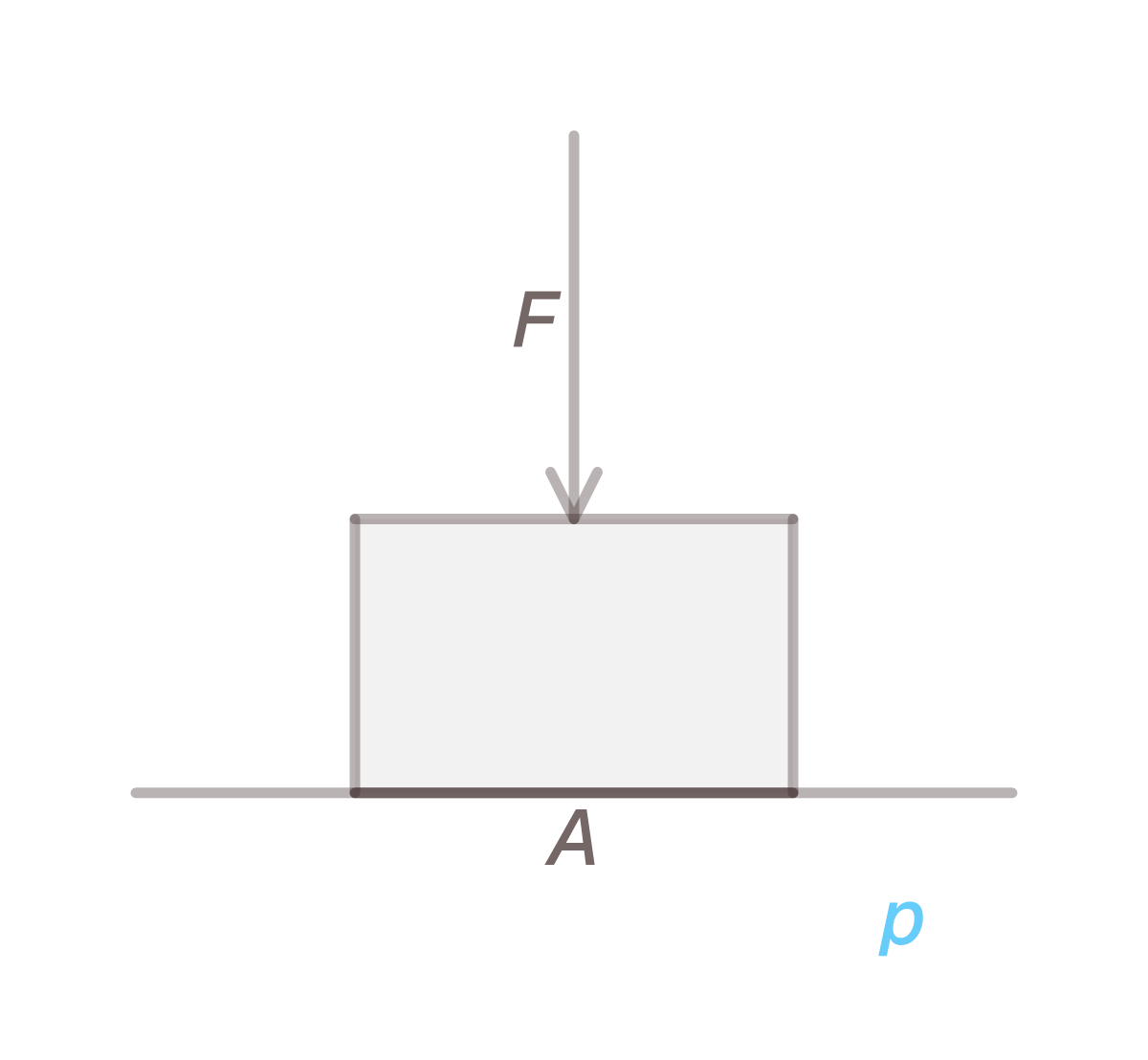
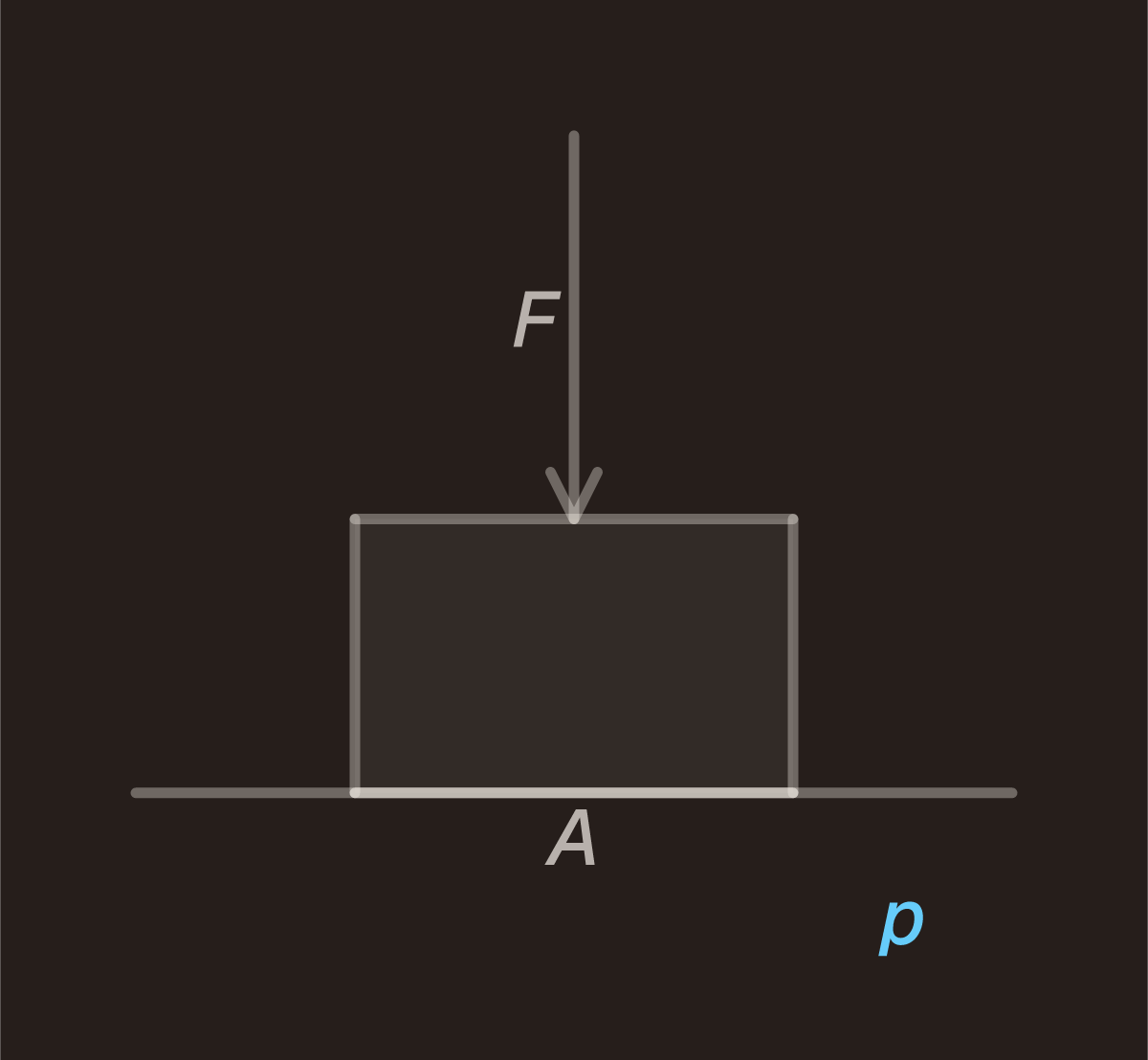
Force divided by the area it is spread over. The same push through a pin point and through a palm are not the same pressure.
Solve for
p=25,000Pa
p equals 500 divided by 0.02, equals 25,000 Pa
Den här sidan finns på svenska. Byt till svenska
Definition — what does that mean?
The same force through a pin point and through a palm is not the same pressure.
In Swedish: Tryck
p
Force divided by the area it is spread over. The same push through a pin point and through a palm are not the same pressure.
p=25,000Pa
p equals 500 divided by 0.02, equals 25,000 Pa
You are given
Round to 2 decimals.
F is the force in newtons, A the area in square metres and p the pressure in pascals. 500 N spread
over 0.02 m² gives 500 / 0.02 = 25,000 Pa.
1 Pa is 1 N spread over 1 m² — a very small pressure. So everyday pressures are counted in kilopascals, or in units that are more convenient:
| Unit | In pascals | Example |
|---|---|---|
| 1 Pa | 1 | A sheet of paper on a table |
| 1 kPa | 1,000 | The water pressure 10 cm below the surface |
| 1 bar | 100,000 | Roughly atmospheric pressure |
| 1 atm | 101,325 | Standard pressure at sea level |
| 1 mmHg | 133 | Blood pressure is measured in these |
A car tyre is inflated to about 2.5 bar, that is 250,000 Pa above atmospheric pressure.
The force can be the same while the pressure differs a millionfold. A hand pressing with 50 N over 100 cm² gives 50 / 0.01 = 5,000 Pa. The same 50 N through a pin point of 0.01 mm² gives 50 / 0.00000001 = 5 billion pascals, which is why the pin goes into the wall and the hand does not.
The same reasoning the other way explains snowshoes, tracked vehicles and why you crawl on thin ice: the force is your weight and you cannot change it, but the area you can.
Under a ski. A 70 kg person weighs 687 N. On two skis totalling 0.3 m² the pressure is 687 / 0.3 ≈ 2,290 Pa. On two shoe soles, 0.04 m², it is 687 / 0.04 ≈ 17,200 Pa — seven and a half times as much, and the difference between standing on the snow and sinking into it.
Force on a surface. Atmospheric pressure of 101,325 Pa on a window 1 m × 1.5 m gives 101,325 · 1.5 ≈ 152,000 N. The glass holds because the same pressure acts on the other side.
What area is needed? A load of 8,000 N must not exceed 200,000 Pa on the floor: A = 8,000 / 200,000 = 0.04 m² at least.
Why does pressure rise underwater?
Because the water above has weight. The pressure grows by about 1 bar every 10 metres, so at 30 metres
it is 4 bar counting the air on top.
What is the difference between pressure and force?
Force is how hard something pushes; pressure is how hard it pushes per square metre. The same force
can give any pressure at all depending on the area.
Why is blood pressure measured in mmHg?
For historical reasons: the first gauges were columns of mercury, and the number is how many
millimetres the column rose. 120 mmHg is about 16,000 Pa.
| Solve for | Rearranged | With the numbers | Comes to |
|---|---|---|---|
| F | pA | 25,000·0.02 | 500 N |
| A | Fp | 50025,000 | 0.02 m² |
| p | FA | 5000.02 | 25,000 Pa |
Last reviewed October 6, 2026 ·How pages are reviewed
Sheets that ask this formula, with their answer keys. Open one to see the questions or print it.
Eight questions on density and eight on pressure. Each is one quantity divided by another, and in both the one asked for changes. Calculator allowed.
Copy the code into your page where the formula card should appear. It loads from lovetocalc.com, so it stays current on its own — all we ask is that the credit line comes with it.