Skip to content
LoveToCalc

Definition — what does that mean?

Poiseuille's law

How much fluid a narrow pipe lets through for a given pressure difference — and why a slightly narrower pipe lets through far less.

In Swedish: Poiseuilles lag

Poiseuille's law

The relation

Q=πΔpr48μL

The flow rate through a narrow pipe under smooth, laminar flow: proportional to the pressure drop and to the radius to the fourth power, and inversely proportional to the viscosity and the length.

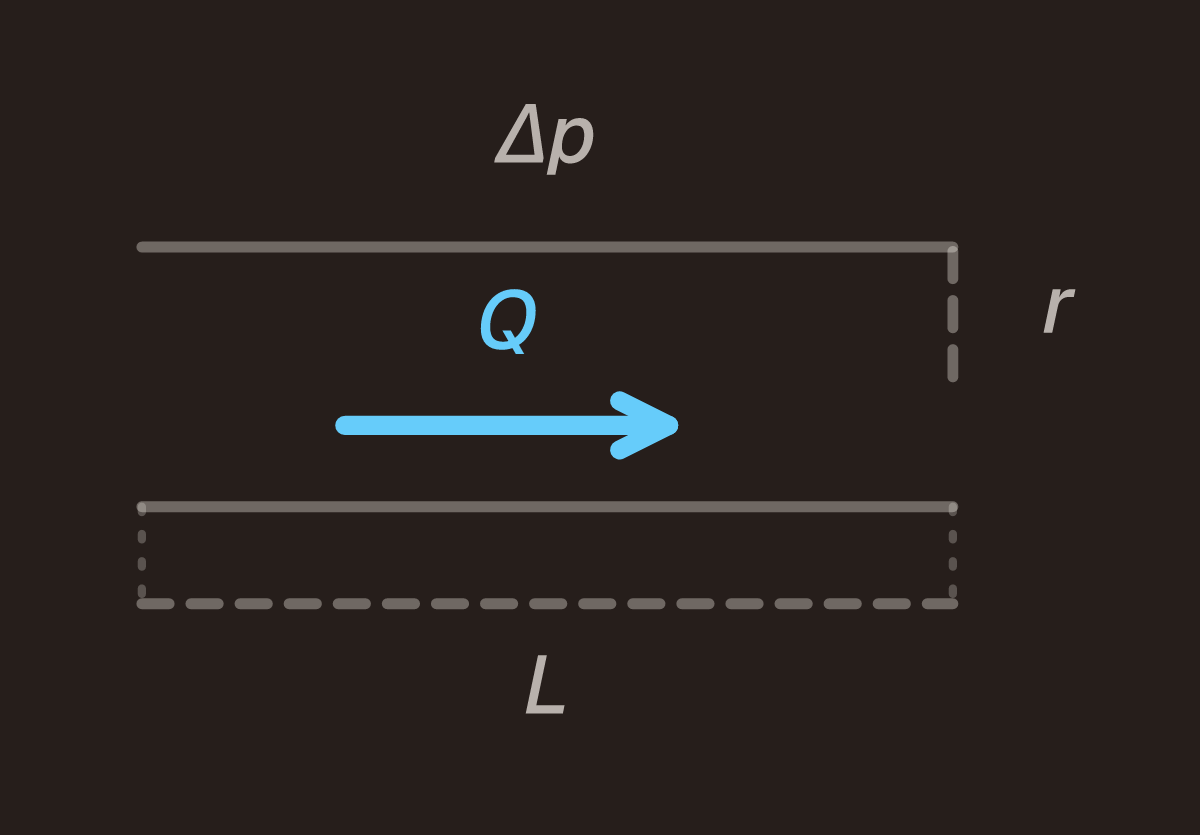
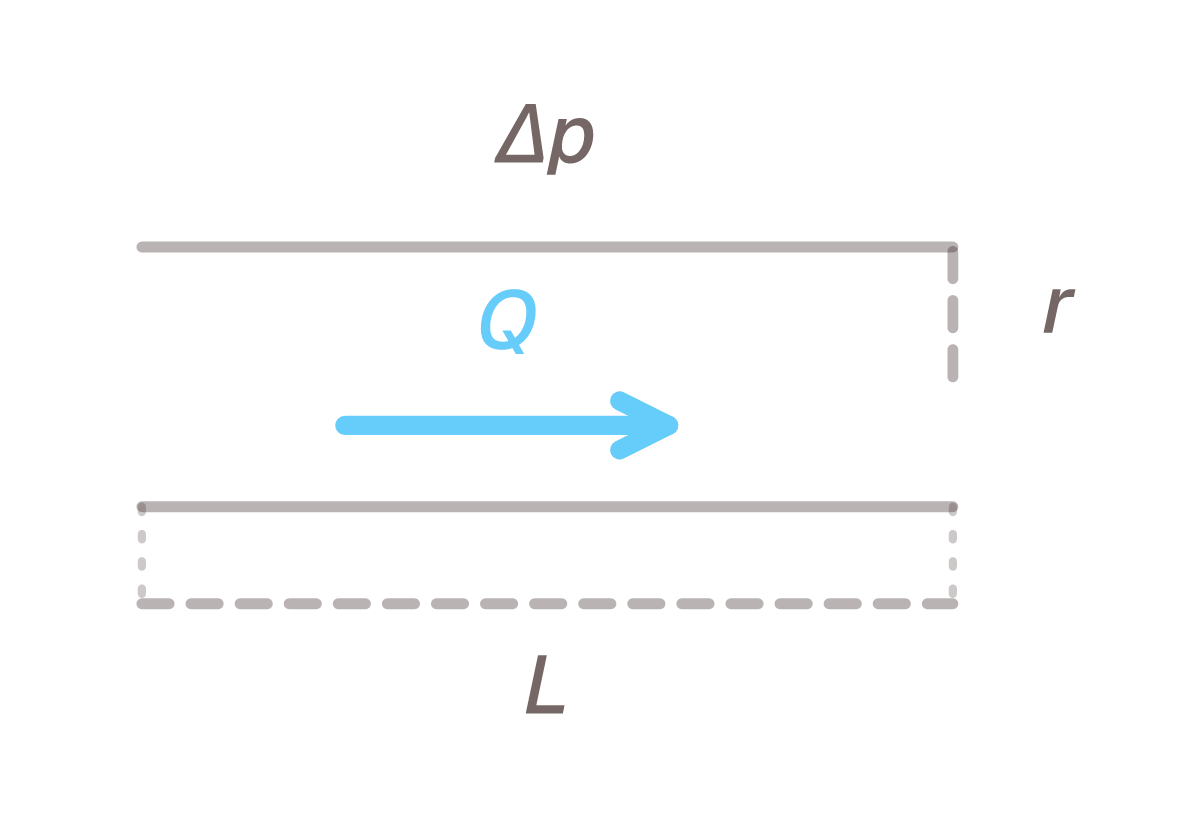
A long straight pipe with liquid flowing to the right. Its length L is marked below, its radius r is drawn at the right-hand end from the centre to the wall, and the arrow is the flow Q. Δp marks the pressure drop between the two ends.
Solve for

Q≈2.454 × 10⁻⁶m³/s

Q equals (π times (10 times 0.005 to the power of 4)) divided by (8 times (0.001 times 1)), equals (π times (10 times 6.25 times 10 to the power of minus 10)) divided by (8 times 0.001), equals (π times 6.25 times 10 to the power of minus 9) divided by 0.008, is approximately 1.963 times 10 to the power of minus 8 divided by 0.008, is approximately 2.454 times 10 to the power of minus 6 m³/s

Working5 steps

Practice questions

You are given

  • Δp=5000Pa
  • r=0.008m
  • μ=0.001Pa·s
  • L=1m

Round to 5 decimals.

The formula

Q = π · Δp · r⁴ / (8 · μ · L)

Q is the flow rate in m³/s, Δp the pressure difference between the ends, r the inner radius, μ the dynamic viscosity and L the length of the pipe.

It is also called the Hagen–Poiseuille equation.

Holds for laminar flow in a long, straight pipe of round cross-section, for a fluid whose viscosity does not depend on the speed.

Water (μ = 0.001 Pa·s) through a 1 m pipe with radius 5 mm, driven by 10 Pa: Q = π · 10 · 0.005⁴ / (8 · 0.001 · 1) ≈ 2.45 · 10⁻⁶ m³/s = 2.45 ml a second.

The fourth power

Double the radius and the flow grows sixteen times. The reason is twofold: a wider pipe has more area to flow through, and more of its fluid is far from the walls, where friction holds it back.

It works the other way too. Narrowing a pipe’s radius by just 16% halves the flow — which is why a partly blocked blood vessel matters so much, and why the body regulates blood flow by adjusting the width of small arteries.

Only for laminar flow

The law assumes the fluid slides in smooth layers. Check it with the Reynolds number: in the example the mean speed is Q / (π r²) ≈ 0.031 m/s, so Re = 1,000 · 0.031 · 0.01 / 0.001 ≈ 310 — comfortably laminar. At Re above a couple of thousand, the flow turns turbulent and Poiseuille’s law overestimates it badly.

Common mistakes

Questions people ask

How does it relate to Ohm’s law? Very closely: pressure difference drives the flow like voltage drives a current, and 8μL / (π r⁴) plays the part of resistance.
Looking for another letter? The formula solved for each one
Solved for each letter
Solve forRearrangedWith the numbersComes to
Δp8μLQπr48·0.001·1·2.454 × 10⁻⁶π·0.005410 Pa
μπΔpr48LQπ·10·0.00548·1·2.454 × 10⁻⁶0.001 Pa·s
LπΔpr48μQπ·10·0.00548·0.001·2.454 × 10⁻⁶1 m
r48μLQπΔp48·0.001·1·2.454 × 10⁻⁶π·100.005 m
QπΔpr48μLπ·10·0.00548·0.001·12.454 × 10⁻⁶ m³/s

Last reviewed October 6, 2026 ·How pages are reviewed

MechanicsAll formulas

Put this formula on your site

Copy the code into your page where the formula card should appear. It loads from lovetocalc.com, so it stays current on its own — all we ask is that the credit line comes with it.