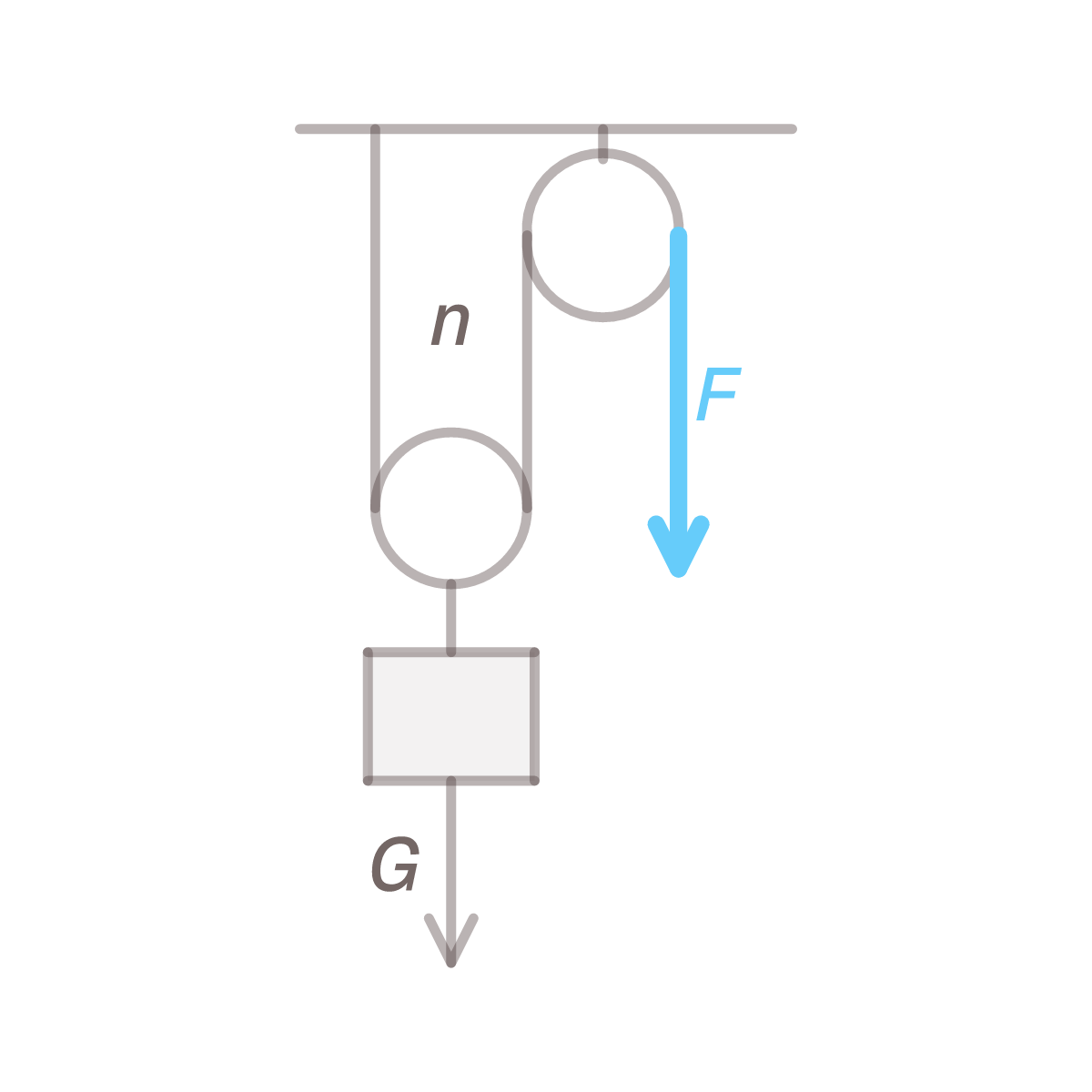
G is the weight of the load in newtons, n the number of rope sections supporting it and F the
pulling force in newtons. A 750 N load hanging from three supporting sections needs 750 / 3 = 250 N.
Many English books write the load as W; the letter here is G.
Holds when the pulley system is ideal: frictionless pulleys and a rope that is weightless and does not
stretch. A real block and tackle needs somewhat more than G/n.
Counting the sections
n is the number of rope sections that run to the moving pulley, the one the load hangs from. It is
not the number of wheels, and not always the total number of rope sections.
- A single fixed pulley in the ceiling: n = 1. The force equals the load; the pulley only changes its
direction.
- One moving pulley, the rope tied to the ceiling and pulled upwards: n = 2.
- The free end counts only if it leaves from the moving pulley. If it comes down from a fixed pulley
in the ceiling, it carries none of the load.
Less force, more distance
A pulley saves force, not work. To raise the load 1 m each of the three sections has to shorten by 1 m,
so you pull in 3 m of rope. The work is the same:
|
Force |
Distance |
Work |
| Lifting directly |
750 N |
1 m |
750 J |
| With pulleys, n = 3 |
250 N |
3 m |
750 J |
It is the trade a lever makes, see moment of a force,
and the same work either way.
Worked examples
An engine out of a car. A 120 kg engine weighs 120 · 9.81 = 1,177.2 N. With four supporting sections
it takes 1,177.2 / 4 ≈ 294.3 N — about like lifting 30 kg.
How many sections? You can pull 200 N and the load weighs 900 N: n = 900 / 200 = 4.5. Sections come
whole, so it takes 5 supporting sections.
Common mistakes
- Counting wheels instead of sections. Two wheels can give two or three supporting sections
depending on how the rope runs.
- Counting the free end when it comes down. It carries none of the load.
- Forgetting the rope. The force is divided by n, and the distance you pull is multiplied by n.
- Mass instead of weight. With F in newtons, G has to be in newtons too: m·g.
Frequently asked questions
Why does a real pulley system need more force?
Friction in the pulley axles and the weight of the rope take part of the force. The ratio of the ideal
force to the real one is the system’s efficiency.
What use is a fixed pulley if the force stays the same?
It changes the direction. Pulling down with your own weight behind you is easier than lifting up, even
with the same force.