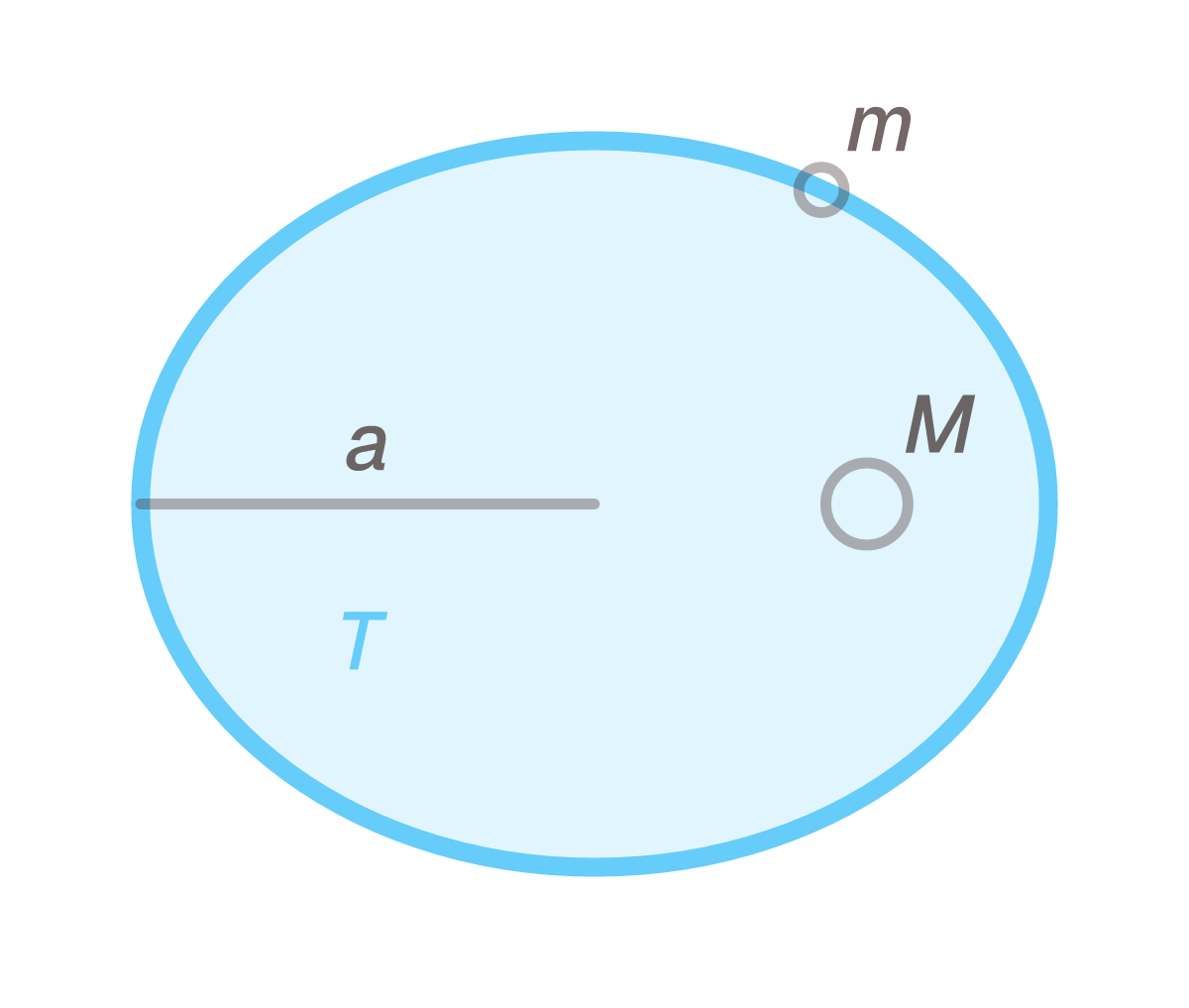
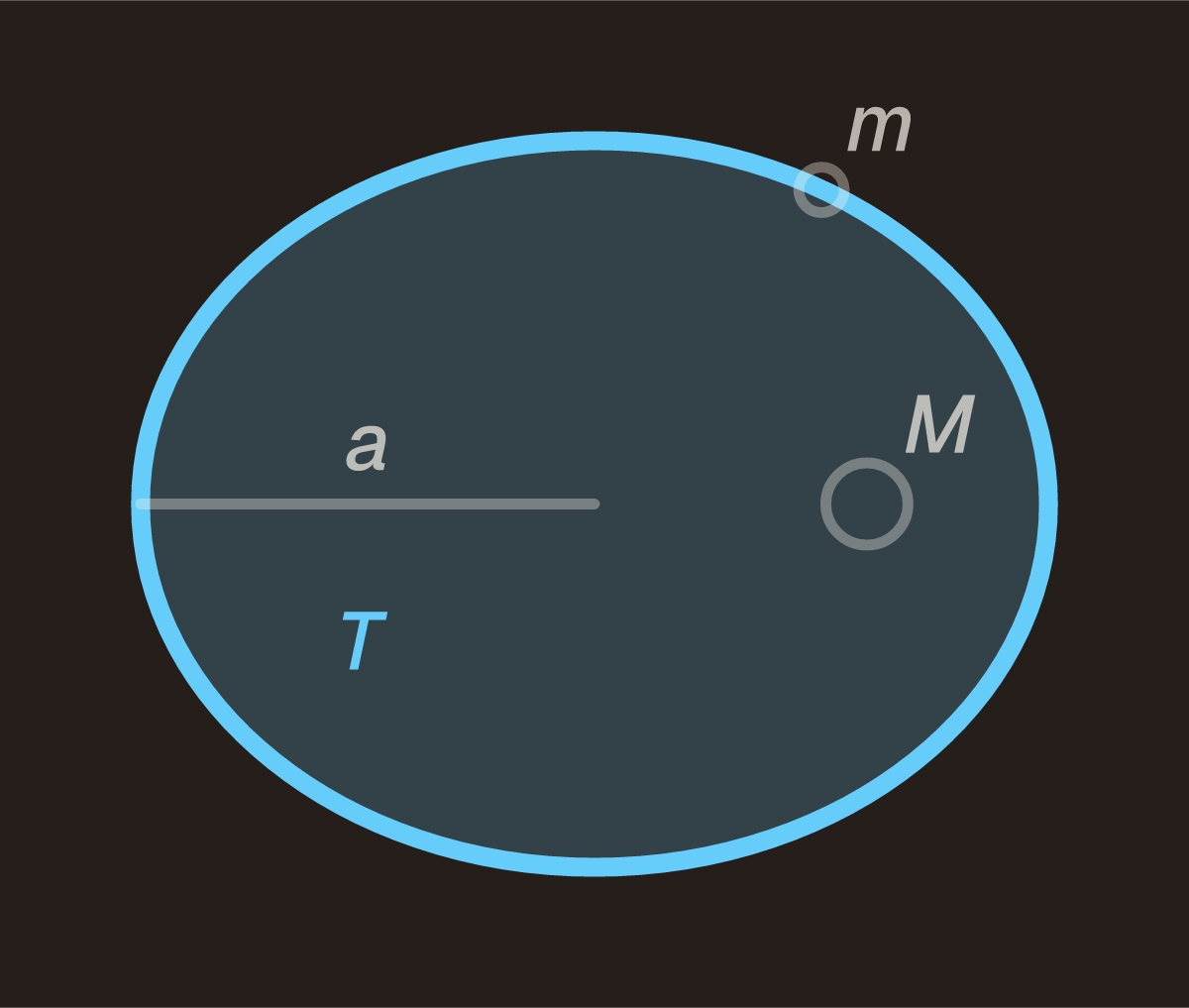
T² = 4π² · a³ / (G · (M + m))
T is the orbital period in seconds, a the semi-major axis of the orbit in metres — on a circle, the
distance between the two bodies — G the gravitational constant, 6.6743 · 10⁻¹¹ N·m²/kg², and M and
m the two masses in kilograms. Solved for the period: T = 2π · √(a³ / (G · (M + m))).
Holds when only the two bodies’ mutual gravity acts and both can be treated as points or spheres; a is
the distance between them, measured centre to centre.
The Earth and the Moon. From NASA’s planetary fact sheet, M = 5.97 · 10²⁴ kg, m = 7.3 · 10²² kg and
a = 0.384 · 10⁹ m:
T = 2π · √((0.384 · 10⁹)³ / (6.6743 · 10⁻¹¹ · (5.97 · 10²⁴ + 7.3 · 10²²))) ≈ 2.354 · 10⁶ s ≈
27.25 days.
Where it comes from
Both bodies circle their common centre of mass, the heavier one on a small circle and the lighter on a
large one. Gravity G·M·m/a² supplies the centripetal force for each. Writing that for both bodies and
adding the two equations removes the centre of mass, and what remains is
G · (M + m) = 4π² · a³ / T². With m dropped, it is the one-body
Kepler’s third law.
When the smaller mass matters
Leaving out m makes the period a little too long. For the Moon:
|
Period |
| With M + m |
27.25 days |
| With M alone |
27.41 days |
| Measured sidereal month (fact sheet) |
27.3 days |
The Moon is 1.2% of the Earth’s mass, and the period changes by half that, about 0.6%. For the planets
the effect is far smaller:
| Pair |
m / M |
Change in T |
| Earth and Moon |
1.2% |
about 0.6% |
| Sun and Jupiter |
0.1% |
about 0.05% |
| Sun and Earth |
0.0003% |
negligible |
Jupiter’s period comes out as 4,334.0 days with both masses and 4,336.1 days with the Sun’s alone, against
the fact sheet’s 4,331 — within the rounding of the distance used. For a double star, where the two
masses are similar, the sum is what a measurement returns: T and a give M + m, which is how the masses
of stars are weighed.
Common mistakes
- Using only the larger mass. Correct to within m/M, which is fine for planets round the Sun and off
by more than half a percent for the Moon.
- Measuring a from the centre of the large body to the centre of mass. a is the full distance between
the two bodies.
- Days and kilometres. G is in SI units, so T comes out in seconds and a must be in metres.
- Forgetting the square root. The formula gives T²; the period is its root.
Frequently asked questions
Why does adding the smaller mass shorten the period?
Both bodies pull on each other, and the lighter one is held by the total G·(M + m) in the relative
orbit. A stronger pull at the same distance means a faster orbit and a shorter period.
Does it work for elliptical orbits?
Yes, with a the semi-major axis of the relative orbit: half the sum of the closest and the furthest
distance between the two bodies.
How are binary star masses found with it?
Measure the period and the separation, and the formula gives M + m. How far each star sits from the
centre of mass then splits that sum into the two masses.