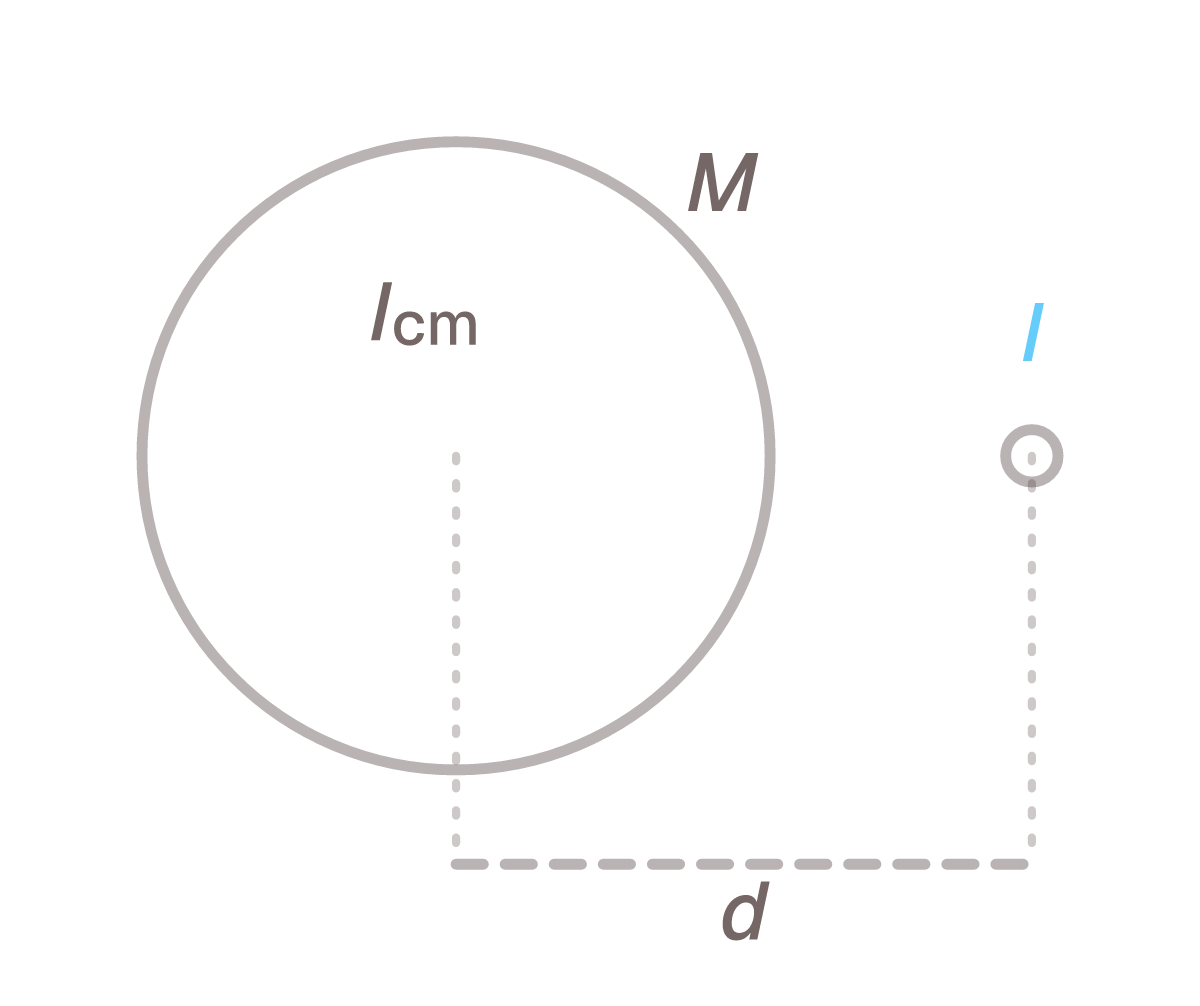
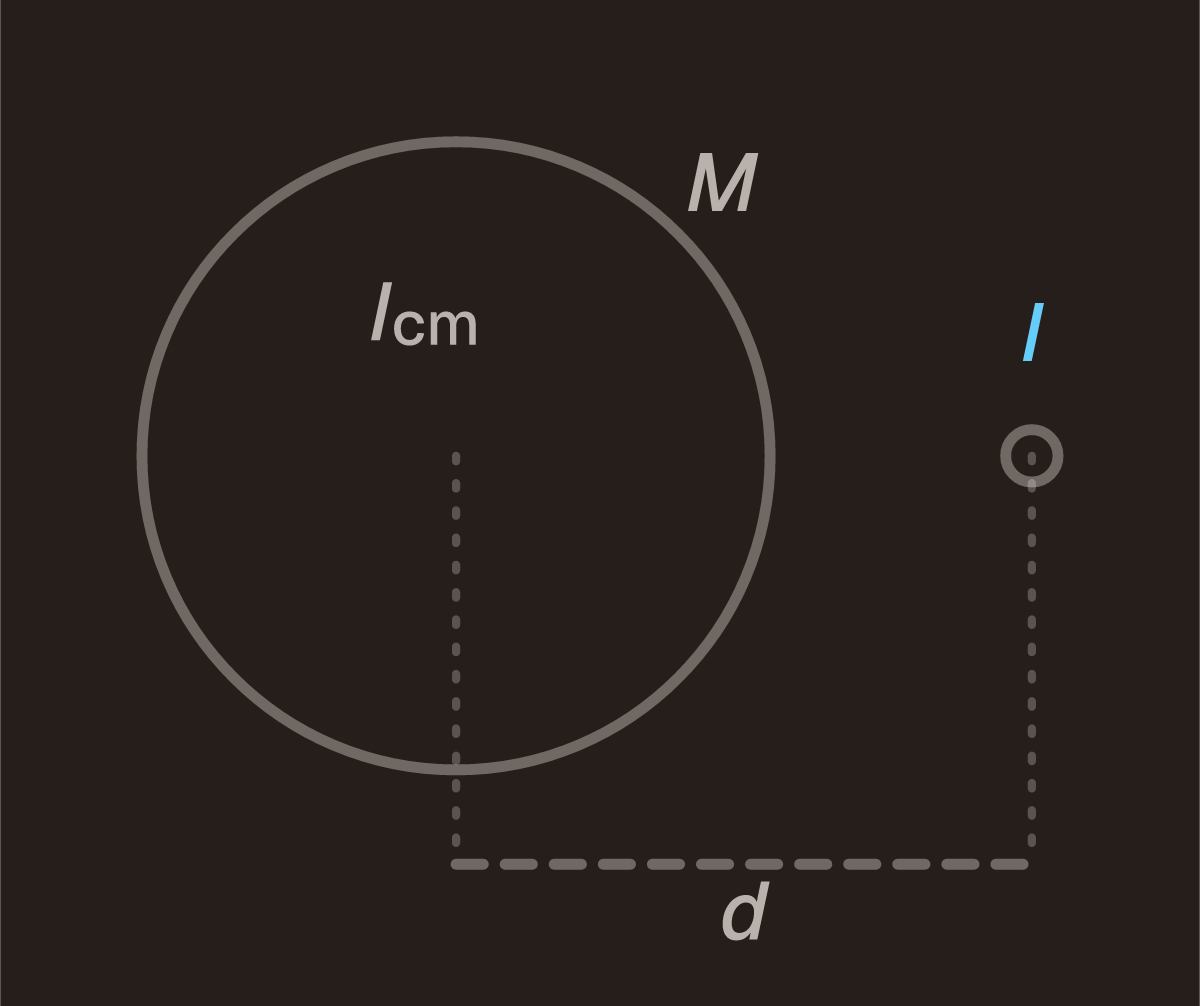
I = I_cm + M · d²
I_cm is the moment of inertia about an axis through the centre of mass, M the mass, d the distance
to the new axis, which must be parallel to the first, and I the result.
I_cm = 2 kg·m², M = 3 kg, d = 2 m: I = 2 + 3 · 2² = 2 + 12 = 14 kg·m².
A disc spun round its rim
A 4 kg disc of radius 0.5 m has I_cm = M R² / 2 = 0.5 kg·m² (see
moment of inertia). About an axis through a point on its rim, d = R:
I = 0.5 + 4 · 0.5² = 0.5 + 1 = 1.5 kg·m² — three times as much.
A rod swung from one end
A thin rod of length L has I_cm = M L² / 12 about its middle. Moved to one end, d = L / 2:
I = M L² / 12 + M L² / 4 = M L² / 3.
That is why a baseball bat is easier to swing when you choke up on the grip: the axis moves closer to the
centre of mass and d shrinks.
The centre of mass is always the minimum
M d² is never negative, so the axis through the centre of mass gives the smallest moment of inertia of all
parallel axes. Any other axis is harder to turn about.
Common mistakes
- Starting from an axis that is not through the centre of mass. The theorem only adds from I_cm; moving
between two off-centre axes has to go via the centre.
- Non-parallel axes. Tilting the axis needs a different calculation.
- Forgetting to square d.
Questions people ask
Who was Steiner?
Jakob Steiner, a Swiss geometer. The theorem carries his name in Swedish, German and several other
languages; in English it is usually called the parallel axis theorem.