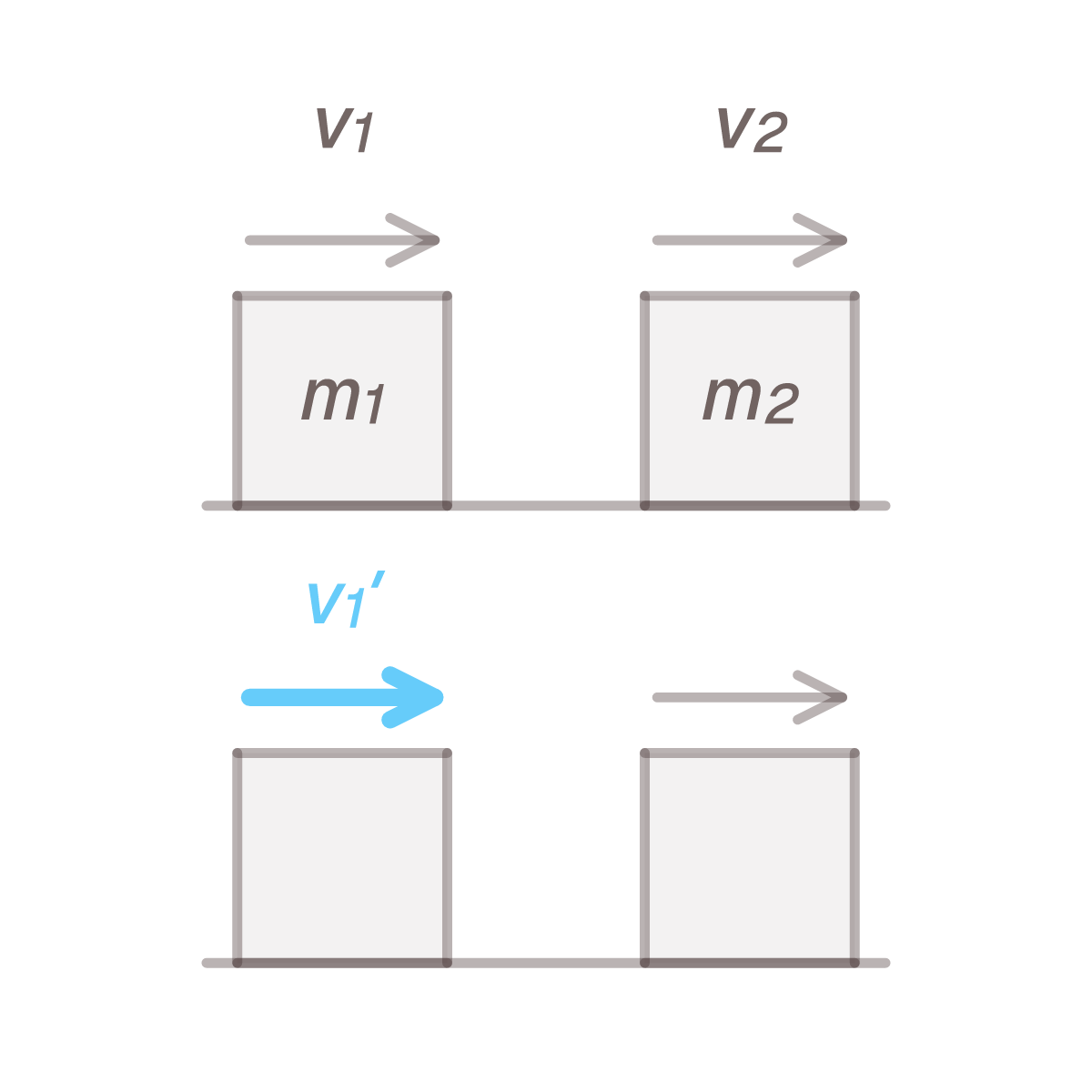
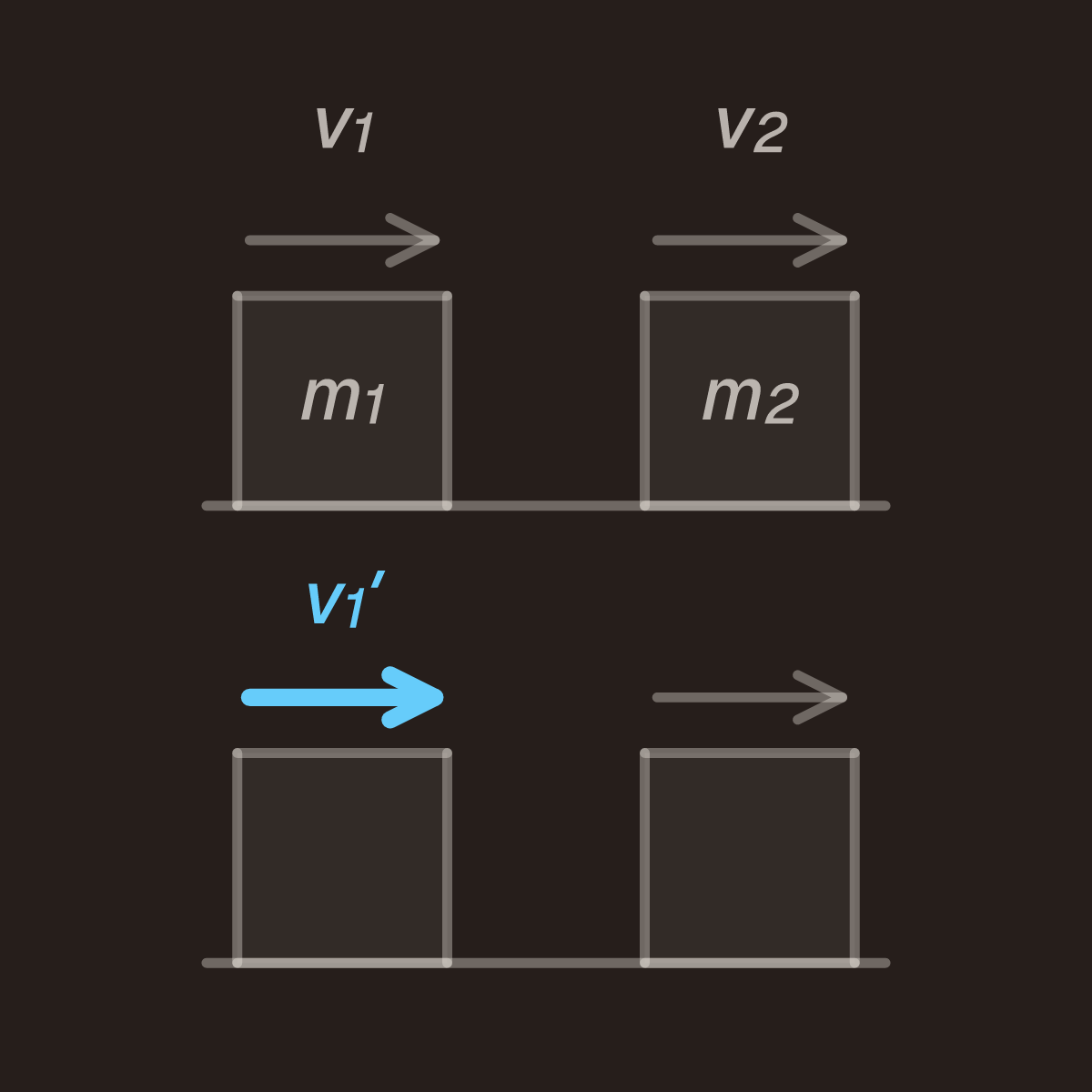
v₁′ = ((m₁ − m₂) · v₁ + 2 · m₂ · v₂) / (m₁ + m₂)
m₁ and v₁ are the first body’s mass and velocity before the collision, m₂ and v₂ the second
body’s, and v₁′ the first body’s velocity after. The second body’s velocity after is the same formula
with 1 and 2 swapped:
v₂′ = ((m₂ − m₁) · v₂ + 2 · m₁ · v₁) / (m₁ + m₂)
Holds when the collision is head-on along one line, no kinetic energy turns into heat, sound or
deformation, and no outside force acts noticeably during the impact.
A 3 kg trolley at 4 m/s runs into a 1 kg trolley at rest:
v₁′ = ((3 − 1) · 4 + 2 · 1 · 0) / 4 = 2 m/s, and v₂′ = ((1 − 3) · 0 + 2 · 3 · 4) / 4 = 6 m/s.
Momentum is 12 kg·m/s before and 3 · 2 + 1 · 6 = 12 after; kinetic energy is 24 J before and 6 + 18 = 24 J
after.
Where it comes from
Two things are conserved, so there are two equations:
- momentum: m₁v₁ + m₂v₂ = m₁v₁′ + m₂v₂′
- kinetic energy: ½m₁v₁² + ½m₂v₂² = ½m₁v₁′² + ½m₂v₂′²
Gather each body’s terms on its own side: m₁(v₁ − v₁′) = m₂(v₂′ − v₂), and
m₁(v₁ − v₁′)(v₁ + v₁′) = m₂(v₂′ − v₂)(v₂′ + v₂). Dividing the second by the first leaves
v₁ + v₁′ = v₂ + v₂′ — the bodies separate as fast as they approached. Put v₂′ from that line into the
momentum equation and solve for v₁′, and the formula above comes out.
The sign is the answer
Velocities carry a direction: pick one direction as positive and give everything moving the other way a
minus sign. A negative v₁′ is not an error — it means the first body bounced back.
A 1 kg ball at 5 m/s hits a 4 kg ball at rest:
v₁′ = ((1 − 4) · 5 + 0) / 5 = −3 m/s, so the light ball rebounds at 3 m/s, and
v₂′ = 2 · 1 · 5 / 5 = 2 m/s forward.
Writing m₂ − m₁ in the first bracket gives +3 m/s instead: the light ball would carry on forward at 3 m/s
behind a heavy ball doing 2 m/s, which means passing through it. Check the masses’ order before the
arithmetic — the body whose velocity you want comes first.
Bodies moving towards each other
A 2 kg trolley at 5 m/s meets a 3 kg trolley coming the other way at 5 m/s, so v₂ = −5 m/s:
v₁′ = ((2 − 3) · 5 + 2 · 3 · (−5)) / 5 = (−5 − 30) / 5 = −7 m/s, and
v₂′ = ((3 − 2) · (−5) + 2 · 2 · 5) / 5 = 3 m/s.
Both bounce back. Momentum before is 10 − 15 = −5 kg·m/s and after −14 + 9 = −5. Left as +5, the second
velocity gives v₁′ = +5 m/s, a number that looks just as plausible and is wrong.
Special cases
| Situation |
v₁′ |
v₂′ |
| Equal masses |
v₂ |
v₁ — they swap velocities |
| m₂ at rest and much heavier |
almost −v₁ — a ball off a wall |
almost 0 |
| m₁ much heavier, m₂ at rest |
almost v₁ |
almost 2v₁ |
The first row is why one billiard ball stops dead when it hits another squarely.
For a collision where the bodies stick together, the
perfectly inelastic collision gives the one
shared velocity, and kinetic energy shows how much is
lost there.
Common mistakes
- Dropping the minus sign. A velocity in the opposite direction is negative, before and after.
- Swapping the masses in the first bracket. For v₁′ it is m₁ − m₂; for v₂′ it is m₂ − m₁.
- Using it for a real car crash. Cars crumple, and kinetic energy goes into the deformation, so the
collision is not elastic.
- Forgetting the factor 2. The second term is 2 · m₂ · v₂, not m₂ · v₂.
Frequently asked questions
How do I know whether a collision is elastic?
Compare the kinetic energy before and after. If it is the same, the collision is elastic. Hard steel or
billiard balls and gas molecules come close; anything that dents, sticks or warms up noticeably does
not.
What if the collision is partly elastic?
Momentum is still conserved, but this formula no longer applies. A coefficient of restitution e, the
ratio of the separation speed to the approach speed, describes the in-between case; e = 1 gives the
formula on this page and e = 0 the perfectly inelastic one.
Does it work in two dimensions?
Not as written. In a glancing collision momentum is conserved separately along each axis, and the
velocities have to be split into components first.