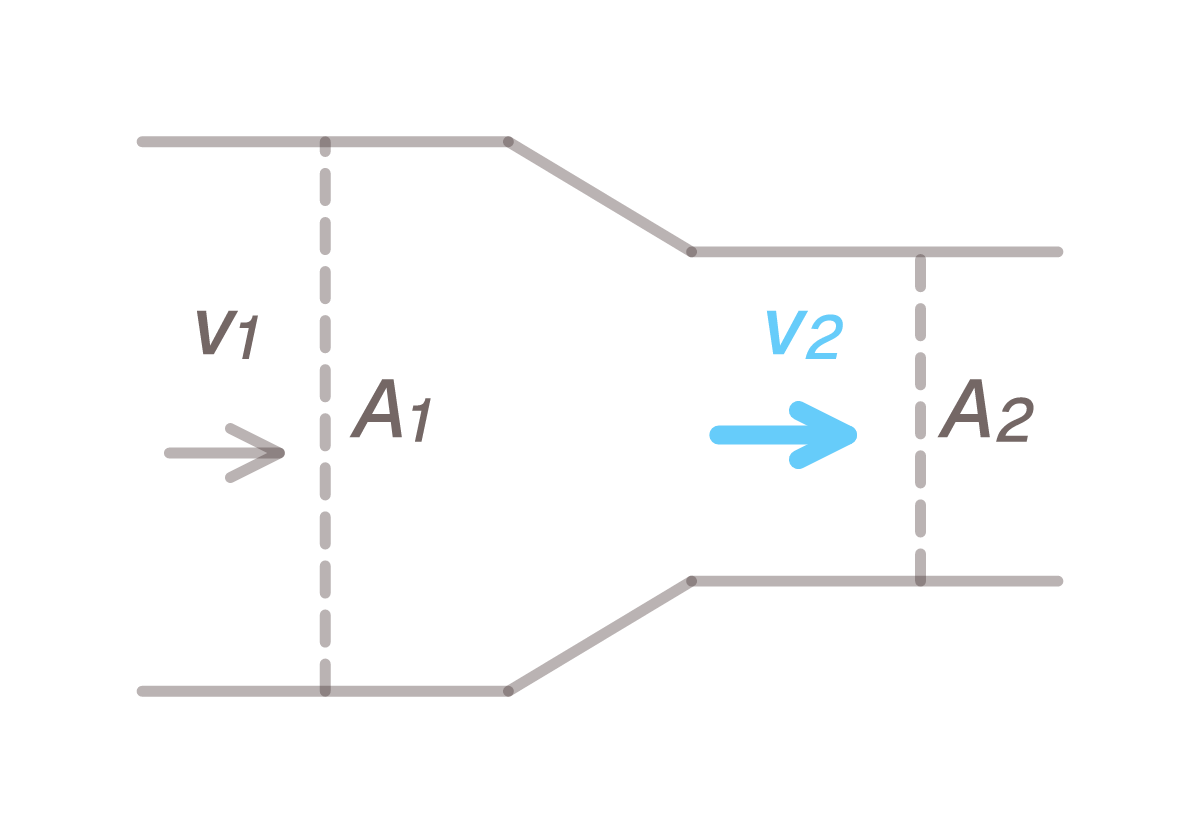
A₁ · v₁ = A₂ · v₂
A is the cross-sectional area of the pipe and v the speed of the fluid, at two places along it.
Holds for steady flow with no leaks, when the density is the same at both points: for liquids, and for gases
well below the speed of sound.
Water at 4 m/s in a pipe of 0.02 m² that narrows to 0.01 m²: v₂ = 0.02 · 4 / 0.01 = 8 m/s.
Both sides equal the flow rate, the volume passing per second: 0.02 · 4 = 0.08 m³/s, or 80 litres a second.
Halve the diameter, four times the speed
Area goes with the square of the diameter, so the speed does too — in reverse. A pipe narrowing from 10 cm to
5 cm has a quarter of the area, and the water in it moves four times as fast. Widening works the other way:
from 0.01 m² to 0.02 m², 2 m/s drops to 1 m/s.
The thumb over a garden hose works on the same principle: the same amount of water forced through a smaller
opening leaves much faster and carries further.
When it holds
In general, mass is what is conserved — ρ₁A₁v₁ = ρ₂A₂v₂ — and the density only cancels when it is the same at
both ends.
Common mistakes
- Using the diameter instead of the area. Halving the diameter doubles nothing; it quadruples the speed.
- Different units for the two areas. Any unit works, as long as it is the same on both sides.
- Expecting the pressure to rise where the fluid speeds up. In a horizontal pipe it falls — that is
Bernoulli’s equation.
Questions people ask
Why does a river flow faster where it is narrow?
The same equation: the same amount of water has to get through a smaller cross-section.