Skip to content
LoveToCalc

Definition — what does that mean?

Conservation of momentum in a perfectly inelastic collision

Two bodies collide and stick together. The momentum after is the same as before.

In Swedish: Rörelsemängdens bevarande vid fullständigt oelastisk stöt

Conservation of momentum in a perfectly inelastic collision

The relation

m₁v₁+m₂v₂=(m₁+m₂)v

Two bodies that collide and stick together: the momentum before equals the momentum after, so the common speed is the total momentum over the total mass.
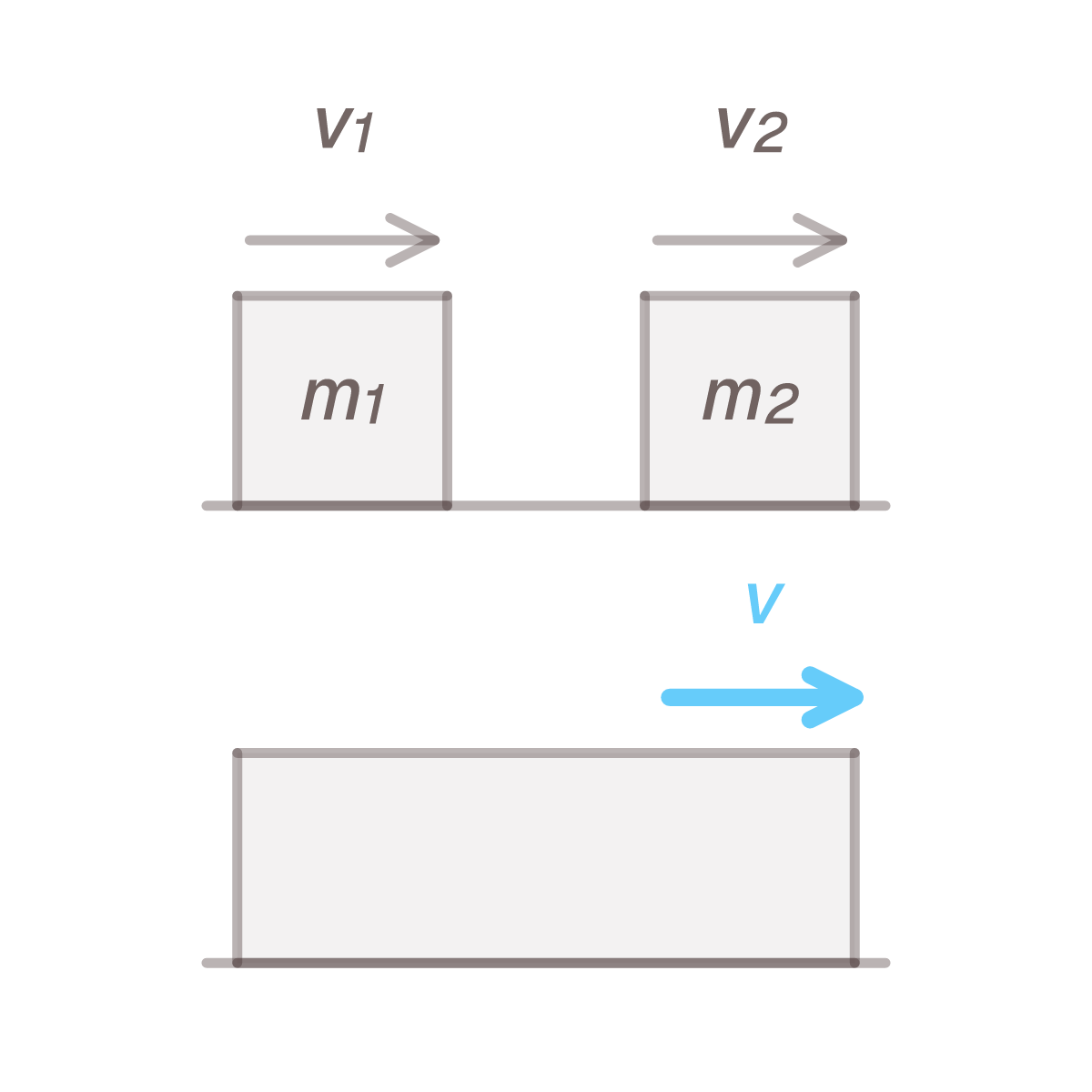
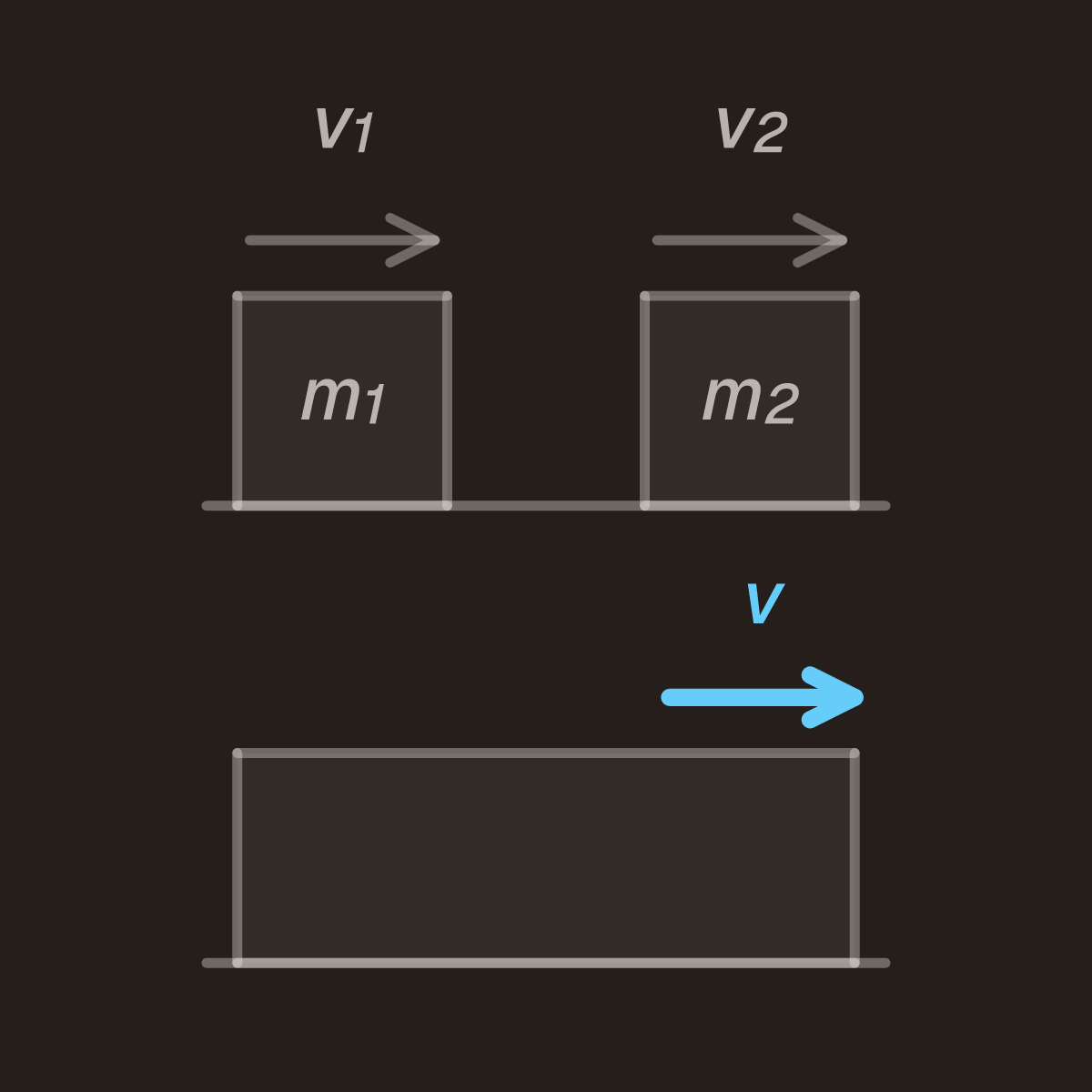
Two blocks side by side, before and after. Above, the block of mass m₁ moves right at speed v₁ towards the block of mass m₂, which moves right at speed v₂; below, they have stuck together into one block that moves on at the common speed v.
Solve for
Solved for v

v=m₁v₁+m₂v₂m₁+m₂

v=6m/s

v equals ((1,200 times 15) plus (1,800 times 0)) divided by (1,200 plus 1,800), equals (18,000 plus 0) divided by 3,000, equals 18,000 divided by 3,000, equals 6 m/s

Working4 steps

Practice questions

You are given

  • m₁=800kg
  • v₁=10m/s
  • m₂=1200kg
  • v=4m/s

Round to 2 decimals.

The formula

m₁ · v₁ + m₂ · v₂ = (m₁ + m₂) · v

m₁ and v₁ are the mass and velocity of one body before the collision, m₂ and v₂ of the other. v is their common velocity afterwards, stuck together.

Holds when the bodies stick together and no outside force has time to act noticeably during the collision itself.

Why it holds

During the collision the bodies push on each other with equal and opposite forces, by Newton’s third law, for the same length of time. The impulses cancel, and the total momentum does not change.

Worked examples

The defaults. A 1,200 kg car at 15 m/s runs into a stationary 1,800 kg car. They lock together: v = (1,200 · 15 + 1,800 · 0) / 3,000 = 6 m/s.

Head on. The same cars, but the second comes the other way at 5 m/s. That velocity is negative: v = (1,200 · 15 + 1,800 · (−5)) / 3,000 = 9,000 / 3,000 = 3 m/s in the first car’s direction.

Common mistakes

Frequently asked questions

What is the difference between elastic and inelastic collisions? In an elastic collision both momentum and kinetic energy are conserved, as when billiard balls bounce. In a perfectly inelastic collision the bodies stick together and as much kinetic energy as possible is lost. Momentum is conserved in both.

Looking for another letter? The formula solved for each one
Solved for each letter
Solve forRearrangedWith the numbersComes to
m₁m₂(v−v₂)v₁−v1,800(6−0)15−61,200 kg
v₁(m₁+m₂)v−m₂v₂m₁(1,200+1,800)·6−1,800·01,20015 m/s
m₂m₁(v₁−v)v−v₂1,200(15−6)6−01,800 kg
v₂(m₁+m₂)v−m₁v₁m₂(1,200+1,800)·6−1,200·151,8000 m/s
vm₁v₁+m₂v₂m₁+m₂1,200·15+1,800·01,200+1,8006 m/s

Last reviewed October 6, 2026 ·How pages are reviewed

Ready-made worksheets with this formula

Sheets that ask this formula, with their answer keys. Open one to see the questions or print it.

High school

  • Momentum, impulse and collisions

    Four questions on momentum, four on impulse and eight on collisions where momentum is conserved. The first one is worked. Calculator allowed.

MechanicsAll formulas

Put this formula on your site

Copy the code into your page where the formula card should appear. It loads from lovetocalc.com, so it stays current on its own — all we ask is that the credit line comes with it.