Strain
The relation
ε
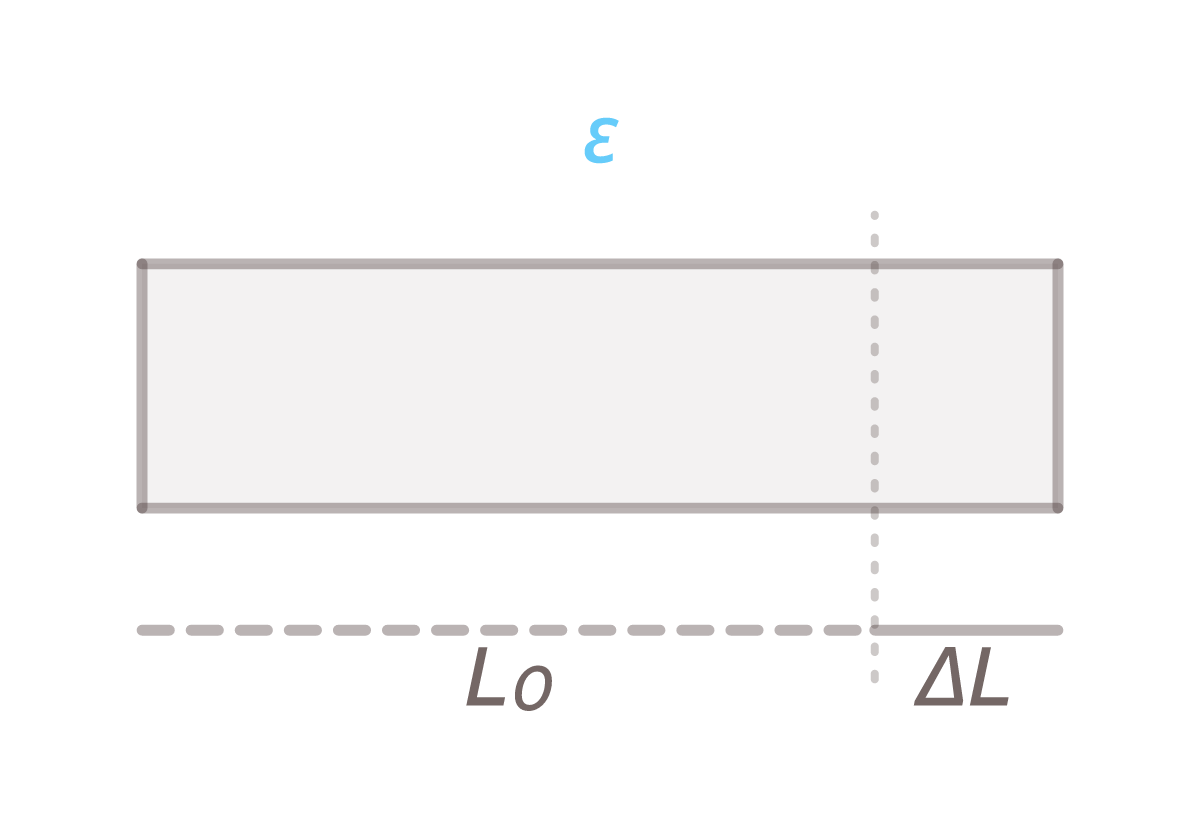
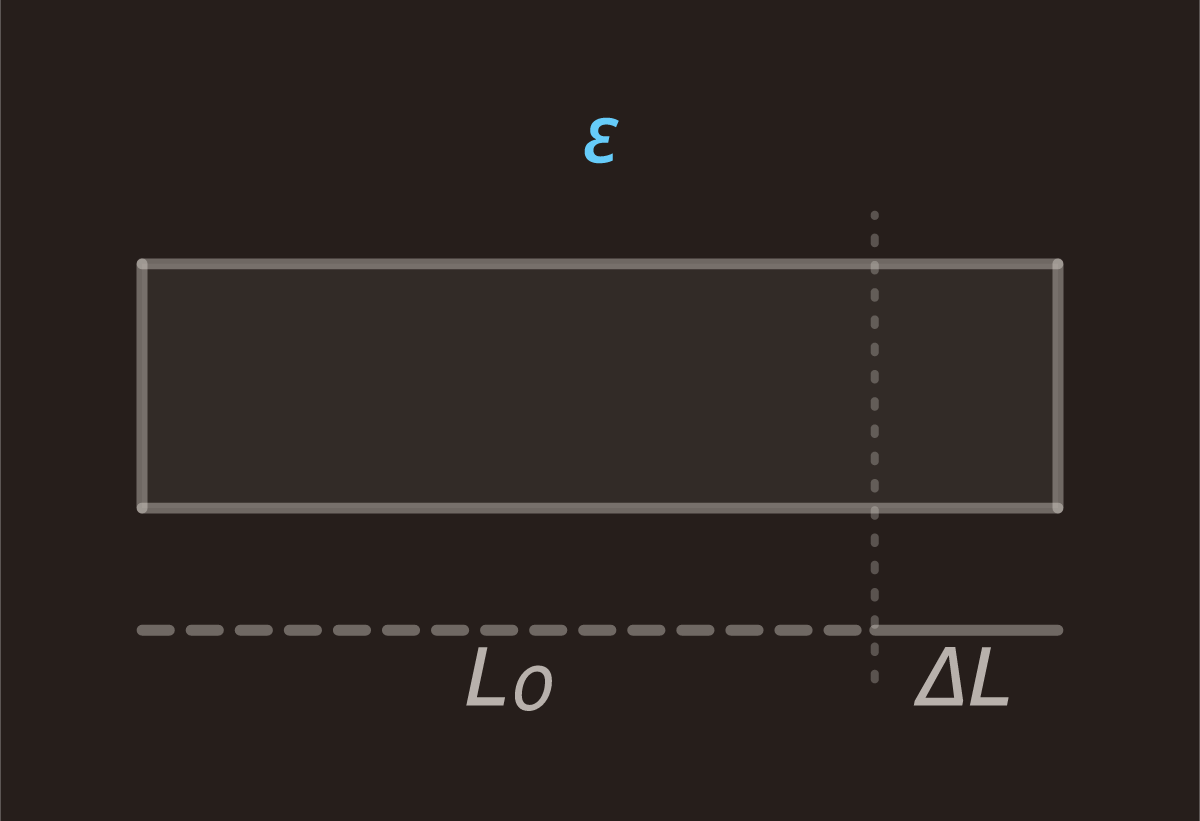
The change in length divided by the original length. A millimetre of stretch is a large strain on a centimetre and a tiny one on a metre.
Solve for
ε=0.001
ε equals 0.002 divided by 2, equals 0.001
Den här sidan finns på svenska. Byt till svenska
Definition — what does that mean?
How much a material stretches, as a share of its original length.
In Swedish: Töjning
ε
The change in length divided by the original length. A millimetre of stretch is a large strain on a centimetre and a tiny one on a metre.
ε=0.001
ε equals 0.002 divided by 2, equals 0.001
You are given
ε = ΔL / L₀
ε (epsilon) is the strain, ΔL the change in length and L₀ the original length, both in the same unit.
A 2 m bar that stretches 2 mm: ε = 0.002 / 2 = 0.001.
Strain has no unit — metres divided by metres — so a 1 m bar stretching 1 mm and a 4 m bar stretching 4 mm are strained exactly the same, ε = 0.001. If they are the same material, they are under the same stress too.
The same number is often written as a percentage, 0.1%, or in microstrain, 1,000 µε — the unit strain gauges read in.
| Stretch | Length | ε |
|---|---|---|
| 2 mm | 2 m | 0.001 |
| 1 mm | 1 m | 0.001 |
| 4 mm | 4 m | 0.001 |
The stress in the material. For metals, wood and other materials that stretch only a little, strain is proportional to stress as long as the material springs back when unloaded, and the constant between them is Young’s modulus: ε = σ / E. It is Hooke’s law written for the material rather than for one spring. Rubber springs back but does not follow the proportion.
Can strain be negative?
Yes — a material that is compressed gets shorter, and ΔL is negative.
| Solve for | Rearranged | With the numbers | Comes to |
|---|---|---|---|
| ΔL | εL₀ | 0.001·2 | 0.002 m |
| L₀ | ΔLε | 0.0020.001 | 2 m |
| ε | ΔLL₀ | 0.0022 | 0.001 |
Table
| Material | Temperature (°C) | E (GPa) |
|---|---|---|
| Diamond | not stated by the source | 1,220 |
| Tungsten | 20 | 411 |
| Stainless steel | 20 | 215.3 |
| Mild steel | 20 | 211.9 |
| Iron (soft) | 20 | 211.4 |
| Cast iron | 20 | 152.3 |
| Copper | 20 | 129.8 |
| Titanium | 20 | 115.7 |
| Brass (70 % Zn, 30 % Cu) | 20 | 100.6 |
| Fused quartz | 20 | 73.1 |
| Crown glass | 20 | 71.3 |
| Aluminium | 20 | 70.3 |
| Granite | not stated by the source | 52 |
| Bone (compact) | not stated by the source | 18 |
| Concrete | not stated by the source | 17 |
| Lead | 20 | 16.1 |
| Scots pine, along the grain | not stated by the source | 16 |
| Oak, along the grain | not stated by the source | 11 |
| Balsa, along the grain | not stated by the source | 6 |
| Polycarbonate | 20 | 2.4 |
| Polyethylene (HDPE) | not stated by the source | 0.8 |
| PTFE (Teflon) | 20 | 0.4 |
Last reviewed October 6, 2026 ·How pages are reviewed
Copy the code into your page where the formula card should appear. It loads from lovetocalc.com, so it stays current on its own — all we ask is that the credit line comes with it.