Skip to content
LoveToCalc

Definition — what does that mean?

Escape velocity

How fast something has to be thrown straight out to never fall back.

In Swedish: Flykthastighet

Escape velocity

The relation

v=2GMr

The speed a body needs to leave a planet for good without any more push. From the surface of the Earth it is about 11.2 km/s.
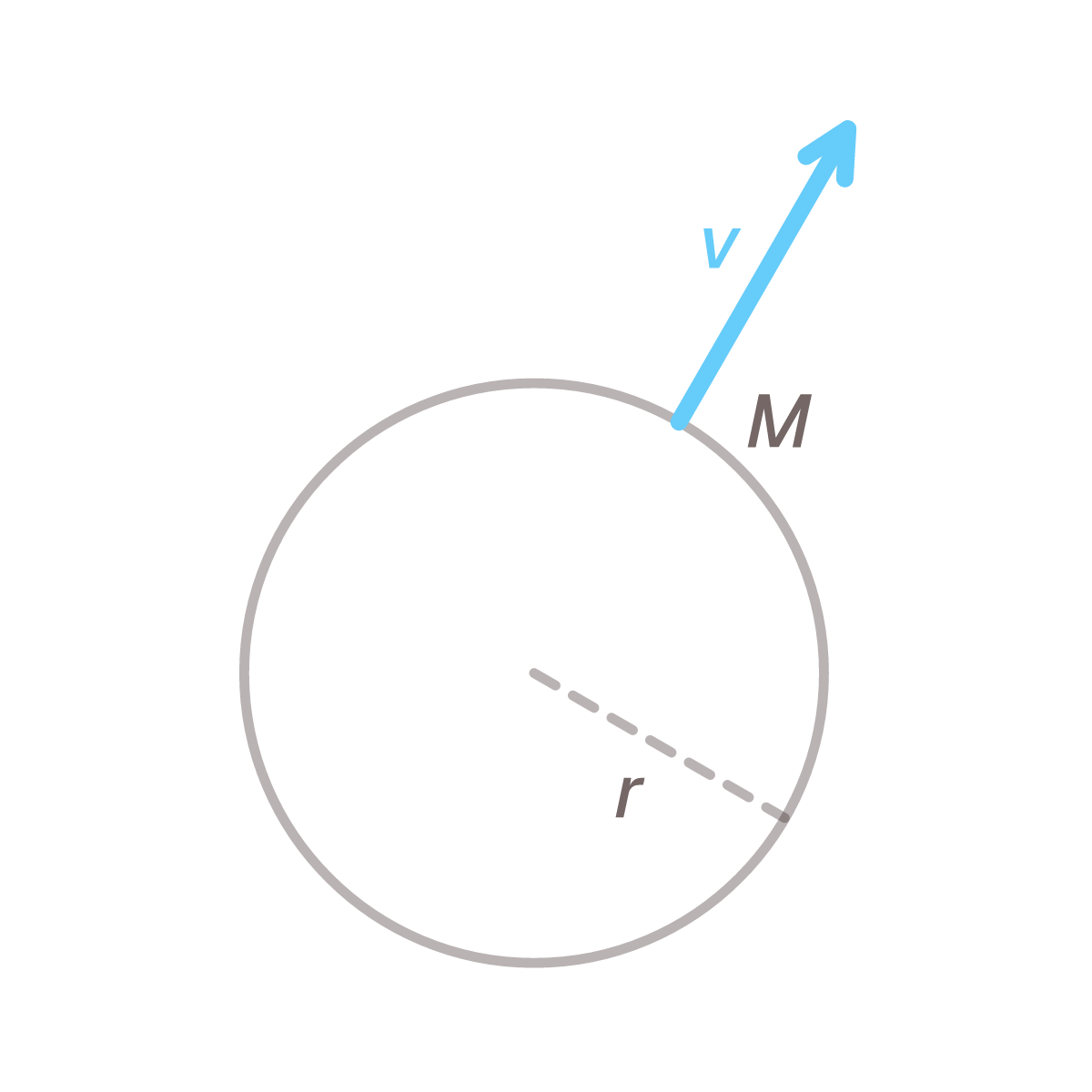
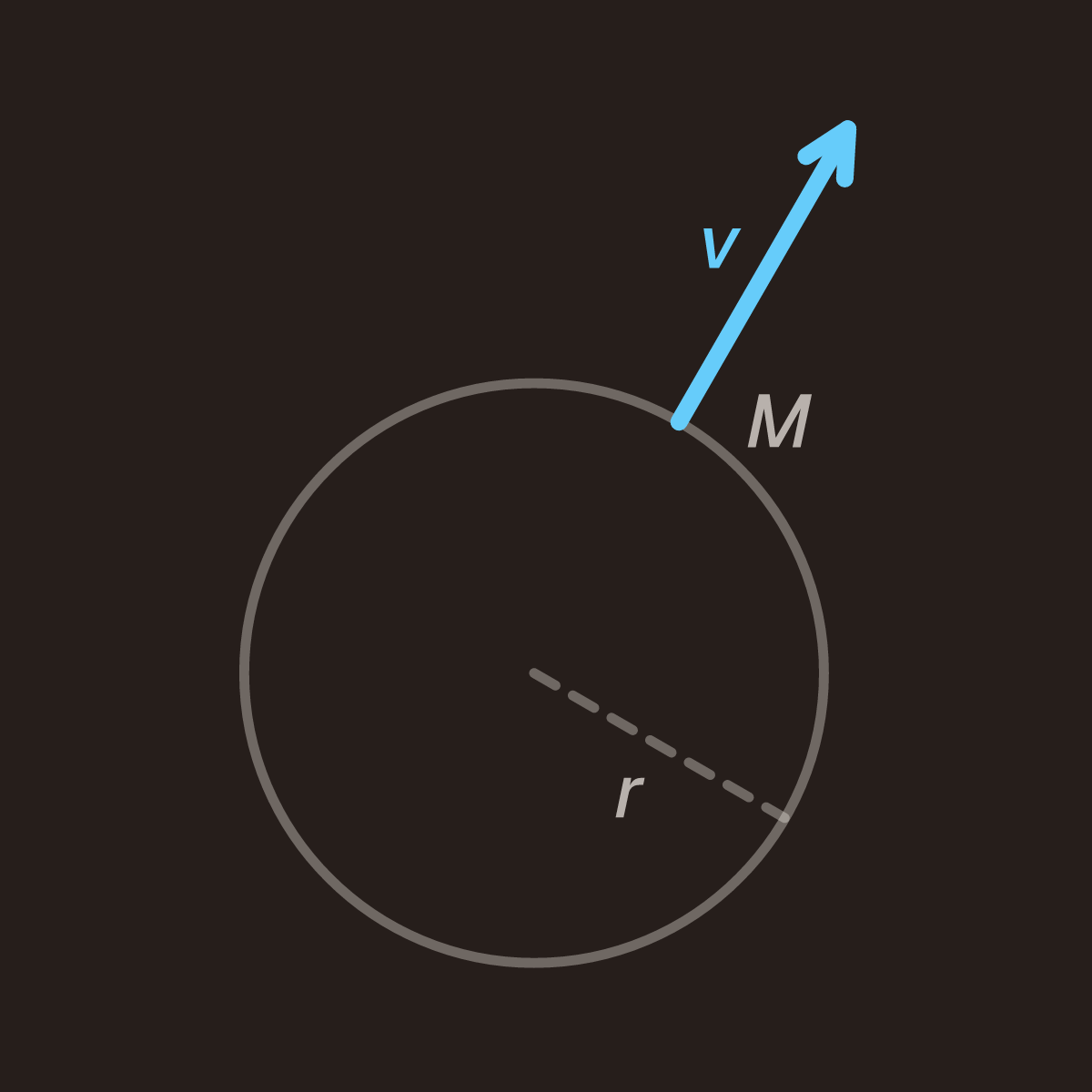
A planet of mass M with its radius r drawn from the centre to the surface. An arrow leaves the surface straight out from the planet, the speed v needed to get away for good.
Solve for

v≈11,185.7265m/s

v equals the square root of ((2 times (6.674 times 10 to the power of minus 11 times 5.972 times 10 to the power of 24)) divided by 6,371,000), is approximately the square root of ((2 times 3.986 times 10 to the power of 14) divided by 6,371,000), is approximately the square root of (7.971 times 10 to the power of 14 divided by 6,371,000), equals the square root of (125,120,477.1621), is approximately 11,185.7265 m/s

Working5 steps

The formula

v = √(2 · G · M / r)

v is the escape velocity in m/s, G the gravitational constant, M the mass of the body being left, in kilograms, and r the starting distance from its centre in metres.

Holds for an object launched from a spherically symmetric body with no air resistance, no further thrust and no pull from other bodies.

Where it comes from

It is an energy balance. The kinetic energy m · v² / 2 has to last all the way out, to where gravity’s grip has gone. That energy is G · M · m / r. Set them equal and solve for v. The mass of whatever escapes cancels, so the escape velocity is the same for a stone and a rocket.

Worked examples

The Earth. v = √(2 · 6.674 · 10⁻¹¹ · 5.972 · 10²⁴ / 6,371,000) ≈ 11,200 m/s, just over 40,000 km/h.

The Moon. M = 7.35 · 10²² kg and r = 1,737,000 m give v ≈ 2,400 m/s. That is why the Apollo lunar module could lift off with a small engine.

Common mistakes

Frequently asked questions

What does escape velocity have to do with black holes? A black hole has so much mass inside so small a radius that the escape velocity at its edge exceeds the speed of light. Not even light gets out. This formula is wrong that close, though; there you need relativity.

Looking for another letter? The formula solved for each one
Solved for each letter
Solve forRearrangedWith the numbersComes to
Gv²r2M11,185.73²·6,371,0002·5.972 × 10²⁴6.674 × 10⁻¹¹ N·m²/kg²
Mv²r2G11,185.73²·6,371,0002·6.674 × 10⁻¹¹5.972 × 10²⁴ kg
r2GMv²2·6.674 × 10⁻¹¹·5.972 × 10²⁴11,185.73²6,371,000 m
v2GMr2·6.674 × 10⁻¹¹·5.972 × 10²⁴6,371,00011,185.73 m/s

The solar system

Table

The solar system
BodyTypeMass (kg)Mean radius (km)Density (kg/m³)Surface gravity (m/s²)Escape velocity (km/s)Rotation period (h)OrbitsOrbital period (days)Mean distance (10⁶ km)Orbital velocity (km/s)
SunStar1.9884 × 10³⁰695,7001,408274.0617.6609.12NoneNot applicableNot applicableNot applicable
MercuryPlanet3.3 × 10²³2,439.55,4293.74.31,407.6The Sun88.057.947.4
VenusPlanet4.87 × 10²⁴6,0525,2438.910.4−5,832.5The Sun224.7108.235.0
EarthPlanet5.97 × 10²⁴6,3785,5149.811.223.9The Sun365.2149.629.8
MoonMoon7.3 × 10²²1,737.53,3401.62.4655.7The Earth27.30.3841.0
MarsPlanet6.42 × 10²³3,3963,9343.75.024.6The Sun687.0228.024.1
JupiterPlanet1.898 × 10²⁷71,4921,32623.159.59.9The Sun4,331778.513.1
SaturnPlanet5.68 × 10²⁶60,2686879.035.510.7The Sun10,7471,432.09.7
UranusPlanet8.68 × 10²⁵25,5591,2708.721.3−17.2The Sun30,5892,867.06.8
NeptunePlanet1.02 × 10²⁶24,7641,63811.023.516.1The Sun59,8004,515.05.4
PlutoDwarf planet1.3 × 10²²1,1881,8500.71.3−153.3The Sun90,5605,906.44.7

Sources

(2)

Last reviewed October 6, 2026 ·How pages are reviewed

MechanicsAll formulas

Put this formula on your site

Copy the code into your page where the formula card should appear. It loads from lovetocalc.com, so it stays current on its own — all we ask is that the credit line comes with it.