Skip to content
LoveToCalc

Definition — what does that mean?

Terminal velocity

A falling body speeds up until the air resistance weighs as much as it does.

In Swedish: Gränshastighet

Terminal velocity

The relation

v=2mgρCdA

The speed at which air resistance has grown as large as the weight, so a falling body stops speeding up. Heavier and more streamlined means faster.
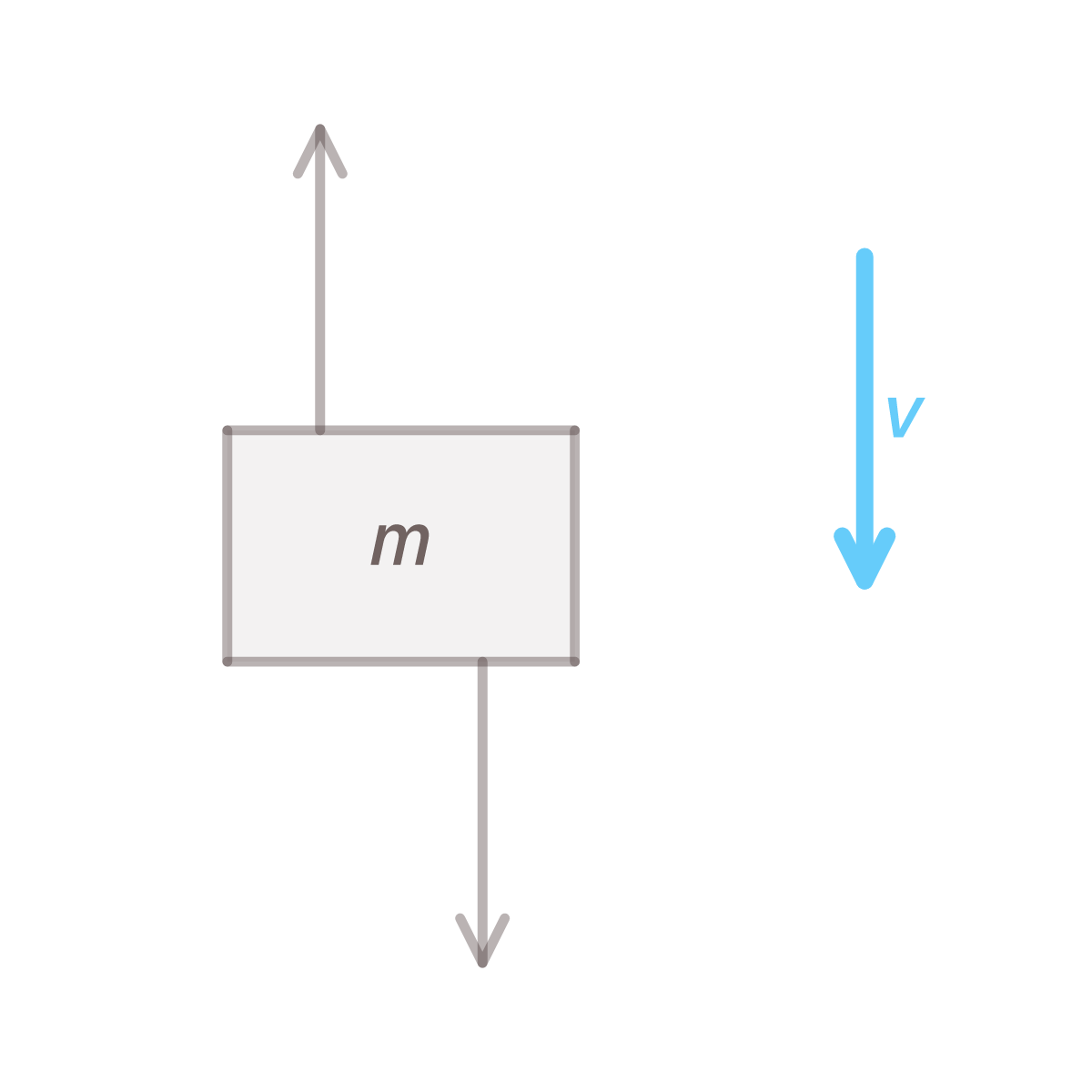
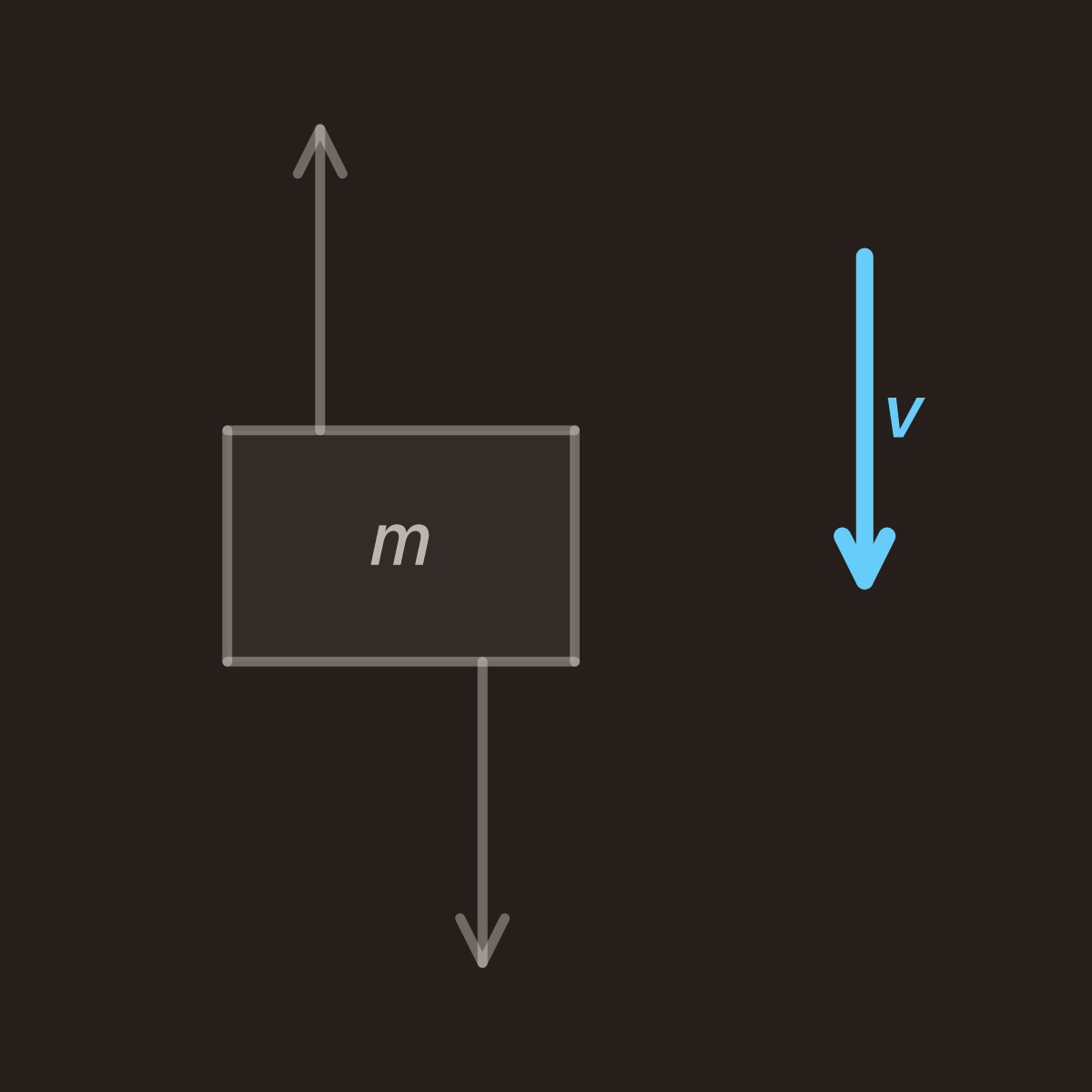
A body of mass m falling at speed v, shown by the arrow beside it. Its weight pulls it down, the arrow below, and the drag from the air pushes up, the arrow above; at terminal velocity the two are equal.
Solve for

v≈55.8058m/s

v equals the square root of ((2 times (80 times 9.81)) divided by (1.2 times (0.7 times 0.6))), equals the square root of ((2 times 784.8) divided by (1.2 times 0.42)), equals the square root of (1,569.6 divided by 0.504), is approximately the square root of (3,114.2857), is approximately 55.8058 m/s

Working5 steps

The formula

v = √(2 · m · g / (ρ · C · A))

m is the mass in kilograms, g the acceleration of gravity, ρ the density of air in kg/m³ (about 1.2 at ground level), C the drag coefficient and A the cross-section facing the direction of travel, in m².

Holds when drag grows with the speed squared and the air density stays the same along the fall.

Where it comes from

Air resistance grows with the speed squared: F = ½ · ρ · C · A · v². Once it is as large as the weight m · g, the net force is zero and the speed stops rising. Set the forces equal and solve for v, and you get the formula.

Worked examples

The defaults. An 80 kg skydiver falling belly down, C = 0.7 and A = 0.6 m²: v = √(2 · 80 · 9.81 / (1.2 · 0.7 · 0.6)) ≈ 56 m/s, about 200 km/h.

With the canopy open. The canopy raises C · A roughly a hundredfold. The speed becomes a tenth, around 5 to 6 m/s, because v depends on the square root of C · A.

Common mistakes

Frequently asked questions

How fast does a raindrop fall? Large drops land at about 9 m/s, small ones much slower. A small drop has a lot of surface for its mass and is braked more.

What is the drag coefficient? A number for how streamlined the body is. A flat plate is around 1.2, a person 0.7 to 1 and a teardrop shape under 0.1. It is measured in a wind tunnel.

Looking for another letter? The formula solved for each one
Solved for each letter
Solve forRearrangedWith the numbersComes to
mv²ρCdA2g55.81²·1.2·0.7·0.62·9.8180 kg
gv²ρCdA2m55.81²·1.2·0.7·0.62·809.81 m/s²
ρ2mgv²CdA2·80·9.8155.81²·0.7·0.61.2 kg/m³
Cd2mgv²ρA2·80·9.8155.81²·1.2·0.60.7
A2mgv²ρCd2·80·9.8155.81²·1.2·0.70.6 m²
v2mgρCdA2·80·9.811.2·0.7·0.655.81 m/s

Drag coefficients

Table

Drag coefficients
Shape or objectCd
Flat plate along the flow, laminar0.001
Flat plate along the flow, turbulent0.005
Streamlined body0.04
Aircraft wing, normal position0.05
Long streamlined body0.1
Modern streamlined electric car0.23
Ordinary family car (mid-size)0.29
Bird0.4
Hemisphere, curved side forward0.42
Sphere0.5
Cube0.8
Cyclist, racing position0.88
Bicycle with rider0.9
Tractor-trailer truck0.96
Cyclist, upright commuting position1.1
Thin circular disc, across the flow1.1
Square plate, across the flow1.17
Motorcycle and rider1.8
Passenger train1.8
Long flat plate, across the flow1.98
Rectangular box2.1

Sources

(1)

Last reviewed October 6, 2026 ·How pages are reviewed

MechanicsAll formulas

Put this formula on your site

Copy the code into your page where the formula card should appear. It loads from lovetocalc.com, so it stays current on its own — all we ask is that the credit line comes with it.