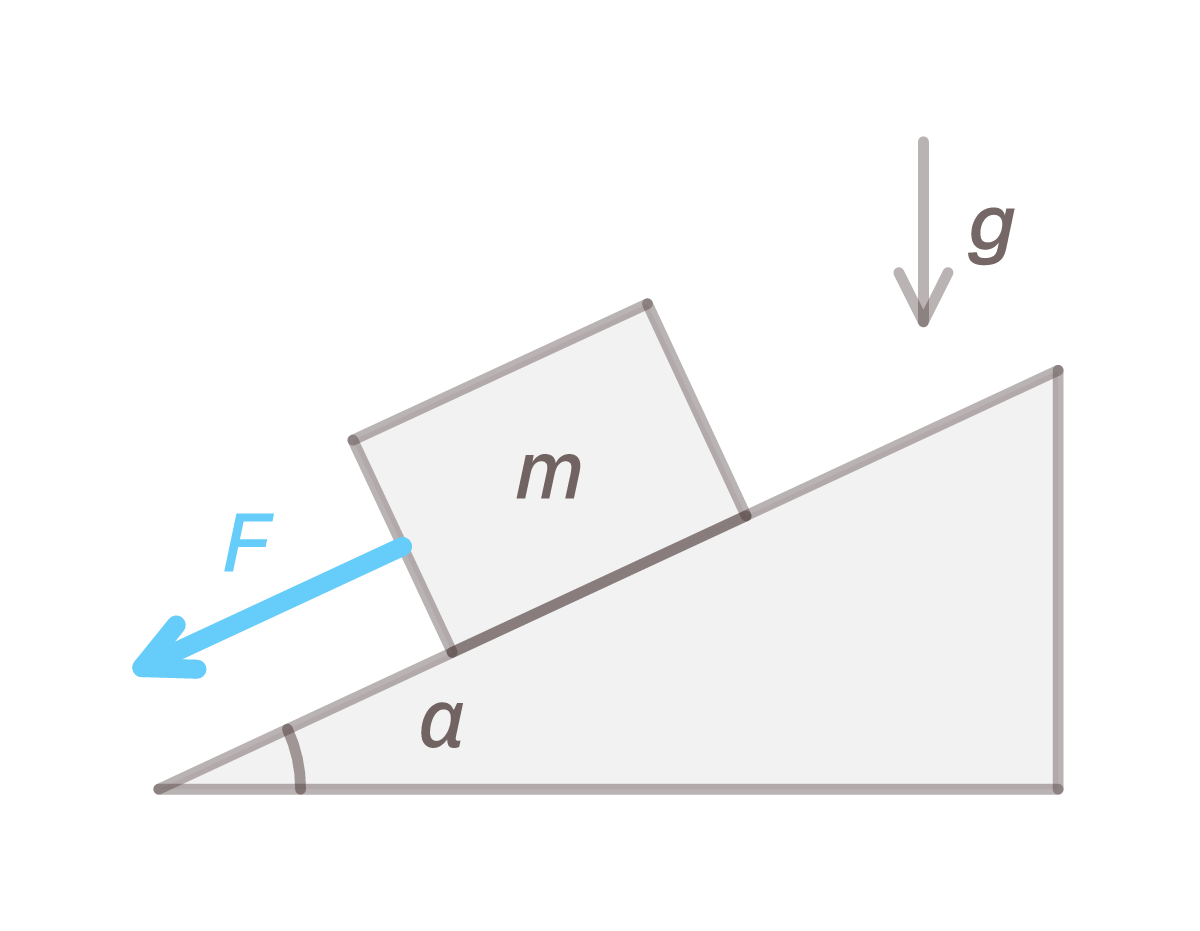
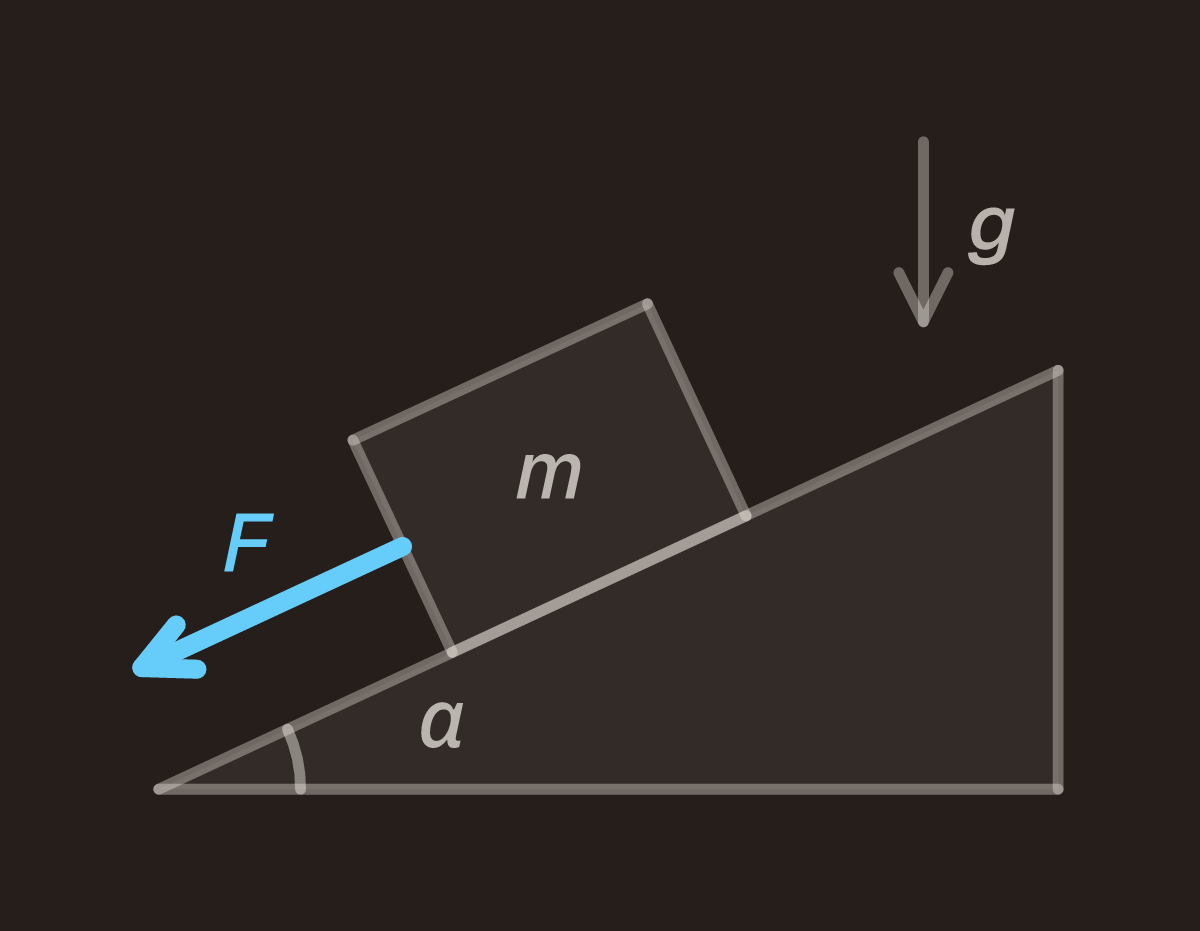
m is the mass in kilograms, g the acceleration due to gravity, α the angle of the slope and F the
part of the weight that pulls along the plane, in newtons. A 62 kg skier on a 25° slope weighs
62 · 9.81 = 608.22 N, and the pull down the slope is 608.22 · sin 25° ≈ 257.0 N.
Holds when the plane is flat and the angle is measured from the horizontal. The formula gives only the
weight’s share; friction and other forces are added separately.
The other component
The weight m·g points straight down. Against a slope it splits into two perpendicular parts:
| Component |
Formula |
The skier, 25° |
| Along the plane |
m·g·sin α |
257.0 N |
| Into the plane |
m·g·cos α |
551.2 N |
The part into the plane is the normal force, and it is what the
friction force is worked out from: μ · m·g·cos α.
Sine or cosine
A common mistake is swapping the two. One check: as α goes to 0° the plane is level and nothing pulls
along it, so that part has to be the sine, which is 0 at 0°. At 25° the sine is 0.42 and the cosine
0.91 — swap them and you get 551.2 N down the slope, more than twice the real pull, and the answer still
looks reasonable.
| Angle |
sin α (along) |
cos α (into) |
| 10° |
0.174 |
0.985 |
| 25° |
0.423 |
0.906 |
| 45° |
0.707 |
0.707 |
| 60° |
0.866 |
0.500 |
Worked examples
Does the skier slide? The skier above with a coefficient of friction of 0.3. Friction can reach at
most 0.3 · 551.2 ≈ 165.4 N, less than the 257.0 N down the slope. The net force is 91.7 N, and by
Newton’s second law the acceleration is
91.7 / 62 ≈ 1.48 m/s².
The angle at which it starts. A block begins to slide when m·g·sin α exceeds μ · m·g·cos α, that is
when tan α > μ. With μ = 0.3 the limit is about 16.7° — whatever the mass.
Common mistakes
- Sine and cosine swapped. Along the plane is the sine, into it the cosine, with the angle measured
from the horizontal.
- Taking the normal force as m·g. On a slope it is m·g·cos α, less than the weight whenever the plane tilts.
- Measuring the angle from the vertical. Then sine and cosine swap roles. Check which angle the
problem gives.
- Mass in place of weight. m·g gives newtons; the mass alone is kilograms.
Frequently asked questions
Why does the sliding angle not depend on the mass?
Both the pull along the plane and the friction are proportional to m·g. The mass appears on both sides
and cancels, so only the coefficient of friction decides the angle at which something starts to slide.
How much force does it take to pull something up the slope?
At least m·g·sin α to hold it still without friction, plus the friction μ·m·g·cos α to move it at a
steady speed, with the pull acting along the plane.
What happens at 90°?
The plane is then a vertical wall: sin 90° = 1, the whole weight pulls along the surface and the normal
force is zero. The object falls freely.