Newton's second law
The relation
F
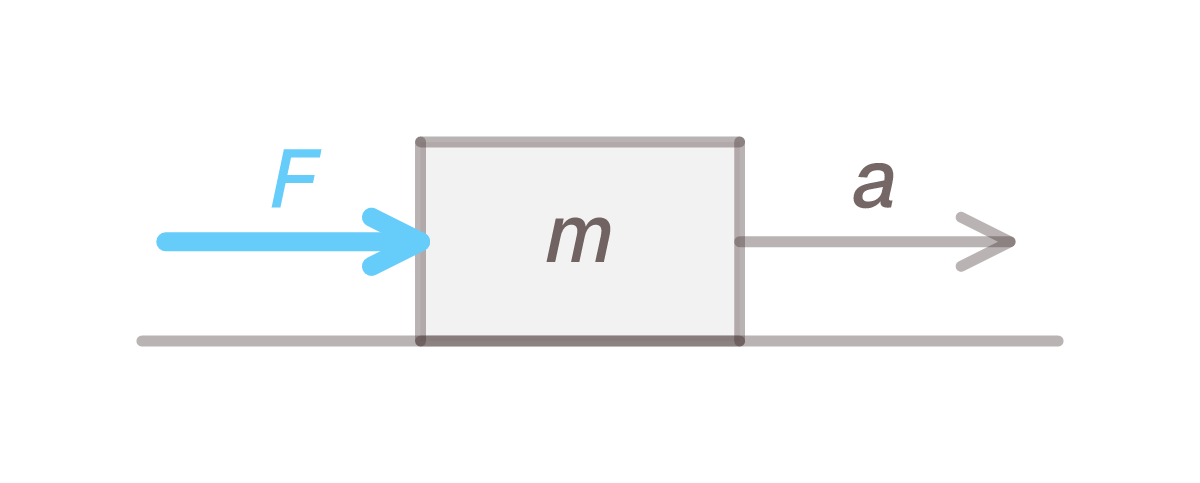
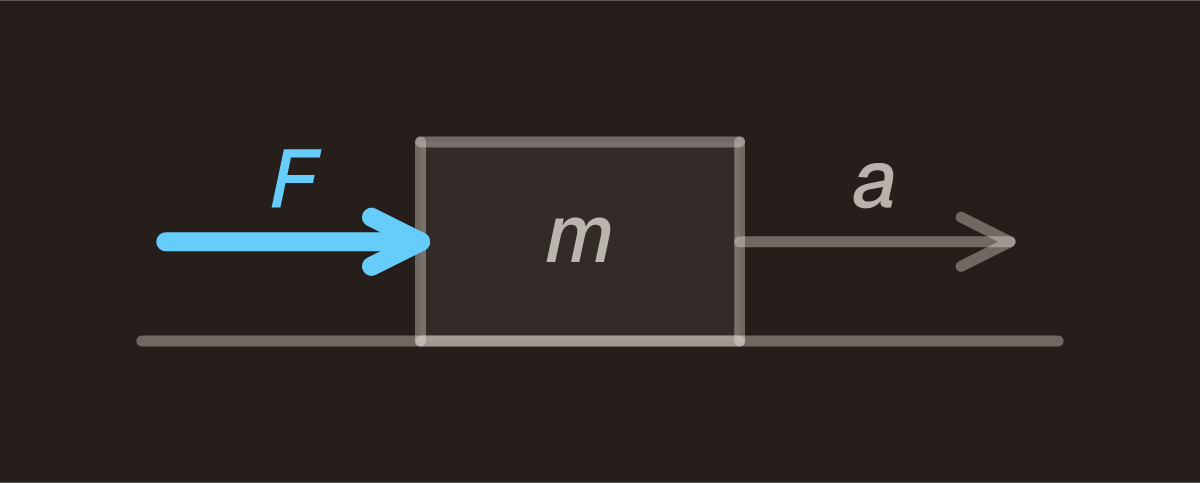
Force is mass times acceleration. The same force moves a light thing easily and a heavy thing barely.
Solve for
F=2,400N
F equals 1,200 times 2, equals 2,400 N
Den här sidan finns på svenska. Byt till svenska
Definition — what does that mean?
Force is mass times acceleration — which is why a newton is one kilogram gaining a metre per second every second.
In Swedish: Newtons andra lag
F
Force is mass times acceleration. The same force moves a light thing easily and a heavy thing barely.
F=2,400N
F equals 1,200 times 2, equals 2,400 N
You are given
m is the mass in kilograms, a the acceleration in m/s² and F the force in newtons. A 1,200 kg car
accelerating at 2 m/s² needs 1,200 · 2 = 2,400 N.
Holds when the mass is constant, the speed is far below the speed of light and the motion is measured from a frame that is not itself accelerating.
The unit is defined by the formula: 1 N is the force that gives 1 kg an acceleration of 1 m/s². That is why the newton is not a base unit but shorthand for kg·m/s².
A 100 g apple weighs about one newton, a useful rule of thumb.
A common misconception is that something needs a force to keep moving. It does not. A force is needed to change the motion. A spacecraft with its engines off, far from planets and stars, keeps its speed, and a car at a steady cruising speed has a net force of zero — the drive and the air resistance cancel exactly.
So F in the formula is the total force. Pull with 300 N against 100 N of friction and
it is 200 N that accelerates the load.
Braking force. A 1,500 kg car decelerating at 5 m/s² needs 1,500 · 5 = 7,500 N from the brakes.
Acceleration from a force. A 25 kg box pulled with 100 N across a frictionless floor: a = 100 / 25 = 4 m/s².
Mass from an experiment. A force of 60 N gives an acceleration of 1.5 m/s²: m = 60 / 1.5 = 40 kg.
Net force. A 20 kg sledge pulled with 80 N while friction takes 30 N. The net force is 50 N, so a = 50 / 20 = 2.5 m/s².
What do the first and third laws say?
The first: with no net force the motion does not change. The third: every force has an equal and
opposite one. The second, this one, is the one that gives the acceleration from the forces.
Does it hold for everything?
No. It holds when the speed is far below the speed of light and the motion is measured from a frame
that is not itself accelerating. Near the speed of light you need relativity, and at atomic scale
quantum mechanics.
What if the acceleration is not constant?
Then the formula holds at each moment, with the force acting at that moment. An average force gives an
average acceleration, which is often enough.
| Solve for | Rearranged | With the numbers | Comes to |
|---|---|---|---|
| m | Fa | 2,4002 | 1,200 kg |
| a | Fm | 2,4001,200 | 2 m/s² |
| F | ma | 1,200·2 | 2,400 N |
Last reviewed October 6, 2026 ·How pages are reviewed
Sheets that ask this formula, with their answer keys. Open one to see the questions or print it.
Seventeen questions on force: F = ma, weight, friction and Hooke's law.
Copy the code into your page where the formula card should appear. It loads from lovetocalc.com, so it stays current on its own — all we ask is that the credit line comes with it.