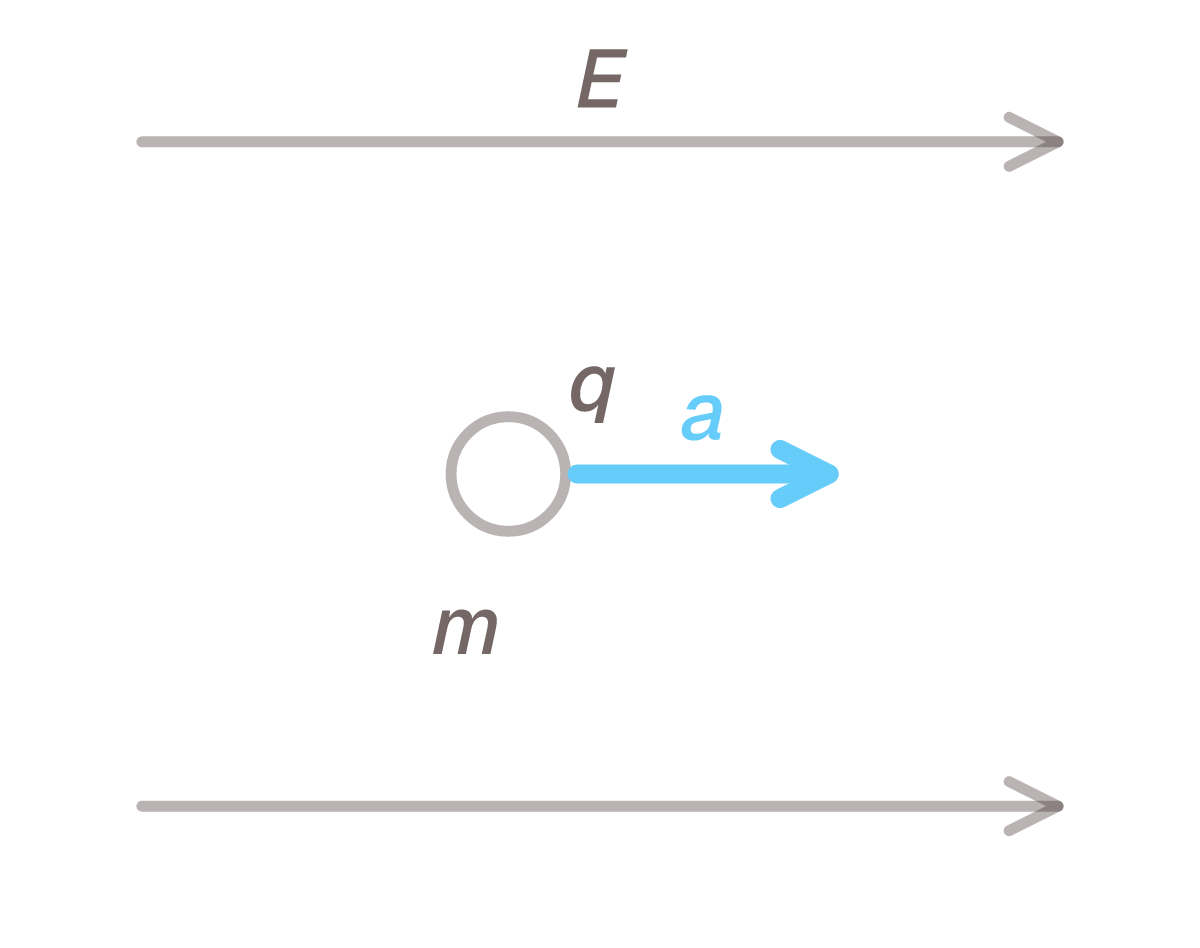
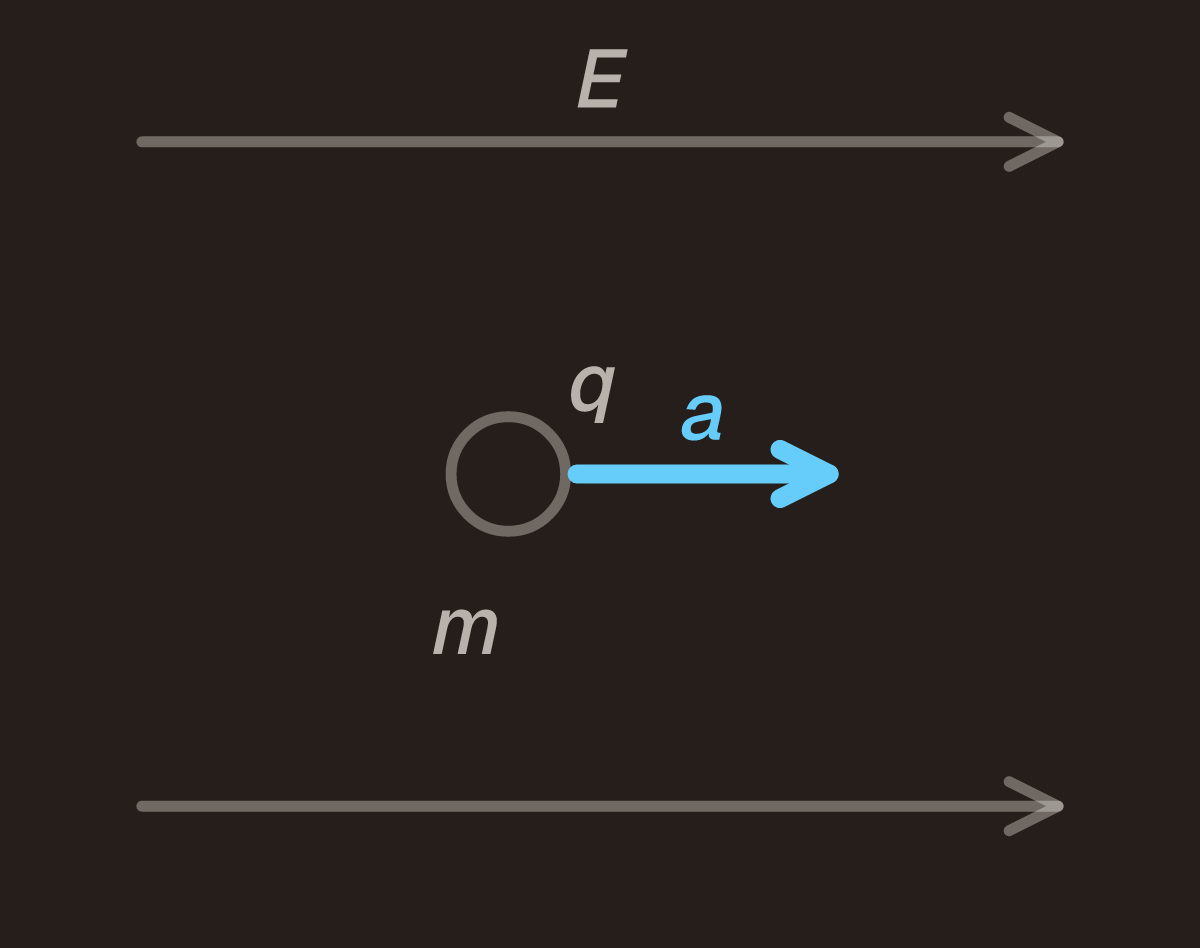
a is the acceleration in m/s², q the charge in coulombs, E the field strength in N/C (the same as
V/m) and m the mass in kg. It is two formulas in one line: the field strength gives the force
F = q · E, and Newton’s second law divides it by the mass.
Holds in a uniform field and when the speed is far below the speed of light.
Worked example
An electron (q = 1.6 · 10⁻¹⁹ C, m = 9.11 · 10⁻³¹ kg) sits in a field of 1,000 N/C.
a = 1.6 · 10⁻¹⁹ · 1,000 / 9.11 · 10⁻³¹ = 1.76 · 10¹⁴ m/s²
That is about 10¹³ times the acceleration of free fall, which is why gravity can be neglected for electrons
and protons.
Between two plates: the field in metres
The field between two plates is the uniform field E = U / d, and the gap is often given in
centimetres or millimetres. With 200 V across 4 cm:
- E = 200 / 0.04 = 5,000 N/C, and a = 1.6 · 10⁻¹⁹ · 5,000 / 9.11 · 10⁻³¹ = 8.8 · 10¹⁴ m/s².
- With d = 4 instead of 0.04, E = 50 N/C and the acceleration comes out a hundred times too small, as a
perfectly ordinary-looking power of ten.
A second example: the parabola
The same electron enters the gap sideways at 2 · 10⁷ m/s, and the plates are 5 cm long. Across the field it
moves at constant speed; along the field it accelerates — the same split as a thrown ball, with a in place
of g.
- Time between the plates: t = 0.05 / 2 · 10⁷ = 2.5 · 10⁻⁹ s.
- Sideways deflection: y = a · t² / 2 = 8.8 · 10¹⁴ · (2.5 · 10⁻⁹)² / 2 ≈ 2.7 mm.
Where next
Common mistakes
- The gap in centimetres. E = U / d needs d in metres.
- Adding gravity. For an electron or a proton it is smaller by ten orders of magnitude or more; for an oil drop it is not, and Millikan’s experiment is built on the balance.
- The direction. A positive charge accelerates along the field lines, an electron against them. The formula gives the size.
- Exponent signs. The charge is 10⁻¹⁹ and the mass 10⁻³¹; swapping a sign moves the answer by dozens of powers of ten.
Common questions
Is the speed after the plates just a · t?
The speed along the field is a · t. The particle still has its original speed across the field, so the
total speed is the two combined with Pythagoras.
Why is a proton so much slower to get going?
It carries the same size of charge as an electron but about 1,800 times the mass, so the same field gives
it about 1,800 times less acceleration: 9.6 · 10¹⁰ m/s² in 1,000 N/C.