Skip to content
LoveToCalc

Definition — what does that mean?

Discharging a capacitor

How the voltage across a capacitor falls away when it empties through a resistor.

In Swedish: Urladdning av kondensator

Discharging a capacitor

The relation

U=U₀e−tRC

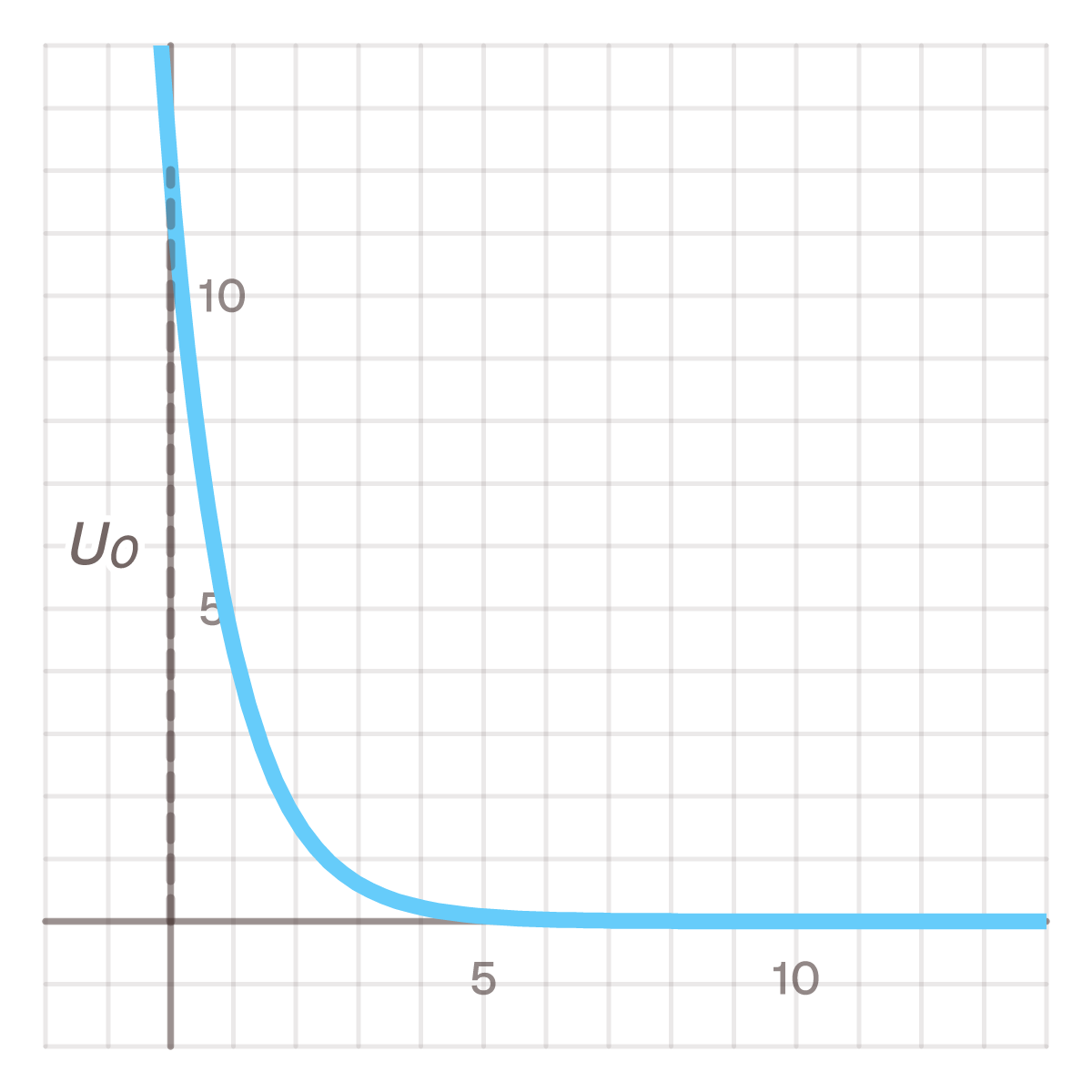
The voltage across a capacitor as it discharges through a resistor, falling from its initial value toward zero. After one RC time constant it has fallen to about 37% of where it started.
Solve for

U≈4.4146V

U equals 12 times e to the power of (minus (0.001 divided by (1,000 times 1 times 10 to the power of minus 6))), equals 12 times e to the power of (minus (0.001 divided by 0.001)), equals 12 times e to the power of (minus 1), equals 12 times e to the power of −1, is approximately 12 times 0.3679, is approximately 4.4146 V

Working6 steps

The formula

U = U₀ · e^(−t / RC)

U₀ is the voltage the capacitor starts with, R the resistance it empties through, C the capacitance, t the time and U the voltage left.

A resistor and a capacitor together are called an RC circuit.

Holds for a capacitor emptying through a resistor, with no voltage source in the circuit.

A capacitor charged to 12 V empties through 1 kΩ, with 1 µF, for 1 ms: t / RC = 1, so U = 12 · e⁻¹ = 12 · 0.368 = 4.41 V.

The same share goes every time constant

Time Voltage left Share of 12 V
1 ms (1 τ) 4.41 V 36.8%
2 ms (2 τ) 1.62 V 13.5%
3 ms (3 τ) 0.60 V 5.0%
5 ms (5 τ) 0.08 V 0.7%

Each time constant takes away the same 63% of what is left. That is exponential decay, the same shape as radioactive decay, and it has a half-life too: the voltage halves every RC · ln 2 = 0.69 ms here.

Put the two curves side by side and they add up: at every moment the charging voltage and the discharging voltage sum to U₀. 7.59 + 4.41 = 12.

Solving for the time

How long until 12 V is down to 1 V? t = 1 ms · ln 12 = 2.48 ms.

Common mistakes

Questions people ask

Why can a switched-off device still give a shock? Because large capacitors hold their charge until something discharges them. With a big C and a large bleed resistor, RC can be minutes — which is why power supplies warn against opening them straight away.

Where does the energy go? Into heat in the resistor: all of the C · U₀² / 2 stored in the capacitor.

Looking for another letter? The formula solved for each one
Solved for each letter
Solve forRearrangedWith the numbersComes to
U₀UetRC4.4146e0.0011,000·1 × 10⁻⁶12 V
RtC ln(U₀U)0.0011 × 10⁻⁶ ln(124.4146)1,000 Ω
CtR ln(U₀U)0.0011,000 ln(124.4146)1 × 10⁻⁶ F
tRC ln(U₀U)1,000·1 × 10⁻⁶ ln(124.4146)0.001 s
UU₀e−tRC12e−0.0011,000·1 × 10⁻⁶4.4146 V

Last reviewed October 6, 2026 ·How pages are reviewed

ElectricityAll formulas

Put this formula on your site

Copy the code into your page where the formula card should appear. It loads from lovetocalc.com, so it stays current on its own — all we ask is that the credit line comes with it.