Skip to content
LoveToCalc

Definition — what does that mean?

Coulomb's law

Like charges push apart, opposite charges pull together, and the force falls off with the distance squared.

In Swedish: Coulombs lag

Coulomb's law

The relation

F=kq₁q₂r²

Coulomb's constant times the two charges, divided by the distance squared. Like charges push apart, opposite charges pull together, and twice the distance gives a quarter of the force.
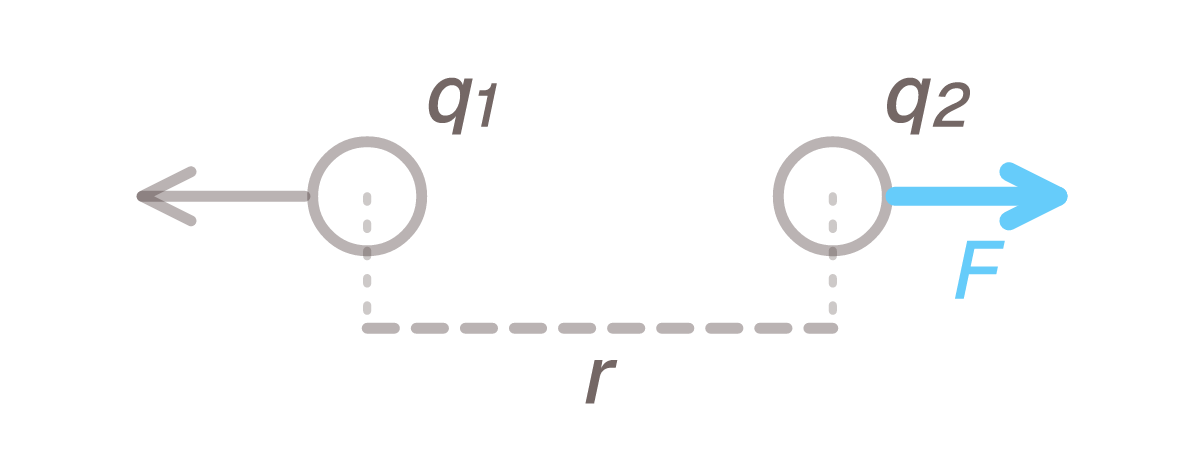
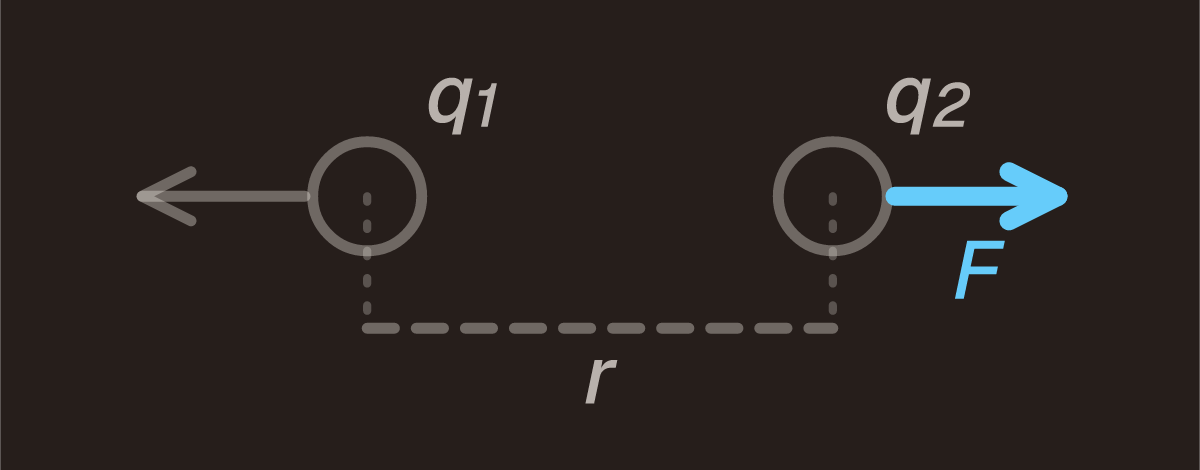
Two charges q₁ and q₂ the distance r apart, measured between their centres. Arrows push each charge away from the other with the force F; the force on one is as large as the force on the other.
Solve for

F≈0.018N

F equals (8.99 times 10 to the power of 9 times (4 times 10 to the power of minus 6 times 2 times 10 to the power of minus 6)) divided by 2 squared, equals (8.99 times 10 to the power of 9 times 8 times 10 to the power of minus 12) divided by 4, is approximately 0.0719 divided by 4, is approximately 0.018 N

Working4 steps

The formula

F = k · q₁ · q₂ / r²

F is the force in newtons, k Coulomb’s constant 8.99 · 10⁹ N·m²/C², q₁ and q₂ the charges in coulombs and r the distance between them in metres.

Holds for point charges, or spherically symmetric charges measured from their centres, in a vacuum; in air almost exactly.

What it says

The formula has the same shape as Newton’s law of gravitation: two quantities multiplied, divided by the distance squared. The difference is that charge has a sign. Like signs give a positive force that pushes apart, opposite signs a negative one that pulls together.

Worked examples

The defaults. 4 µC and 2 µC, 2 m apart: F = 8.99 · 10⁹ · 4 · 10⁻⁶ · 2 · 10⁻⁶ / 2² ≈ 0.018 N.

The hydrogen atom. The electron and the proton each carry 1.602 · 10⁻¹⁹ C and sit 5.29 · 10⁻¹¹ m apart. F ≈ 8.2 · 10⁻⁸ N. Gravity between them is about 10³⁹ times weaker, which is why chemistry can leave it out.

Common mistakes

Frequently asked questions

Why is k so large? Because a coulomb is an enormous charge. Two 1 C charges a metre apart would push each other with 9 billion newtons. Everyday charges are measured in micro- and nanocoulombs.

Looking for another letter? The formula solved for each one
Solved for each letter
Solve forRearrangedWith the numbersComes to
kFr²q₁q₂0.018·2²4 × 10⁻⁶·2 × 10⁻⁶8.99 × 10⁹ N·m²/C²
q₁Fr²kq₂0.018·2²8.99 × 10⁹·2 × 10⁻⁶4 × 10⁻⁶ C
q₂Fr²kq₁0.018·2²8.99 × 10⁹·4 × 10⁻⁶2 × 10⁻⁶ C
rkq₁q₂F8.99 × 10⁹·4 × 10⁻⁶·2 × 10⁻⁶0.0182 m
Fkq₁q₂r²8.99 × 10⁹·4 × 10⁻⁶·2 × 10⁻⁶2²0.018 N

Last reviewed October 6, 2026 ·How pages are reviewed

ElectricityAll formulas

Put this formula on your site

Copy the code into your page where the formula card should appear. It loads from lovetocalc.com, so it stays current on its own — all we ask is that the credit line comes with it.