Skip to content
LoveToCalc

Definition — what does that mean?

Capacitors in series

Two capacitors one after the other hold less than either one alone.

In Swedish: Kondensatorer i serie

Capacitors in series

The relation

1C=1C₁+1C₂

The reciprocals add, so the total is smaller than the smallest capacitor. It is the rule for resistors in parallel, turned around.
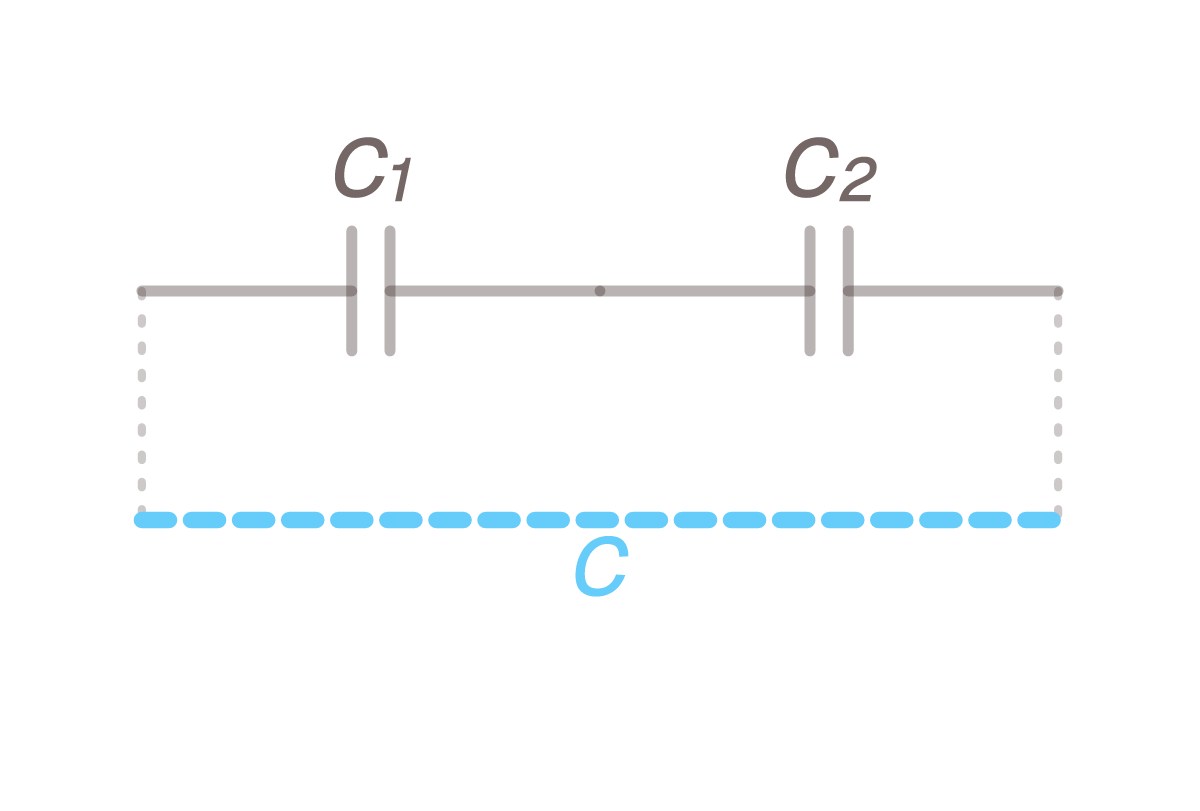
Two capacitors C₁ and C₂ one after the other between two terminals. The dashed line below marks the total capacitance C, measured between the terminals.
Solve for
Solved for C

C=C₁C₂C₁+C₂

C=1.5 × 10⁻⁶F

C equals (6 times 10 to the power of minus 6 times 2 times 10 to the power of minus 6) divided by (6 times 10 to the power of minus 6 plus 2 times 10 to the power of minus 6), equals 1.2 times 10 to the power of minus 11 divided by 8 times 10 to the power of minus 6, equals 1.5 times 10 to the power of minus 6 F

Working3 steps

The formula

1 / C = 1 / C₁ + 1 / C₂

C is the total capacitance, C₁ and C₂ the capacitances of the two capacitors, all in the same unit.

Why the reciprocals add

In series both capacitors take the same charge, while the voltage is shared between them. The voltage across each is Q / C₁ and Q / C₂. Their sum is the total voltage Q / C, and with Q cancelled the formula is left. It is the same rule as for resistors in parallel, only for series.

Worked examples

The defaults. 6 µF and 2 µF: 1 / C = 1/6 + 1/2 = 4/6, so C = 1.5 µF.

Two equal ones. Two 10 µF capacitors in series give 5 µF, half. Each then takes half the voltage, and that is a common reason to put them in series: to handle a higher voltage. In practice each capacitor often needs a resistor across it so that the voltage divides evenly.

Common mistakes

Frequently asked questions

Is there a shorter formula for two capacitors? Yes: C = C₁ · C₂ / (C₁ + C₂), the product over the sum. For 6 and 2 µF that is 12 / 8 = 1.5 µF.

Looking for another letter? The formula solved for each one
Solved for each letter
Solve forRearrangedWith the numbersComes to
C₁CC₂C₂−C1.5 × 10⁻⁶·2 × 10⁻⁶2 × 10⁻⁶−1.5 × 10⁻⁶6 × 10⁻⁶ F
C₂CC₁C₁−C1.5 × 10⁻⁶·6 × 10⁻⁶6 × 10⁻⁶−1.5 × 10⁻⁶2 × 10⁻⁶ F
CC₁C₂C₁+C₂6 × 10⁻⁶·2 × 10⁻⁶6 × 10⁻⁶+2 × 10⁻⁶1.5 × 10⁻⁶ F

Last reviewed October 6, 2026 ·How pages are reviewed

ElectricityAll formulas

Put this formula on your site

Copy the code into your page where the formula card should appear. It loads from lovetocalc.com, so it stays current on its own — all we ask is that the credit line comes with it.