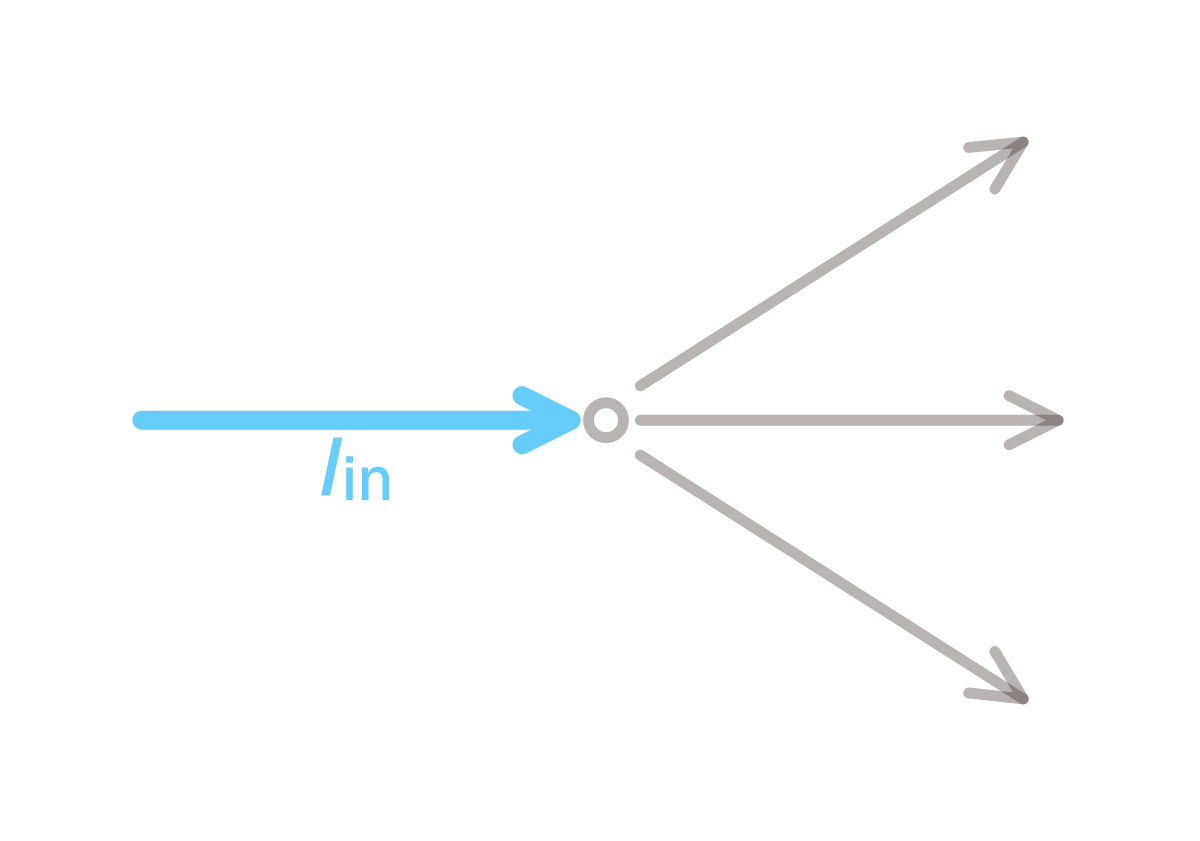
I_in is the current into the junction and I_out the currents leaving it along the branches. Three
branches carrying 0.6 A, 1.5 A and 0.45 A are fed by a wire carrying 0.6 + 1.5 + 0.45 = 2.55 A.
It is also called the junction rule, or Kirchhoff’s first rule.
Holds when the circuit is steady, so that no charge collects at the junction itself. That covers direct
current and the instantaneous values of alternating current in an ordinary circuit.
Charge does not pile up
Current is charge per second. If more charge arrived each second than left, it would collect at the
junction, which would quickly build up a voltage that stopped the inflow. The law is conservation of
charge, written for one point in a circuit.
The general form has sums on both sides: ΣI_in = ΣI_out. The calculator handles the case a problem
usually draws, one current in and several out. If a junction instead has several currents in and one
out, enter the incoming ones in the list and read the answer as the current out.
The sign convention
Draw an arrow for each current before calculating, and decide which go in and which go out. Then enter
the sizes. If a branch comes out negative when you solve for it, its current flows against the arrow.
| Branch |
Arrow |
Current |
| Main wire |
in |
2.55 A |
| Branch 1 |
out |
0.6 A |
| Branch 2 |
out |
1.5 A |
| Branch 3 |
out |
0.45 A |
Worked examples
A missing current. 3.2 A enters a junction and two of three branches carry 1.4 A and 0.9 A. The
third carries 3.2 − 1.4 − 0.9 = 0.9 A.
A parallel circuit with Ohm’s law. Resistors of 6 Ω and 12 Ω are connected in parallel across 12 V.
The branch currents are 12/6 = 2 A and 12/12 = 1 A, so the main wire carries 3 A.
Resistance in parallel gives the same: 4 Ω
across 12 V draws 3 A.
Where to go next
The voltages round a closed loop follow
Kirchhoff’s voltage law. The current in each
branch comes from Ohm’s law.
Common mistakes
- Mixing up in and out. A current leaving the junction is not added to the current entering it.
- Counting a branch twice. A branch that splits again further on is counted here only once, where it
starts.
- Adding voltages instead. Parallel branches share the same voltage. It is the currents that add.
Frequently asked questions
Does the current law hold for alternating current?
Yes, for the instantaneous values. rms values cannot always be added directly when the branches
contain coils or capacitors, because the branch currents are then out of phase with each other.
What else is it called?
Kirchhoff’s first law, KCL, or the junction rule.