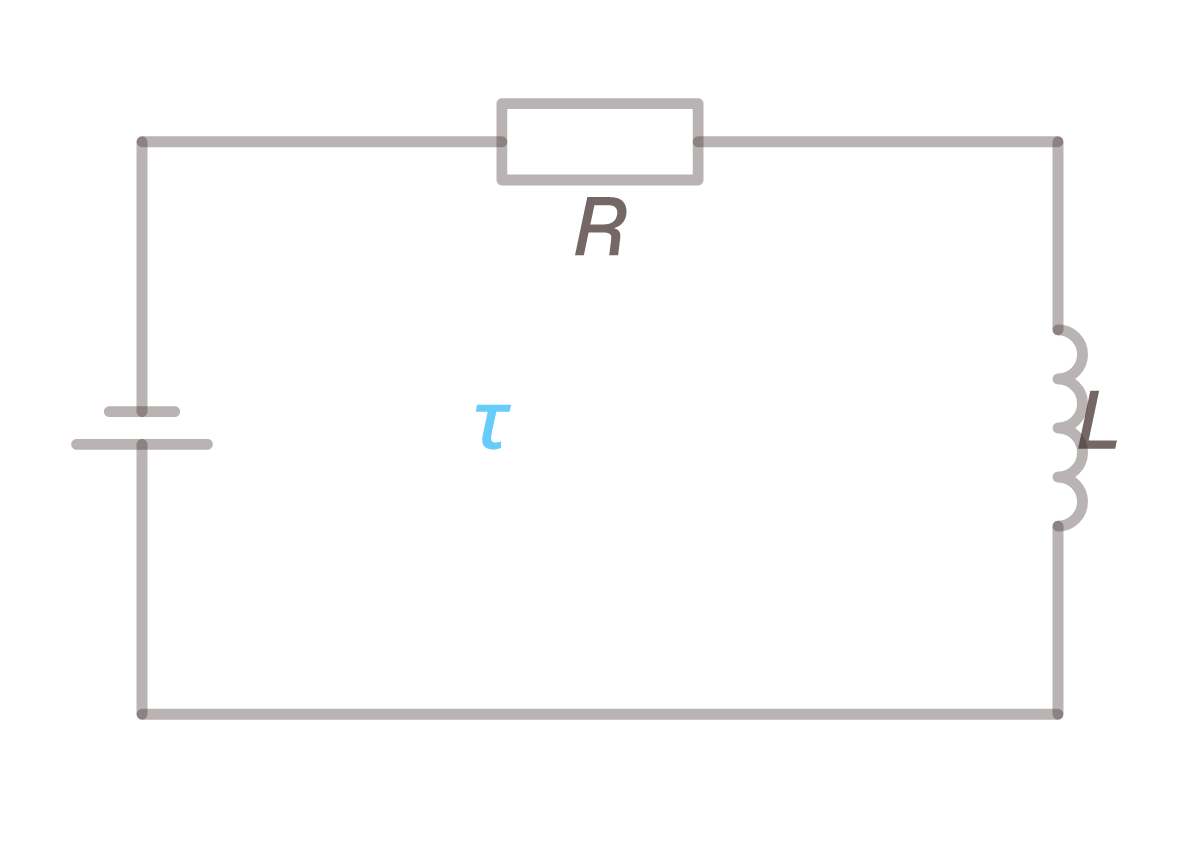
τ = L / R
τ is the time constant in seconds, L the inductance in henries and R the resistance in ohms.
Holds for a coil of constant inductance switched onto a constant voltage through a resistor.
A 0.5 H coil in a circuit with 100 Ω: τ = 0.5 / 100 = 0.005 s = 5 ms.
After one τ, the current has reached 63% of its final value U / R; after five, it is there for all practical
purposes. The table is the same as for the RC time constant.
Why divided, when RC is multiplied?
A coil resists changes in current — when the current rises, the coil
induces a voltage against it. A larger inductance fights
harder, so τ grows with L. A larger resistance means a smaller final current to reach, and the coil gets
there sooner, so τ shrinks with R.
In an RC circuit it is the other way round: a larger resistance lets less current through to fill the
capacitor, so τ grows with R. Mixing up the two is a common mistake.
A second example
A relay coil. 1 H and 50 Ω: τ = 1 / 50 = 20 ms. Doubling the resistance to 100 Ω halves τ to 10 ms,
which is why relay drivers sometimes add series resistance and raise the supply voltage by the same factor:
the current reaches the same final value in half the time, and the relay pulls in faster.
Common mistakes
- L · R instead of L / R. 0.5 · 100 = 50 s, ten thousand times too long.
- R / L. 100 / 0.5 = 200 — that is 1/τ, in per second.
- Millihenries unconverted. 50 mH is 0.05 H.
Questions people ask
What happens if the circuit is broken suddenly?
The coil tries to keep the current flowing and the voltage across the gap can jump very high — the spark
in an ignition coil. A diode across relay coils is there to give that current a path.
How much energy is in the coil once the current is steady?
W = L · I² / 2 — see the energy stored in an inductor.