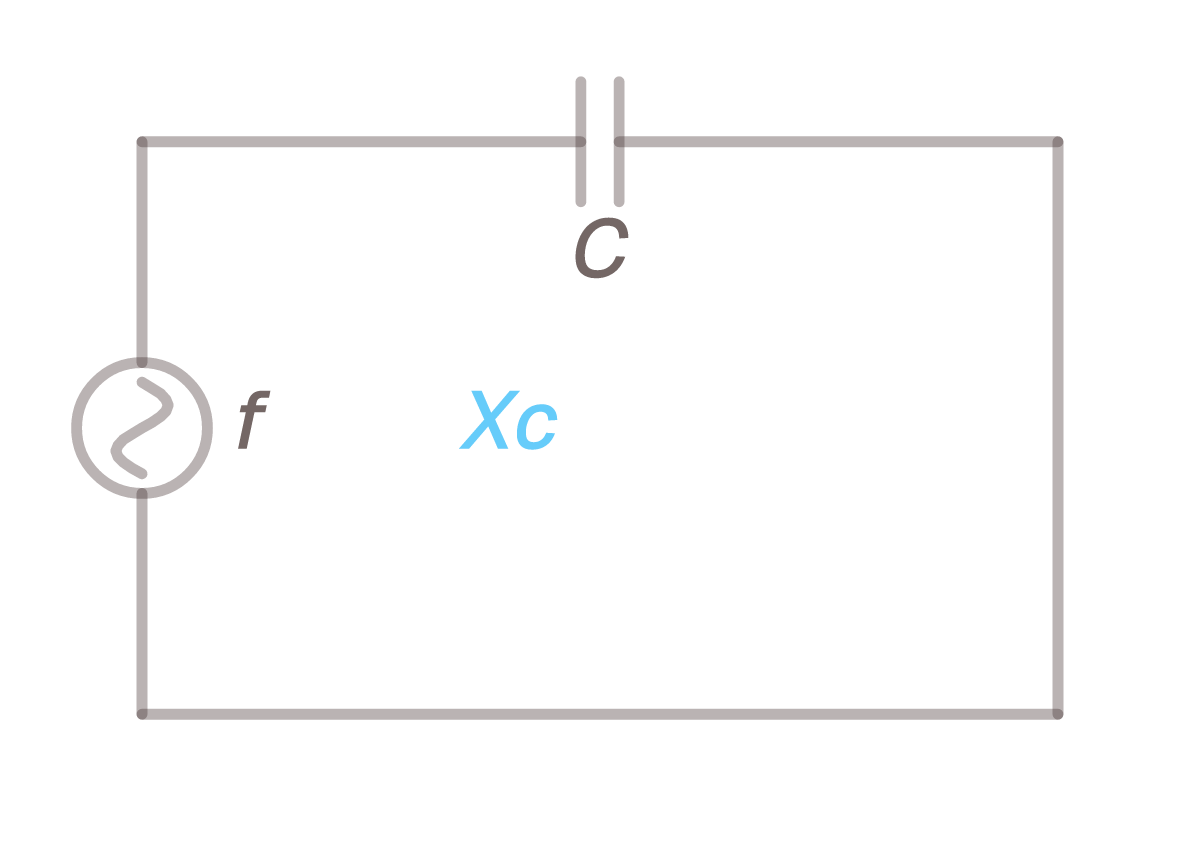
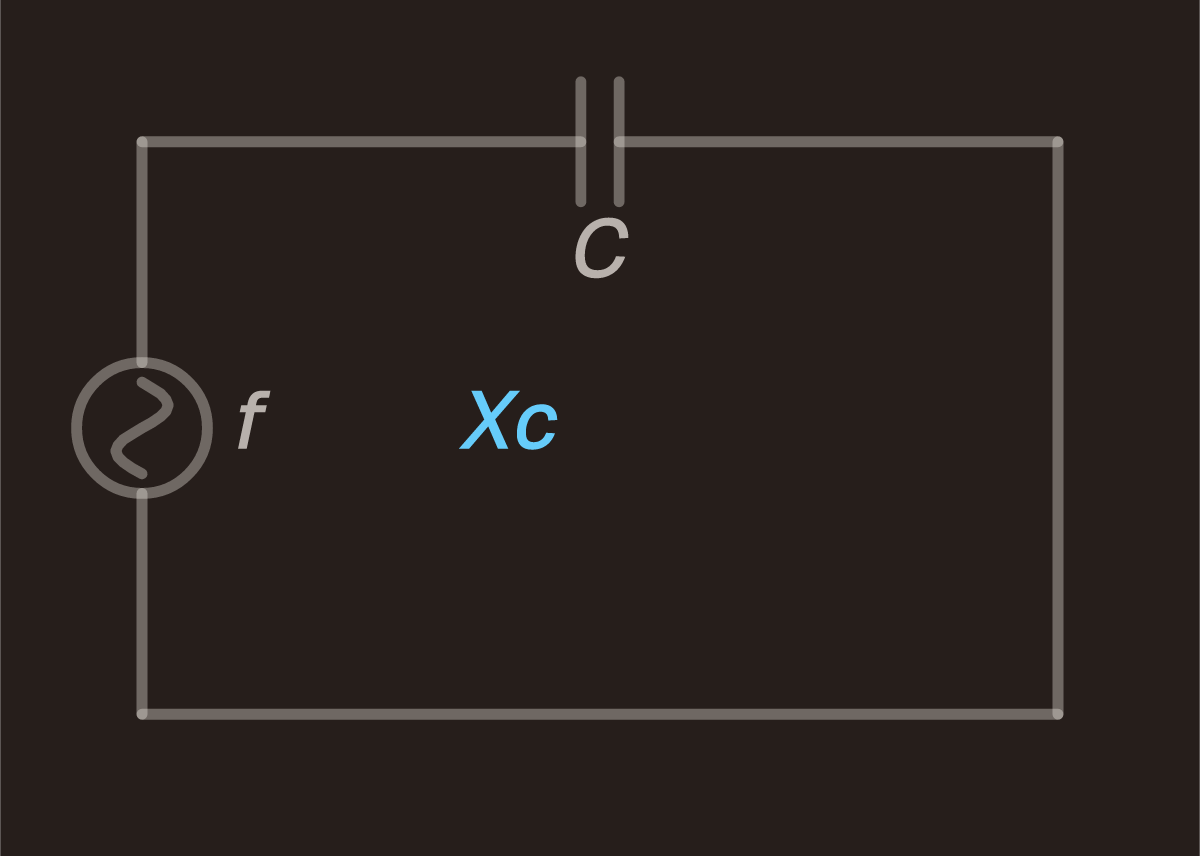
Xc = 1 / (2π · f · C)
Xc is the capacitive reactance in ohms, f the frequency in hertz and C the capacitance in farads.
Holds for an ideal capacitor on a sinusoidal alternating voltage.
50 Hz and 0.1 µF: Xc = 1 / (2π · 50 · 0.000 000 1) ≈ 31,831 Ω.
At mains frequency a small capacitor lets almost nothing through. Raise the frequency and the picture changes.
It falls as the frequency rises
f and C both sit in the denominator, so doubling either one halves the reactance.
| Frequency |
Capacitance |
Xc |
| 50 Hz |
0.1 µF |
31,831 Ω |
| 50 Hz |
1 µF |
3,183 Ω |
| 1 kHz |
1 µF |
159.15 Ω |
At 0 Hz — plain direct current — the reactance is infinite: once the capacitor is charged, no current flows
at all. That is why a capacitor is used to block DC while letting an AC signal pass, as in the coupling
capacitor between two amplifier stages.
The intuition: a capacitor opposes a change in voltage. At a high frequency it never has time to fill
before the current turns around, so it hardly gets in the way.
Reactance is not resistance
Both are measured in ohms, and U = Xc · I works just like Ohm’s law
for the sizes of voltage and current. But a reactance uses no energy: what the capacitor takes in one quarter
of a cycle it gives back in the next. The current also runs a quarter of a cycle ahead of the voltage, which
is why a resistance and a reactance cannot simply be added — see the
impedance of an RLC circuit.
Common mistakes
- Microfarads left as microfarads. 1 / (2π · 50 · 1) ≈ 0.003 Ω instead of 3,183 Ω. Convert to farads.
- Forgetting the 2π. 1 / (f · C) mixes ordinary frequency with angular frequency ω = 2πf.
- Expecting Xc to grow with C. A larger capacitor has a smaller reactance — the opposite of how a
larger resistor behaves.
Questions people ask
What is the inductive counterpart?
Inductive reactance, Xl = 2πfL, which grows with
frequency instead. The frequency where the two are equal is the
LC resonant frequency.
Why do some books write Xc = 1 / (ωC)?
They use the angular frequency ω = 2πf in radians per second. It is the same formula with the 2π folded in.