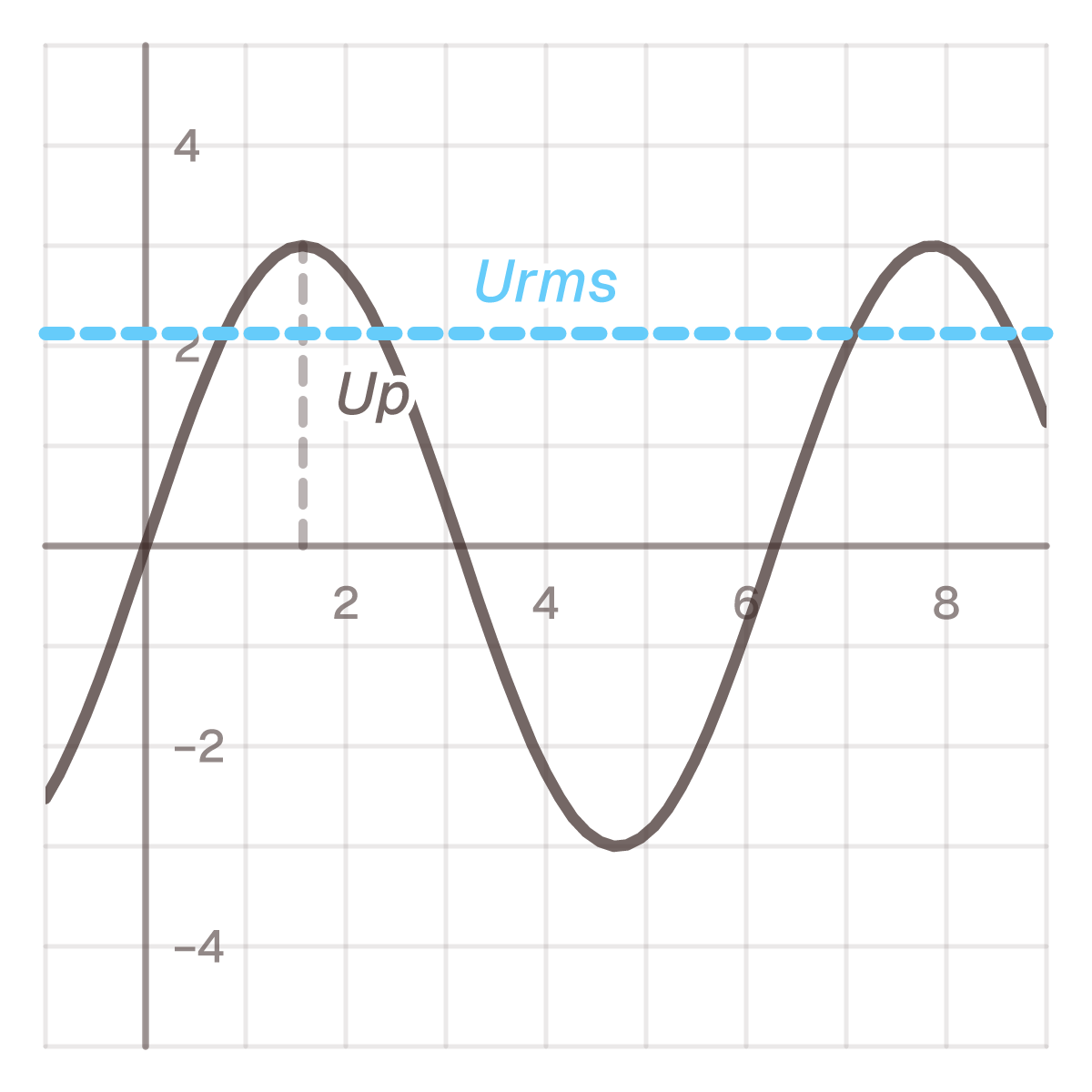
Urms = Up / √2
Urms is the RMS (root mean square) voltage and Up the peak voltage of a sine wave, both in volts.
A sine wave peaking at 325 V: Urms = 325 / √2 ≈ 229.8 V — the 230 V of European mains.
Peaking at 12 V: Urms = 12 / 1.414 ≈ 8.49 V.
Going the other way, 230 V mains peaks at 230 · √2 ≈ 325 V, and swings from +325 V to −325 V, a full 650 V
from top to bottom.
Why the RMS value is the one that counts
To a heater it makes no difference which way the current runs; its power
is U² / R at every instant. Average U² over a whole cycle of a sine wave and you get Up² / 2. The steady
voltage with that same U² is its square root, Up / √2. So a kettle on 230 V AC heats just as fast as it
would on 230 V DC.
That is why an RMS voltage plugs straight into Ohm’s law and the
power formulas: 230 V across 52.9 Ω gives 230² / 52.9 = 1,000 W, the same as with direct current.
RMS is not the average
The plain average of a sine wave over a cycle is zero — it spends as long below the axis as above. Even the
average of the rectified wave, 2Up / π ≈ 206.9 V for mains, is below the RMS value. Cheap multimeters
measure that average and scale it up by assuming a pure sine; on a distorted waveform they read wrong, which
is what “true RMS” on a meter’s label protects against.
Common mistakes
- Treating 230 V as the peak. Insulation and components have to survive 325 V, not 230 V.
- Dividing by 2 instead of √2. 162.5 V is nothing in particular.
- Using √2 for a non-sine wave. A square wave’s RMS equals its peak; a triangle wave’s is Up / √3. The √2
belongs to the sine.
Questions people ask
Does the same apply to current?
Yes. For a sinusoidal current Irms = Ip / √2, and a “10 A” rating is an RMS value.
Why is it called root mean square?
It is the recipe backwards: square the voltage, take the mean over a cycle, then the root.