Electrical work
The relation
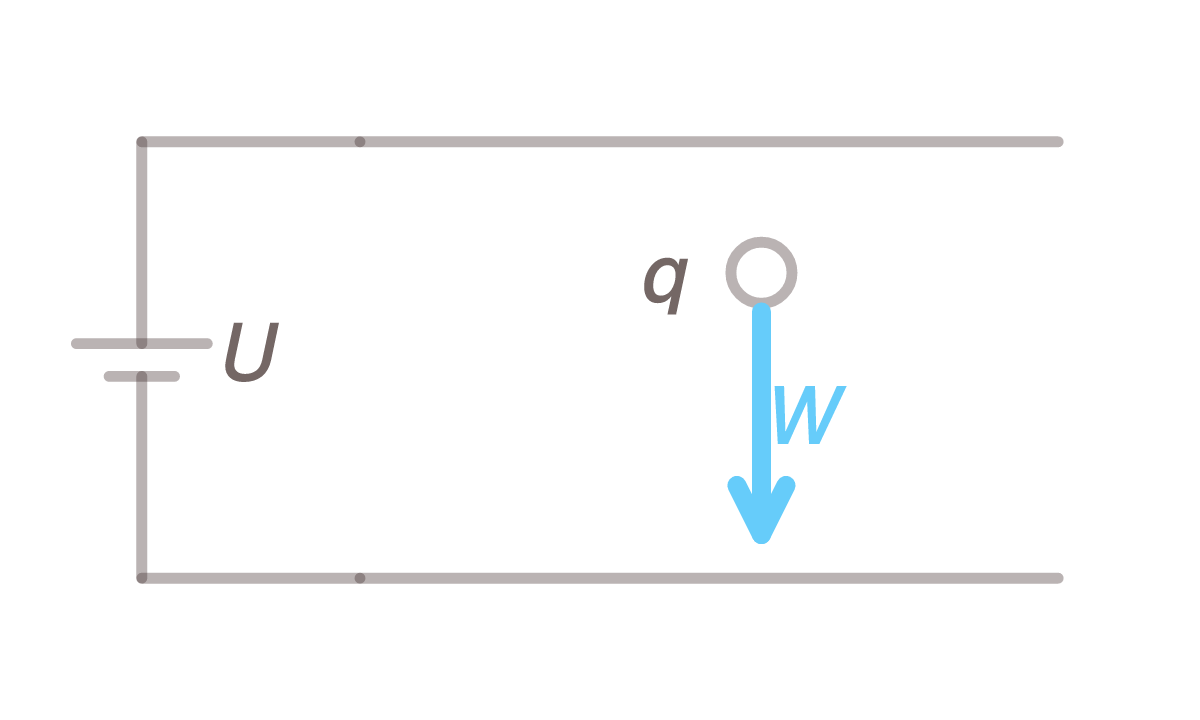
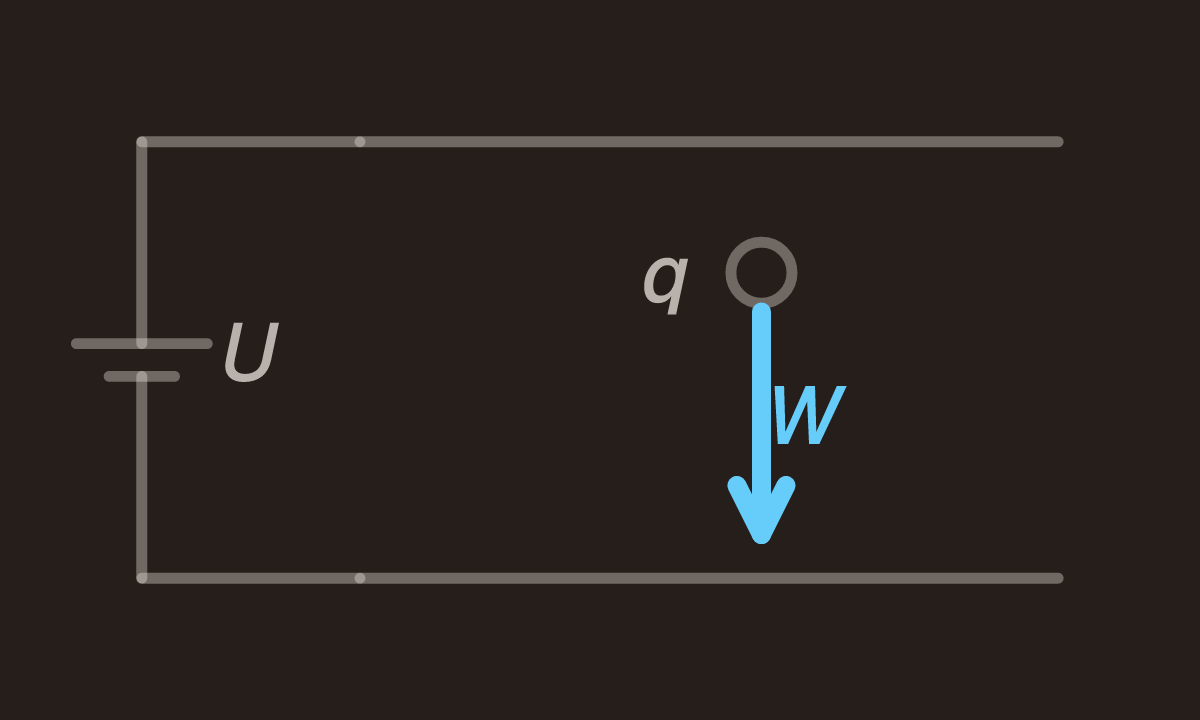
W
Charge times voltage. A volt is a joule per coulomb, so the voltage says how much energy each coulomb picks up or leaves behind on its way through.
Solve for
W=24J
W equals 2 times 12, equals 24 J
Den här sidan finns på svenska. Byt till svenska
Definition — what does that mean?
A volt is a joule per coulomb. Multiply by the charge and you have the energy.
In Swedish: Elektriskt arbete
W
Charge times voltage. A volt is a joule per coulomb, so the voltage says how much energy each coulomb picks up or leaves behind on its way through.
W=24J
W equals 2 times 12, equals 24 J
You are given
W = q · U
W is the work or energy in joules, q the charge in coulombs and U the voltage in volts. The formula
is really the definition of the volt: the voltage between two points is how many joules each coulomb
picks up or gives up going from one to the other.
Charge is current times time, q = I · t (see electric charge). Put that in and W = U · I · t, the power times the time. The formulas say the same thing; this one fits when the charge is what you know.
The defaults. 2 C through 12 V: W = 2 · 12 = 24 J.
A phone battery. A 3,000 mAh battery holds 3 A · 3,600 s = 10,800 C. At 3.7 V the energy is 10,800 · 3.7 ≈ 40,000 J, about 11 Wh.
The other way round. How much charge has to pass through a 230 V lamp for it to convert 1,000 J? q = 1,000 / 230 ≈ 4.3 C.
What is an electronvolt?
The energy an electron gains passing through 1 V. The electron’s charge is very small, so an electronvolt
is a very small energy. The unit is used in atomic and nuclear physics.
Can the work be negative?
Yes: if the charge goes the other way through the voltage, it gives up energy instead of gaining it. The
calculator works with the size and leaves you to keep track of the direction.
| Solve for | Rearranged | With the numbers | Comes to |
|---|---|---|---|
| q | WU | 2412 | 2 C |
| U | Wq | 242 | 12 V |
| W | qU | 2·12 | 24 J |
Last reviewed September 24, 2026 ·How pages are reviewed
Copy the code into your page where the formula card should appear. It loads from lovetocalc.com, so it stays current on its own — all we ask is that the credit line comes with it.