Skip to content
LoveToCalc

Definition — what does that mean?

Force on a moving charge in a magnetic field

The field pushes a moving charge sideways. It turns, but its speed stays the same.

In Swedish: Kraft på rörlig laddning i magnetfält

Force on a moving charge in a magnetic field

The relation

F=qvB

Charge times speed times flux density, for a charge moving at right angles to the field. The force is sideways to the motion, so it bends the path without changing the speed.
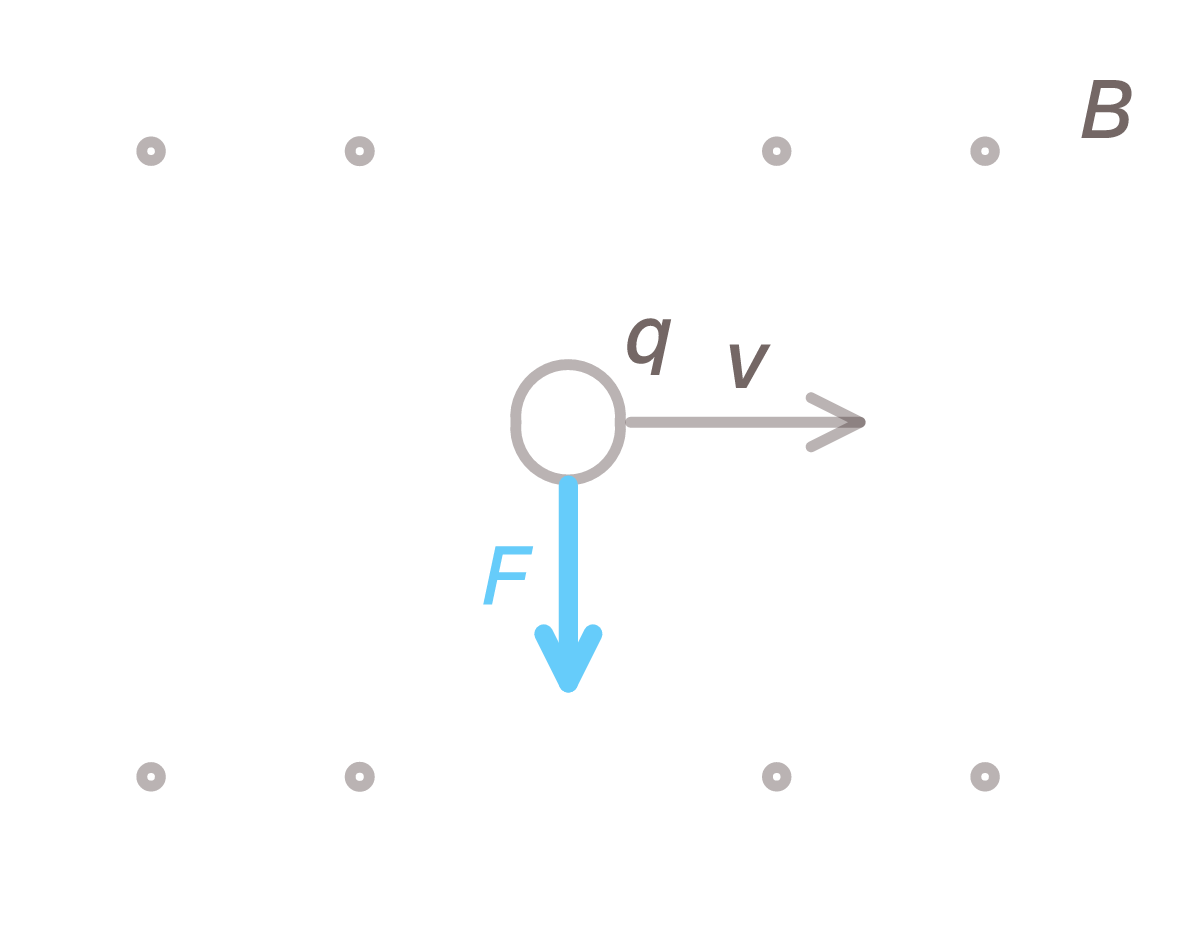
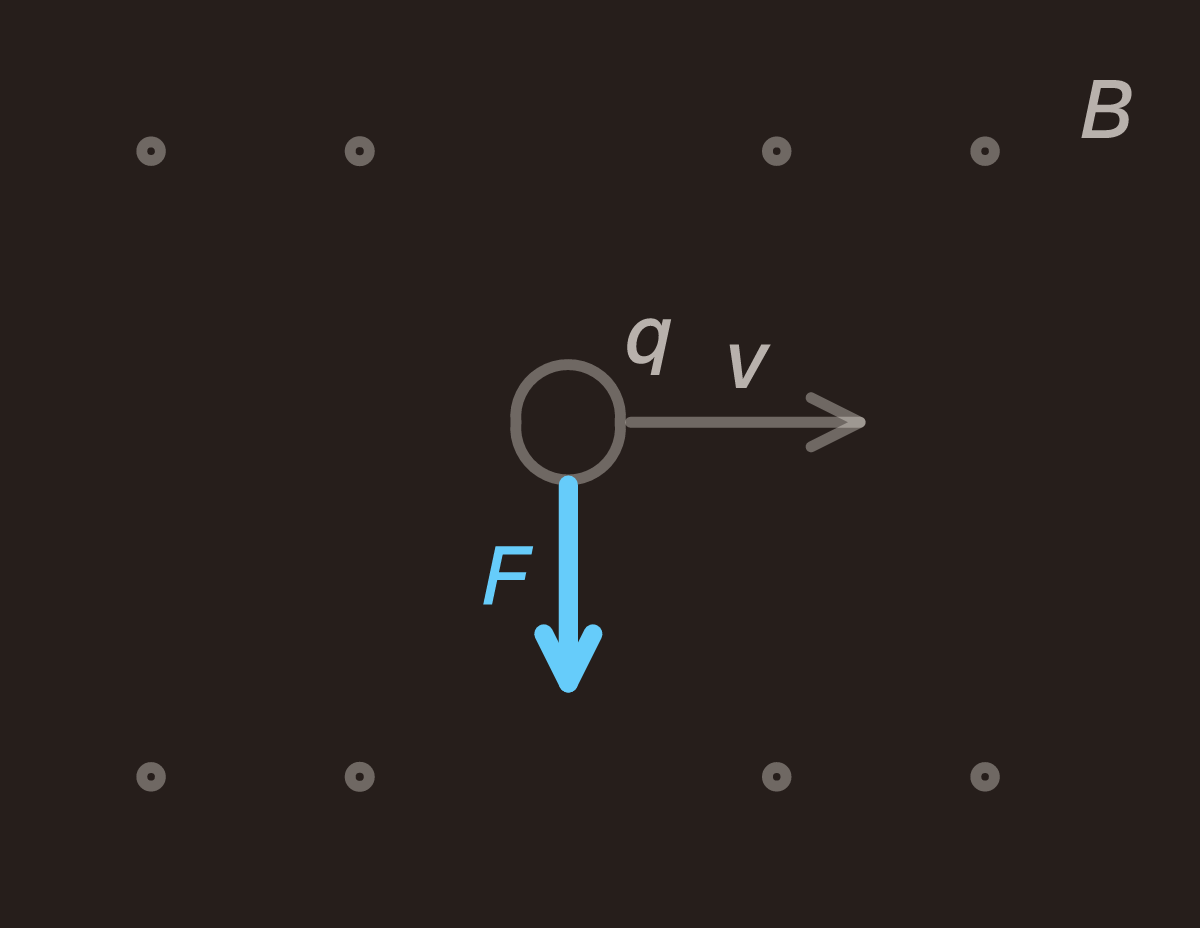
A charge q moves to the right with the speed v in a magnetic field B that points out of the page (the dots). An arrow downwards shows the force F on the charge, at a right angle to both v and B.
Solve for

F=4N

F equals 0.02 times (50 times 4), equals 0.02 times 200, equals 4 N

Working3 steps

Practice questions

You are given

  • q=0.43C
  • v=81m/s
  • B=0.7T

Round to 2 decimals.

The formula

F = q · v · B

F is the force in newtons, q the charge in coulombs, v the speed in m/s and B the flux density in tesla. The formula holds when the charge moves at right angles to the field. A charge at rest, or one moving along the field, feels no magnetic force at all.

It is the magnetic part of the Lorentz force.

The force changes direction, not speed

The force is always at right angles to the motion. It never pulls the charge forward or back; it only bends the path. A charged particle moving at right angles to a uniform magnetic field goes round in a circle at constant speed; if it also moves along the field, the path is a spiral. Mass spectrometers and particle accelerators use this, and it is why the aurora appears near the poles: charged particles from the sun follow the Earth’s field down towards them.

Worked examples

The defaults. q = 0.02 C, v = 50 m/s and B = 4 T: F = 0.02 · 50 · 4 = 4 N.

The speed from the force. A 0.01 C charge in a 0.5 T field feels a force of 0.2 N: v = 0.2 / (0.01 · 0.5) = 40 m/s.

Common mistakes

Frequently asked questions

What is the Lorentz force? The total force on a charge from both electric and magnetic fields. The magnetic part is this formula.

How does it relate to the force on a wire? The current in a wire is charges in motion. Add up the force on all of them and you get the force on a current-carrying conductor, F = B · I · l.

Looking for another letter? The formula solved for each one
Solved for each letter
Solve forRearrangedWith the numbersComes to
qFvB450·40.02 C
vFqB40.02·450 m/s
BFqv40.02·504 T
FqvB0.02·50·44 N

Last reviewed October 6, 2026 ·How pages are reviewed

ElectricityAll formulas

Put this formula on your site

Copy the code into your page where the formula card should appear. It loads from lovetocalc.com, so it stays current on its own — all we ask is that the credit line comes with it.