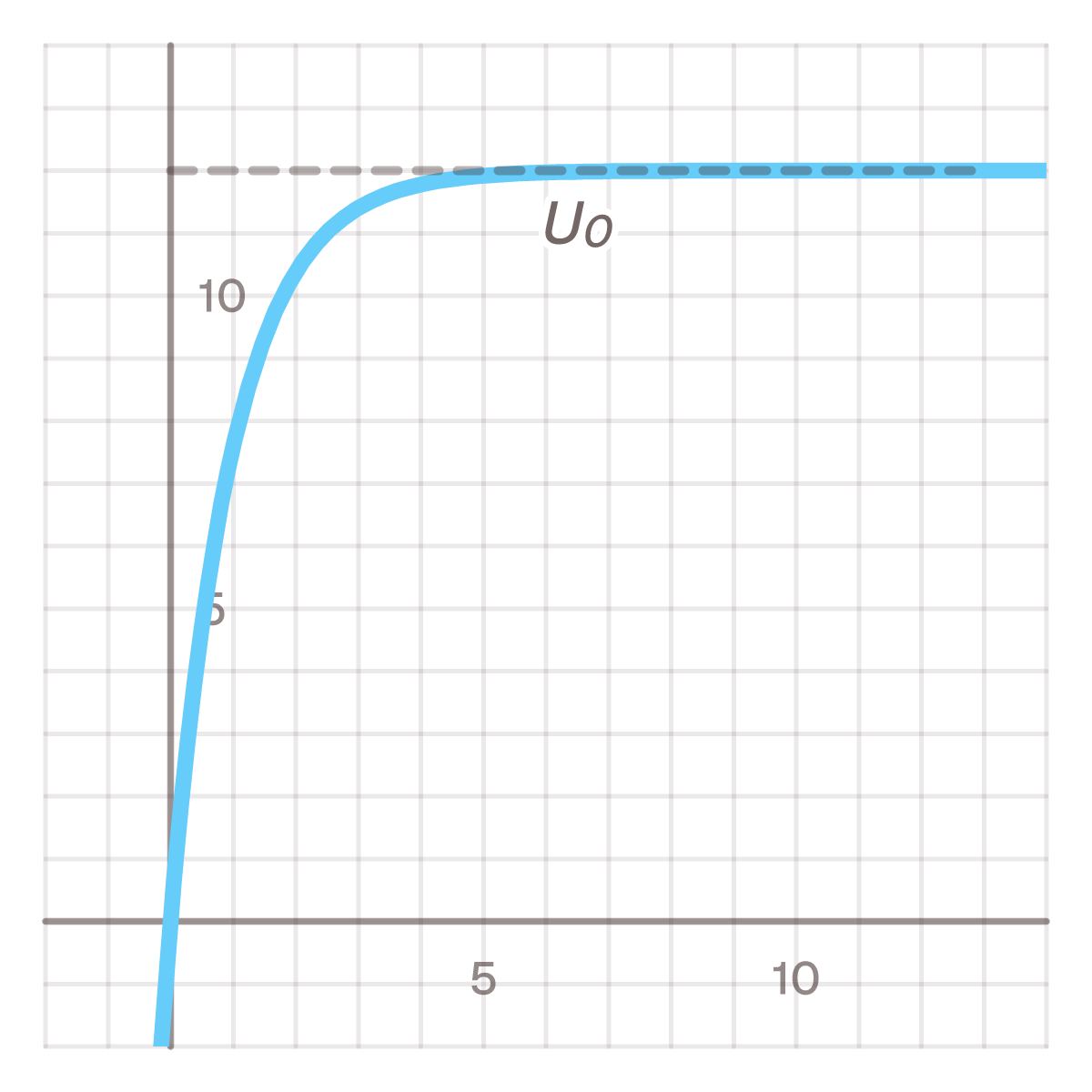
U = U₀ · (1 − e^(−t / RC))
U₀ is the supply voltage, R the resistance, C the capacitance, t the time since the switch closed
and U the voltage across the capacitor at that moment.
A resistor and a capacitor together are called an RC circuit.
Holds for an empty capacitor charged from a constant voltage through a resistor, with t counted from when
the circuit closed.
12 V through 1 kΩ into 1 µF, after 1 ms: RC = 1 ms, so t / RC = 1 and
U = 12 · (1 − e⁻¹) = 12 · 0.632 = 7.59 V.
Fast, then slow
At the start the capacitor is empty, the whole 12 V lies across the resistor and a large current flows.
As the capacitor fills, less voltage is left to push current through R, so it fills more slowly — and the
closer it gets, the slower it goes.
| Time |
Voltage |
Share of 12 V |
| 1 ms (1 τ) |
7.59 V |
63.2% |
| 2 ms (2 τ) |
10.38 V |
86.5% |
| 3 ms (3 τ) |
11.40 V |
95.0% |
| 5 ms (5 τ) |
11.92 V |
99.3% |
The first millisecond adds 7.59 V; the second only 2.79 V more. RC is the
time constant, and the table is the one most RC
problems come back to.
Solving for the time
To find when the capacitor reaches a given voltage, isolate the exponential and take the natural logarithm:
- t = RC · ln(U₀ / (U₀ − U))
When does it reach 6 V, half the supply? t = 1 ms · ln(12 / 6) = 1 ms · ln 2 = 0.69 ms.
Common mistakes
- Forgetting the “1 −”. 12 · e⁻¹ = 4.41 V is the discharging curve.
- Microfarads and kilohms unconverted. Put R in ohms and C in farads so RC comes out in seconds.
- Asking when it reaches 12 V. It never does exactly; ln(12 / 0) has no value. Ask for 99% instead.
Questions people ask
What does the current do meanwhile?
It falls the opposite way: I = (U₀ / R) · e^(−t/RC). Full current at the start, almost none at the end.
How much energy ends up in the capacitor?
C · U₀² / 2 once it is full — see the
energy in a capacitor. The same amount again is
turned to heat in the resistor on the way.