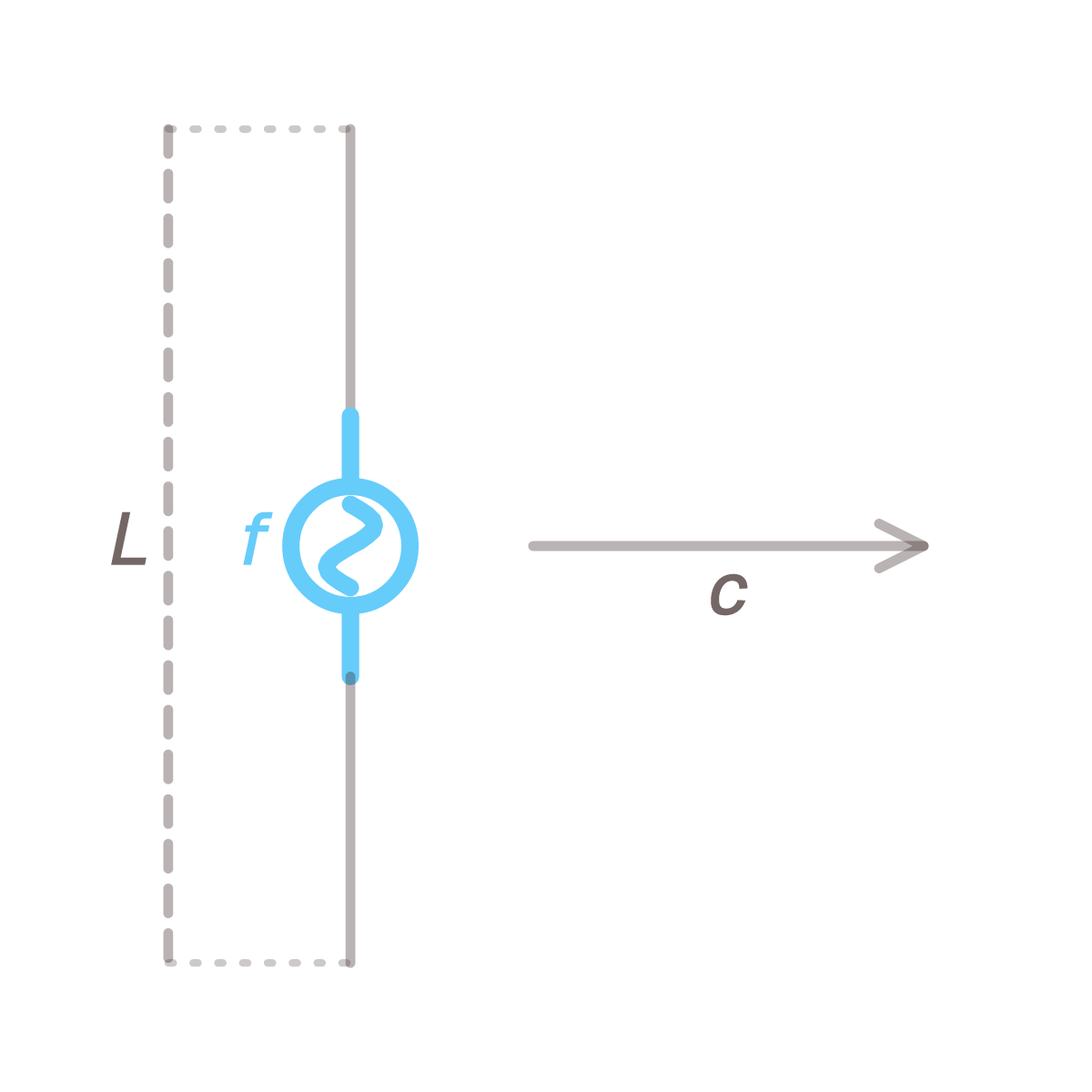
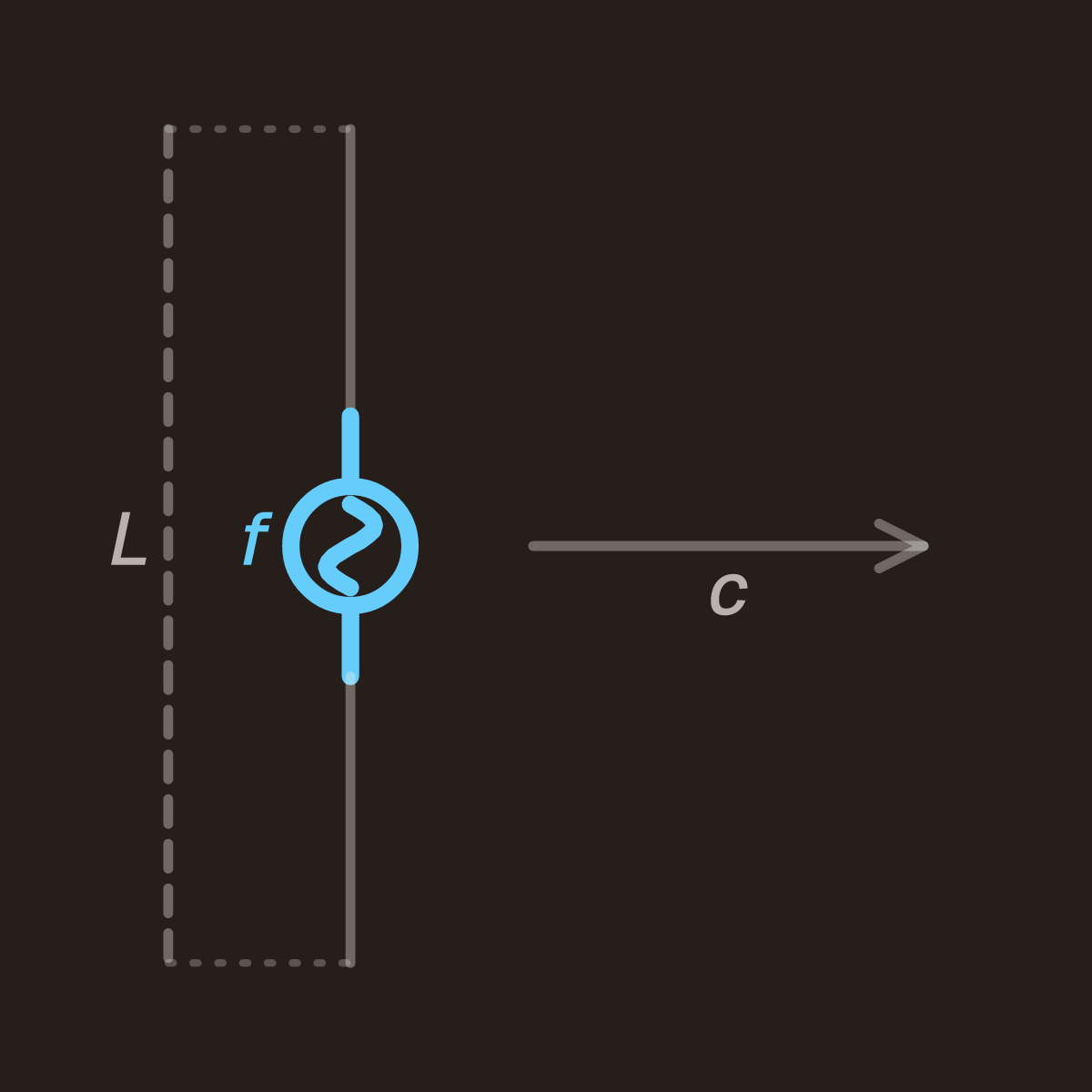
c is the speed of light, 299,792,458 m/s, L the dipole’s full length from tip to tip and f its
fundamental frequency. A dipole 1.5 m long:
f = 299,792,458 / (2 · 1.5) ≈ 99,930,819 Hz ≈ 99.9 MHz.
Holds for a thin, ideal dipole in free space.
Half a wavelength, not a whole one
The current on the dipole forms a standing wave with a node at each end and an antinode in the middle,
where the antenna is fed. That fits on half a wavelength, so λ = 2L. With the
wave speed, c = f · λ, that gives the formula above.
| Assumption |
Answer for L = 1.5 m |
| λ = 2L (right) |
99.9 MHz |
| λ = L (wrong) |
199.9 MHz |
Worked example: cutting an antenna
A dipole is to resonate at 145 MHz. Solve for the length:
L = c / (2f) = 299,792,458 / (2 · 145,000,000) ≈ 1.03 m, that is two arms of about 52 cm.
Taking λ = c/f as the antenna’s length cuts 2.07 m, twice too long.
Where to go next
The speed of light from the field constants is the
speed of an electromagnetic wave, and
the period for a frequency is in frequency and period.
Common mistakes
- λ = L. The dipole is half a wavelength. The answer comes out at twice the frequency or twice the
length.
- One arm instead of the whole. L is the whole dipole; each arm is L/2, a quarter wavelength.
- MHz as Hz. 145 MHz is 145,000,000 Hz.
Frequently asked questions
Does the dipole work at other frequencies?
An ideal centre-fed dipole also resonates near odd multiples of its fundamental, 3f, 5f and so on.
How does it differ from a quarter-wave antenna?
A quarter-wave antenna is a single arm of λ/4 over a ground plane, which mirrors it into a half-wave
dipole. It is therefore half as long for the same frequency.