Wave speed
The relation
v
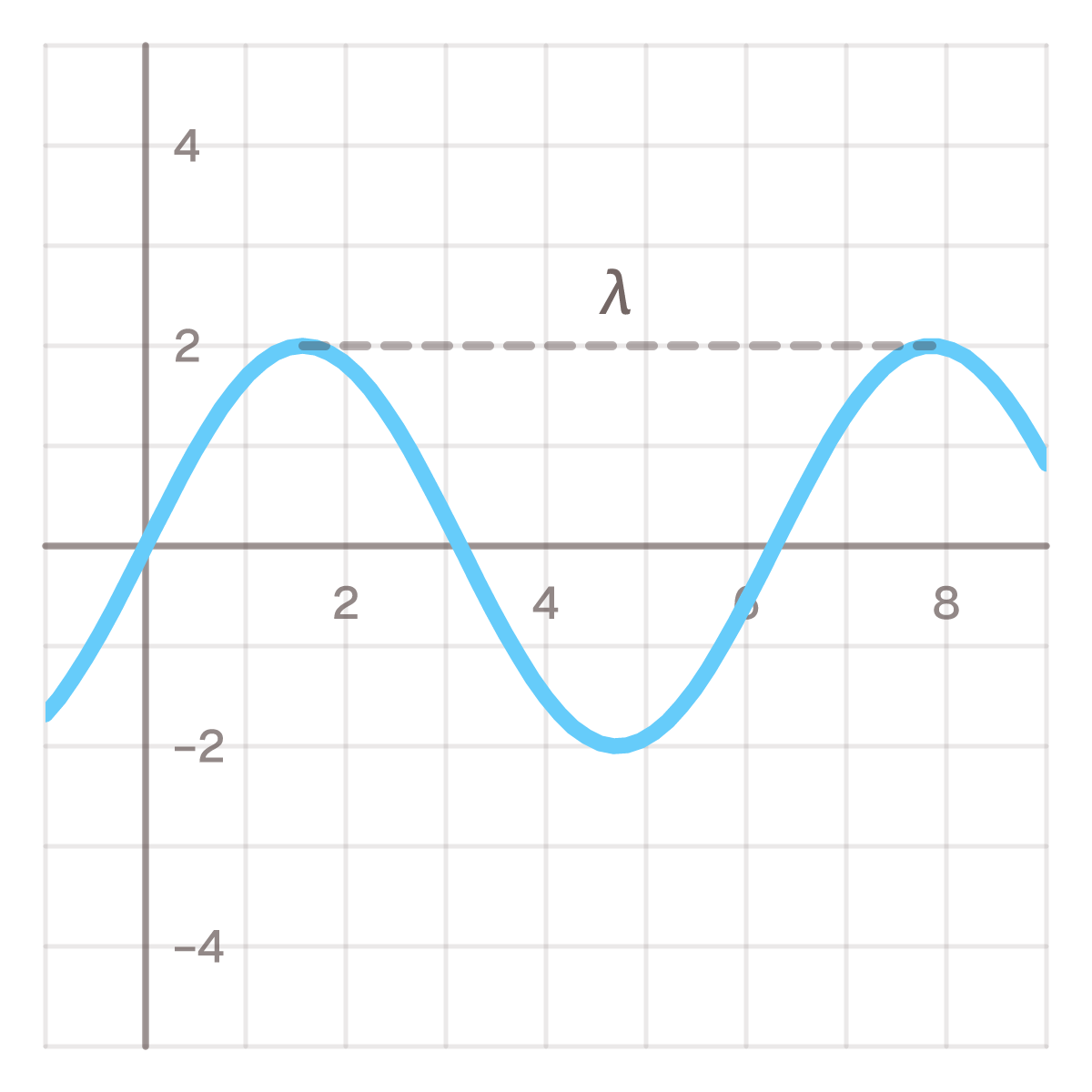
A wave travels one wavelength every period, so its speed is the frequency times the wavelength.
Solve for
v=343m/s
v equals 686 times 0.5, equals 343 m/s
Den här sidan finns på svenska. Byt till svenska
Definition — what does that mean?
Frequency times wavelength — the same formula for sound, light and ripples.
In Swedish: Vågens hastighet
v
A wave travels one wavelength every period, so its speed is the frequency times the wavelength.
v=343m/s
v equals 686 times 0.5, equals 343 m/s
You are given
f is the frequency in hertz, λ (lambda) the wavelength in metres and v the speed in metres per
second. A 686 Hz note in air has a wavelength of 0.5 m: 686 · 0.5 = 343 m/s, the speed of sound.
All the formula really says is that a wave travels one wavelength every period. If that happens 686 times a second and each time the wave moves half a metre, the wave covers 343 metres in a second.
For sound, the speed is set by what the wave travels through, not by its frequency. The same holds for light in vacuum. Water waves and light in glass are exceptions: there the speed also depends on the wavelength, which is how a prism splits white light into colours.
| Sound in | Speed |
|---|---|
| Air (20 °C) | 343 m/s |
| Water | 1,480 m/s |
| Pine, along the grain | 3,600 m/s |
| Steel, in a rod | 5,200 m/s |
The values come from the table of speeds of sound, with a source for every row; in a large steel block the speed is higher than in a rod. Shout underwater and the sound travels four times faster. The frequency, though, is yours — it is set by the source and does not change. What has to give is the wavelength, which becomes four times longer.
Light travels at 300,000 km/s in vacuum and more slowly in glass, which is why it bends on entering a lens.
| Wave | Frequency | Wavelength |
|---|---|---|
| Deep bass | 50 Hz | 6.9 m |
| Concert A | 440 Hz | 0.78 m |
| High note | 10,000 Hz | 3.4 cm |
| FM radio | 100 MHz | 3 m |
| Mobile network | 2 GHz | 15 cm |
| Red light | 430 THz | 700 nm |
| Blue light | 650 THz | 460 nm |
Radio waves and light are the same kind of wave travelling at the same speed in vacuum; what separates them is where on the scale they sit. Long waves also bend around obstacles better than short ones.
The wavelength of concert A. 343 / 440 ≈ 0.78 m.
The frequency of a one-metre sound wave. 343 / 1 = 343 Hz.
Radio. An FM station at 100 MHz: 300,000,000 / 100,000,000 = 3 m. That is roughly why a car aerial is about a metre — a quarter of a wavelength.
Underwater. The same 440 Hz in water: 1,480 / 440 ≈ 3.4 m, four times as long as in air.
Why does the bass come through the wall?
A wall damps low frequencies less than high ones, because a wall’s sound insulation grows with the
frequency. The bass gets through a wall that stops the treble.
What is a hertz?
Oscillations per second. 50 Hz means fifty times a second, which is also a
period of 0.02 s.
Does the formula hold for every wave?
Yes — sound, light, radio, ripples on water and waves on a rope. It follows from the wave moving one
wavelength per period, which every periodic wave does.
| Solve for | Rearranged | With the numbers | Comes to |
|---|---|---|---|
| f | vλ | 3430.5 | 686 Hz |
| λ | vf | 343686 | 0.5 m |
| v | fλ | 686·0.5 | 343 m/s |
Table
| Capital | Lowercase | Name | Used for |
|---|---|---|---|
| Α | α | alpha | Angles |
| Β | β | beta | Angles |
| Γ | γ | gamma | Angles |
| Δ | δ | delta | Change (Δ), as in ΔT and Δx |
| Ε | ε | epsilon | A small positive number |
| Ζ | ζ | zeta | — |
| Η | η | eta | Efficiency |
| Θ | θ | theta | Angles, such as the central angle |
| Ι | ι | iota | — |
| Κ | κ | kappa | — |
| Λ | λ | lambda | Wavelength |
| Μ | μ | mu | Coefficient of friction and the mean; the prefix micro |
| Ν | ν | nu | — |
| Ξ | ξ | xi | — |
| Ο | ο | omicron | — |
| Π | π | pi | A circle's circumference divided by its diameter, about 3.14 |
| Ρ | ρ | rho | Density |
| Σ | σ | sigma | Standard deviation (σ) and sum (Σ) |
| Τ | τ | tau | — |
| Υ | υ | upsilon | — |
| Φ | φ | phi | Angles |
| Χ | χ | chi | The chi-squared test (χ²) |
| Ψ | ψ | psi | — |
| Ω | ω | omega | The ohm, the unit of resistance (Ω); angular velocity (ω) |
Table
| Radiation | Shortest wavelength (m) | Longest wavelength (m) | Lowest frequency (Hz) | Highest frequency (Hz) |
|---|---|---|---|---|
| Radio waves | 0.1 | No limit | No limit | 3,000,000,000 |
| Microwaves | 0.001 | 0.1 | 3,000,000,000 | 300,000,000,000 |
| Infrared | 7 × 10⁻⁷ | 0.001 | 300,000,000,000 | 4 × 10¹⁴ |
| Visible light | 4 × 10⁻⁷ | 7 × 10⁻⁷ | 4 × 10¹⁴ | 7.5 × 10¹⁴ |
| Ultraviolet | 1 × 10⁻⁸ | 4 × 10⁻⁷ | 7.5 × 10¹⁴ | 3 × 10¹⁶ |
| X-rays | 1 × 10⁻¹¹ | 1 × 10⁻⁸ | 3 × 10¹⁶ | 3 × 10¹⁹ |
| Gamma rays | No limit | 1 × 10⁻¹¹ | 3 × 10¹⁹ | No limit |
Table
| Medium | Temperature (°C) | In a large block (m/s) | Along a thin rod (m/s) |
|---|---|---|---|
| Gases (1 atm) | |||
| Air, dry | 0 | 331.46 | — |
| Air, 50 % relative humidity | 0 | 331.6 | — |
| Air, 50 % relative humidity | 10 | 337.8 | — |
| Air, 50 % relative humidity | 20 | 344.0 | — |
| Air, 50 % relative humidity | 30 | 350.3 | — |
| Helium | 0 | 972.5 | — |
| Liquids | |||
| Ethanol | 25 | 1,145 | — |
| Mercury | 25 | 1,449 | — |
| Water (distilled) | 20 | 1,482.36 | — |
| Sea water (3.5 % salinity) | 20 | 1,521.5 | — |
| Solids | |||
| Cork | 20 | — | 500 |
| Natural rubber | 20 | 1,600 | — |
| Lead | 20 | 2,160 | 1,188 |
| Acrylic (Perspex) | 20 | 2,700 | 2,177 |
| Pine, along the grain | 20 | — | 3,600 |
| Brick | 20 | — | 3,650 |
| Marble | 20 | — | 3,810 |
| Ice (polar) | −20 | 3,840 | — |
| Oak, along the grain | 20 | — | 4,100 |
| Copper | 20 | 4,759 | 3,813 |
| Borosilicate glass (Pyrex) | 20 | 5,640 | 5,170 |
| Crown glass | 20 | 5,660 | 5,342 |
| Iron (soft) | 20 | 5,957 | 5,189 |
| Mild steel | 20 | 5,960 | 5,196 |
| Aluminium | 20 | 6,374 | 5,102 |
Last reviewed October 6, 2026 ·How pages are reviewed
Sheets that ask this formula, with their answer keys. Open one to see the questions or print it.
Eight questions on frequency and period, six on wave speed and four on the period of a pendulum. The first one is worked as an example. Calculator allowed.
Copy the code into your page where the formula card should appear. It loads from lovetocalc.com, so it stays current on its own — all we ask is that the credit line comes with it.