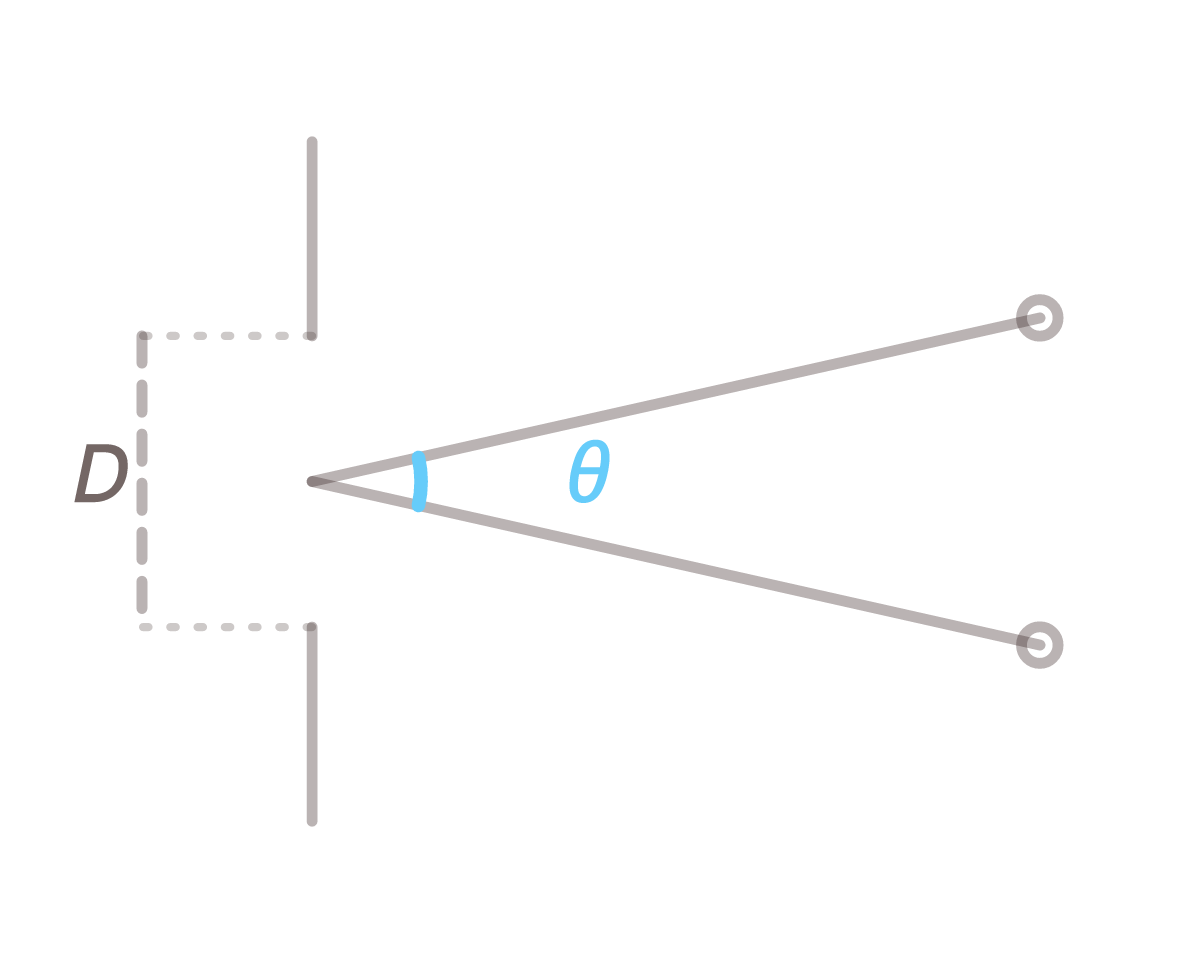
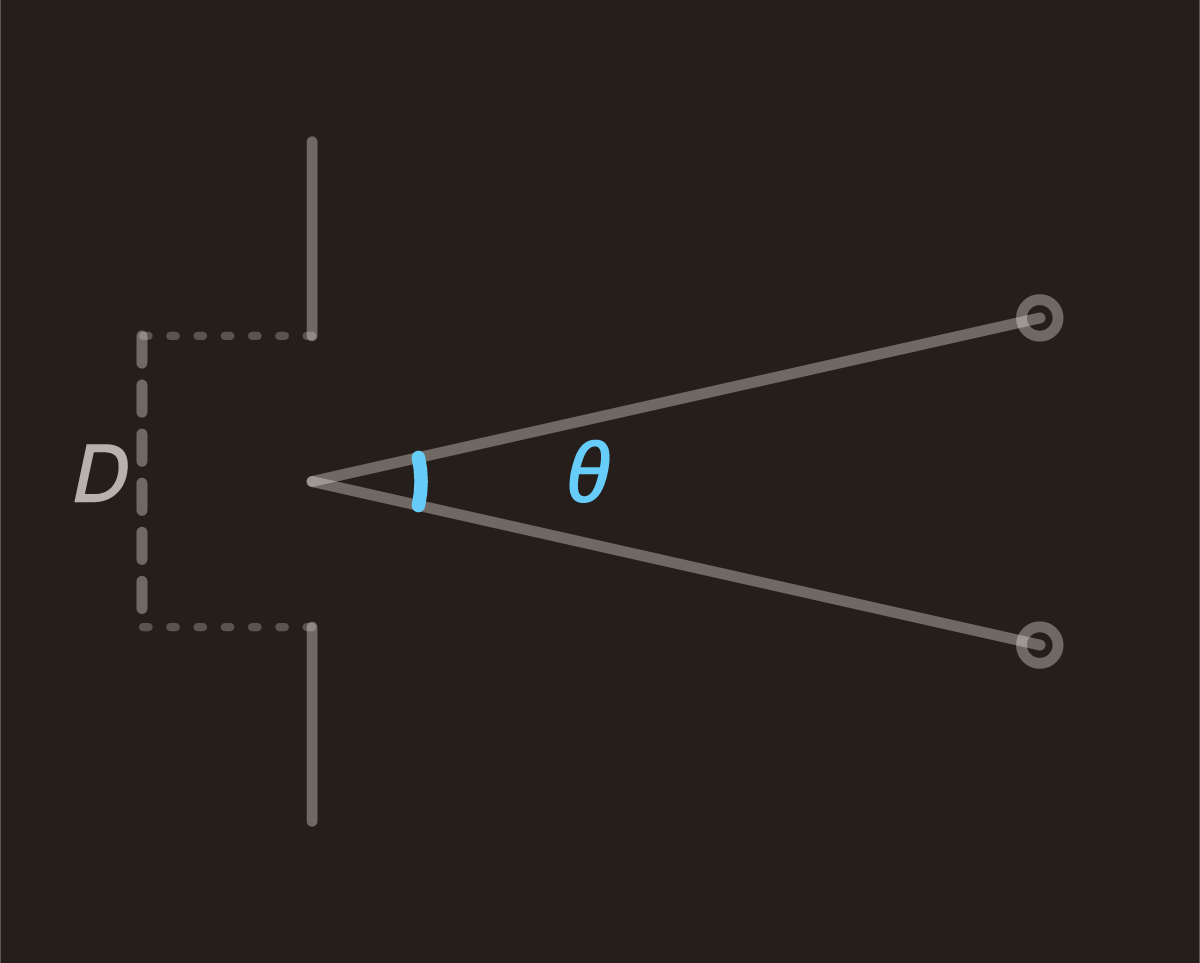
θ is the smallest angle between two points that can still be told apart, in radians. λ is the
wavelength of the light and D the diameter of the circular aperture: the lens, the mirror or the eye’s
pupil.
Holds when the aperture is circular, the light has a single wavelength, the angles are small and the
instrument has no flaw other than diffraction. The criterion is an agreed place to draw the line, not a sharp limit in
nature.
A telescope with a 10 cm mirror and green light at λ = 550 nm:
θ = 1.22 · 550 · 10⁻⁹ / 0.10 ≈ 6.7 · 10⁻⁶ rad.
The answer is in radians
1.22 · λ / D is a ratio of two lengths, and that ratio is the angle in radians. Reading the answer as
degrees makes the angle 57 times smaller than it is, and the instrument 57 times sharper.
| Reading |
θ |
The same angle |
| Radians (right) |
6.7 · 10⁻⁶ rad |
0.00038°, or 1.4 arcseconds |
| Degrees (wrong) |
6.7 · 10⁻⁶° |
1.2 · 10⁻⁷ rad, 57 times too sharp |
To convert to degrees, multiply the radians by 180/π.
Where 1.22 comes from
A point seen through a circular aperture is imaged not as a point but as a small bright disc with rings
around it, an Airy disc. The first dark ring lies where sin θ = 1.22 · λ / D. The number is 3.8317/π,
where 3.8317 is the first zero of the Bessel function J₁. Rayleigh took two points as resolved when the
centre of one disc falls on the first dark ring of the other.
A second example: the eye
The pupil is about 4 mm across in daylight. At λ = 550 nm, θ = 1.22 · 550 · 10⁻⁹ / 0.004 ≈
1.7 · 10⁻⁴ rad. Two headlights 1.5 m apart can then be told apart up to about
1.5 / 1.7 · 10⁻⁴ ≈ 9 km away, if nothing else blurs them.
The same diffraction through a straight slit is single-slit diffraction.
Common mistakes
- Reading radians as degrees. The ratio λ/D is an angle in radians.
- Leaving out 1.22. λ/D is for a straight slit, not a circular aperture.
- Radius instead of diameter. D is the full width of the aperture.
- Mixing nm and m. 550 nm is 550 · 10⁻⁹ m.
Frequently asked questions
Why are telescopes built so large?
D is in the denominator. A mirror twice as wide gives half the angle, so the telescope can separate stars
twice as close together.
Why does shorter wavelength give a sharper image?
λ is in the numerator. A shorter wavelength gives a smaller angle, which is one reason an electron
microscope, with its far shorter wavelength, shows finer detail than a light microscope.
Is this the only limit on a telescope?
No. From the ground, the moving air usually blurs the image more than diffraction does, which is one of
the reasons telescopes are sent into space.