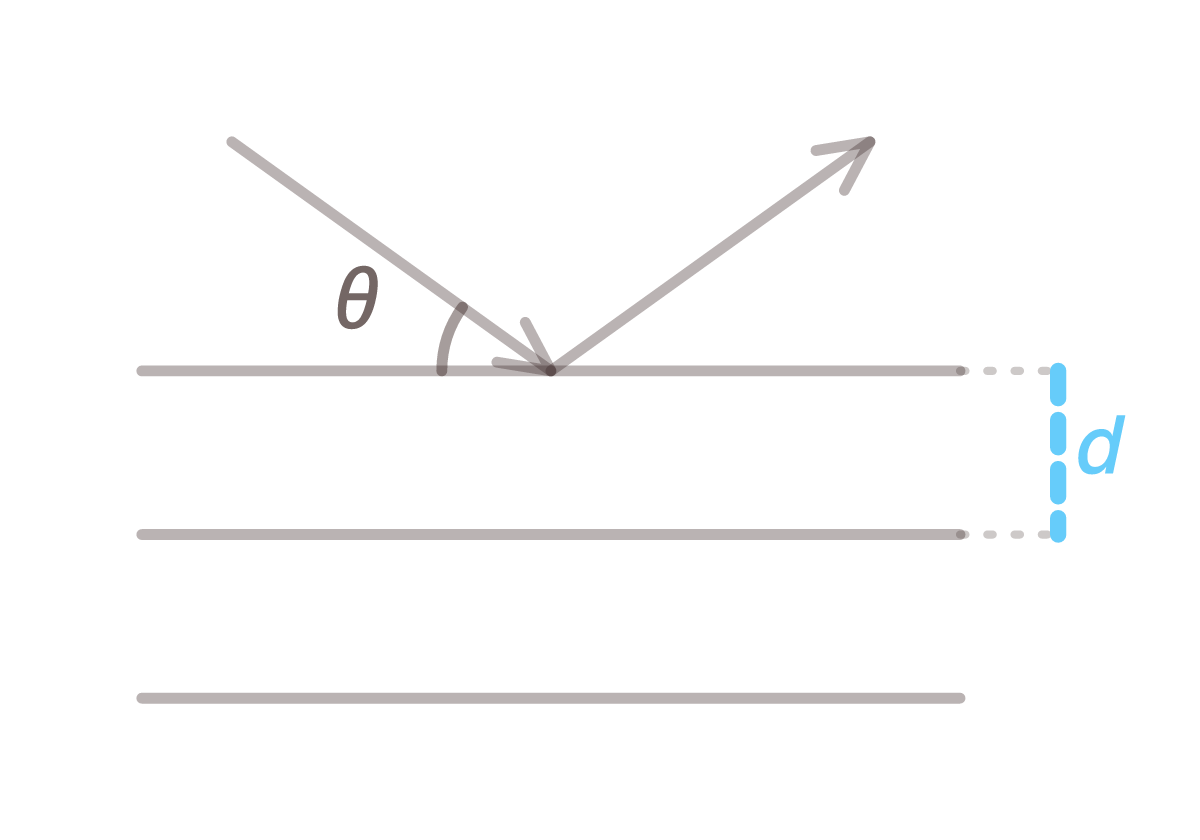
d is the spacing between neighbouring planes of atoms in the crystal, θ the glancing angle between
the incoming ray and the planes, λ the wavelength of the radiation and n the order of the reflection,
a whole number 1, 2, 3 …
Holds when the crystal is regular, the radiation has a single wavelength, and the reflection is from a
whole family of parallel planes.
Copper Kα radiation, λ = 0.154 nm, gives a first-order reflection off a rock salt crystal at
θ = 15.8°: d = 1 · 0.154 / (2 · sin 15.8°) ≈ 0.283 nm. The tabulated value for sodium chloride is
0.282 nm.
The glancing angle, not the angle of incidence
In Snell’s law and the law of reflection, angles are measured from the normal. In Bragg’s law θ is
measured from the planes themselves. The two angles add up to 90°, so taking the angle to the normal
puts a cosine where the sine belongs.
| Angle used |
Its sine |
Spacing d |
| 15.8° to the planes (right) |
0.272 |
0.283 nm |
| 74.2° to the normal (wrong) |
0.962 |
0.080 nm |
Both answers are fractions of a nanometre and both look plausible. Check which angle the question gives
before substituting it.
Why 2d
The ray reflected off the second plane travels further than the one reflected off the top plane: down to
its plane and back up. Each leg adds d · sin θ, so the path difference is 2d · sin θ. When that is a whole
number of wavelengths the rays arrive in phase and reinforce each other.
A second example: higher orders
The same crystal and the same radiation, second order: sin θ = 2 · 0.154 / (2 · 0.282) = 0.546, so
θ ≈ 33.1°. Third order gives sin θ = 0.819 and θ ≈ 55.0°. Fourth order would need sin θ = 1.09, and
that reflection does not exist.
The same condition for light through many slits is the diffraction grating equation.
Common mistakes
- The angle to the normal. θ in Bragg’s law is measured to the planes.
- Forgetting the 2. The extra path goes down and back up, 2d · sin θ.
- Mixing nm and Å. 1 Å (ångström) is 0.1 nm, and older tables give plane spacings in ångströms.
- Calculator in radians. The angle is in degrees.
Frequently asked questions
Why X-rays and not visible light?
The spacing between planes of atoms is a few tenths of a nanometre. Visible light has wavelengths
around 500 nm, which would make sin θ = λ/(2d) far larger than 1. X-rays have wavelengths of the same
size as d.
What is Bragg’s law used for?
Working out crystal structures, from salts and metals to proteins, and the other way round, measuring
an X-ray wavelength with a crystal whose spacing is known.
Does it work with electrons too?
Yes. Electrons have a de Broglie wavelength, and electron diffraction off a crystal follows the same
condition.