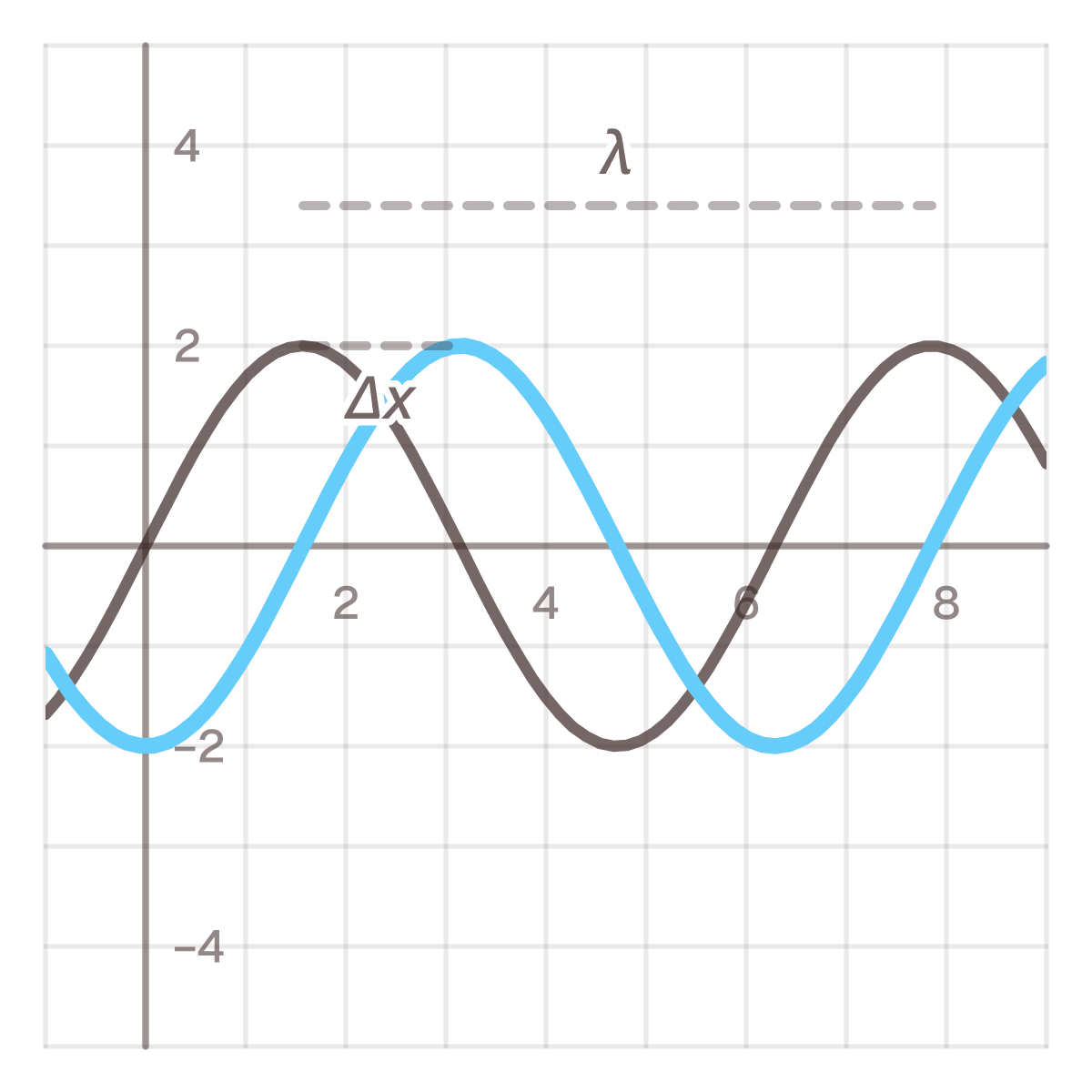
Δx is the path difference, λ the wavelength and Δφ the phase difference in radians. Every wavelength
of path difference adds a full turn, 2π.
Two points 0.5 m apart on a wave of wavelength 2 m: Δφ = 2π · 0.5 / 2 = π/2 ≈ 1.57 rad, a quarter of a
period out of step.
Books that work in degrees write 360° in place of 2π: Δφ = 360° · Δx / λ, and the example gives 90°.
Do not drop the 2π
The ratio Δx / λ is the phase difference counted in turns, not in radians. Two loudspeakers play the same
note with a wavelength of 0.6 m, and the sound from one travels 0.75 m further:
| Step |
Value |
| Δx / λ (turns, not the answer) |
1.25 |
| Δφ = 2π · 1.25 (right) |
2.5π ≈ 7.85 rad |
| Leaving out whole turns |
0.5π, a quarter period |
The answer 1.25 looks like a plausible phase difference in radians but is 2π times too small.
When do waves add and when do they cancel?
Only what is left after whole turns decides how two waves meet.
| Path difference |
Phase difference |
What happens |
| 0, λ, 2λ … |
0, 2π, 4π … |
in phase, reinforcement |
| λ/2, 3λ/2 … |
π, 3π … |
in antiphase, cancellation |
| λ/4 |
π/2 |
a quarter period out of step |
The double slit’s bright fringes are exactly the condition Δφ = m · 2π; see the double-slit interference condition.
A second example: time instead of path
The same idea works for a time difference: Δφ = 2π · Δt / T. An oscillation with a period of 0.02 s that
runs 0.005 s behind another has a phase difference of 2π · 0.005 / 0.02 = π/2.
Common mistakes
- Dropping the 2π. Δx / λ counts turns, not radians.
- Mixing radians and degrees. 2π goes with radians, 360° with degrees.
- Thinking a bigger phase difference is further out of step. 2π is back in phase; only the remainder
after whole turns matters.
- The path instead of the path difference. It is the difference between the two paths that goes in.
Frequently asked questions
What does it mean for two waves to be in antiphase?
The phase difference is π, or π plus a whole number of turns. Where one wave has a crest the other has a
trough, and two waves of equal size cancel.
How does phase difference connect to the wave equation?
In y = A · sin(ωt − kx), k = 2π/λ. Two points Δx apart differ by k · Δx = 2π · Δx / λ in the angle, and
that is the phase difference. See the sinusoidal wave equation.